
A fall vegetable garden often starts while summer crops are still growing. By the time the nights feel autumnal, the best sowing window for many vegetables may already be closing. The key is not a universal list of September crops: it is the relationship between your local autumn frost risk, the crop’s development time, hot late-summer soil and the amount of sunlight remaining. This guide uses an adaptable calendar calculation, crop-selection decisions, and protection limits. A USDA plant hardiness zone is about average extreme winter cold; it does not give your first frost date or the sowing calendar for annual vegetables.
Find the Right Local Fall Starting Point
Look up your location’s approximate first fall frost date through a local Extension service or regional climate records, then treat it as a planning estimate, not an appointment with the weather. Valleys, city centers, water bodies, elevation and the particular year can all alter frost timing. Maryland and Kansas State Extension emphasize crop tolerance and seasonal differences. Identify whether a crop must be harvested before frost or can continue into cool weather. The answer affects how far backward you plan.
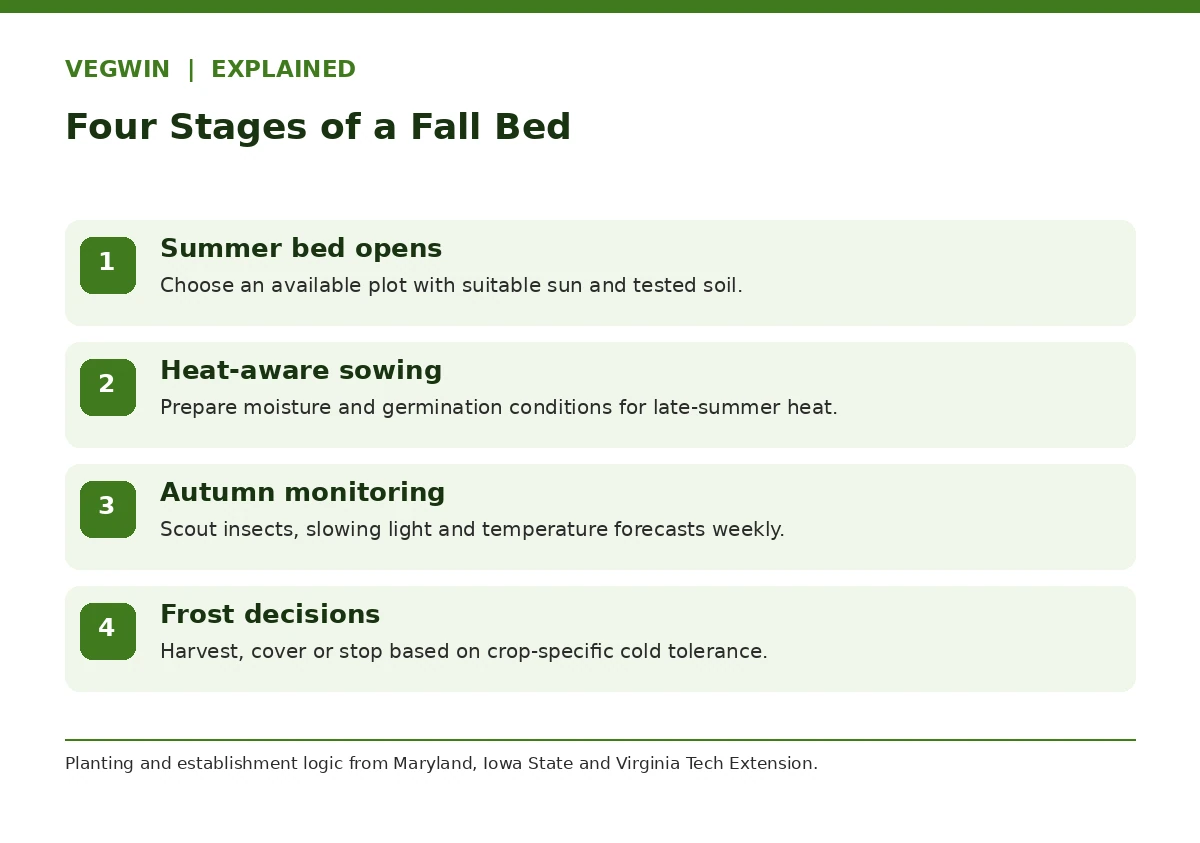
Review available bed space next. An exhausted bean or cucumber planting may free a bed, but an actively productive tomato crop is not automatically worth removing. Make a map of which rows open first and note sun exposure after nearby trees lose or retain foliage. If you have only a small patch, choose one or two reliable crops rather than a list that requires more space and daylight than the site has.
Count Backward From Harvest Requirements
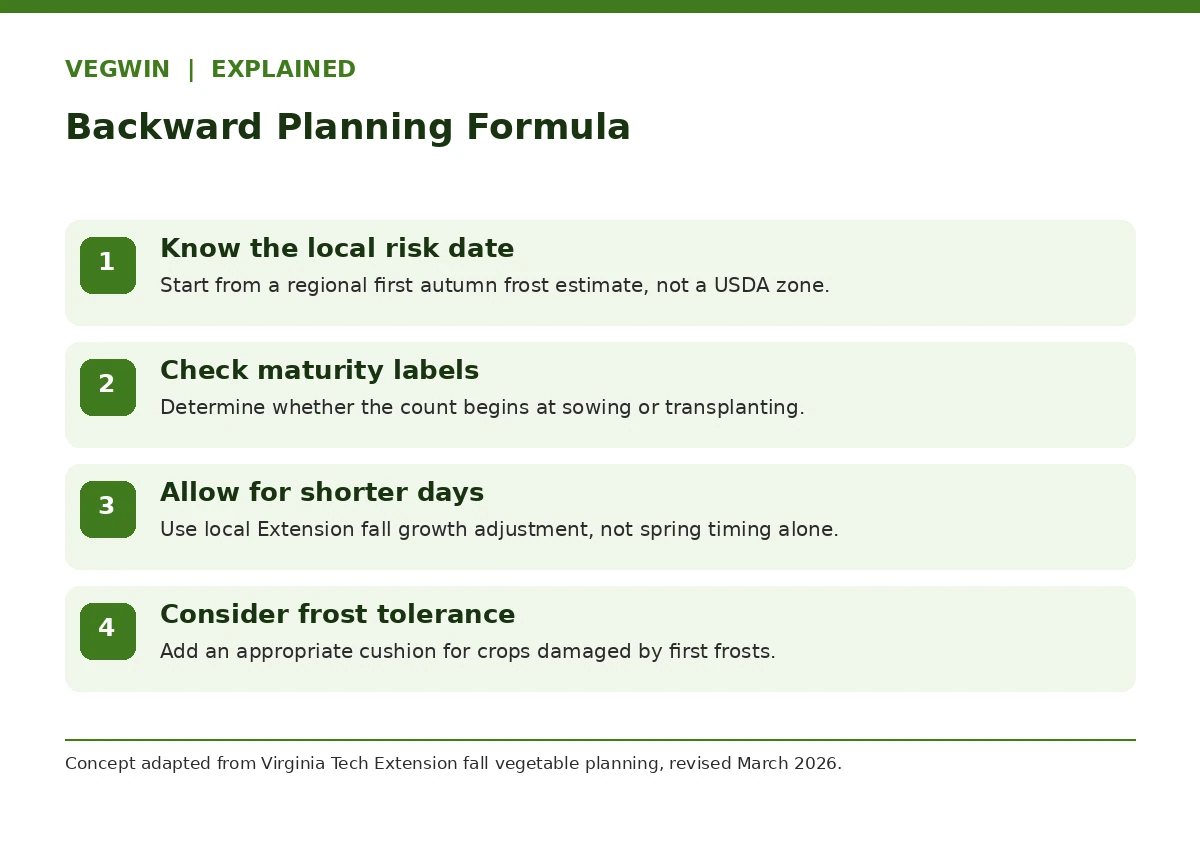
Use the seed packet’s days-to-maturity as a starting point and check whether it counts from sowing or transplanting. Add time for raising the transplant if necessary and for repeated harvests if you want more than one picking. Virginia Tech Extension explains an additional fall growth allowance because cooling temperatures and shorter days slow development; it also distinguishes frost-tender crops that need a cushion before a damaging freeze. Its published formula is an example of a regional planning method, not a date guarantee for every climate.
For illustration only, imagine a directly seeded crop estimated at 45 days to harvest and an Extension-recommended 14-day fall allowance. That suggests planning roughly 59 days before the chosen frost reference, not exactly 45. If the crop is frost-tender, a further safety margin may be needed under the Virginia Tech method. Check the seed variety and your region before deciding which factors apply. A local heat spell, cool nights or insufficient light can still move the actual harvest.
Match Crops to Cool or Warm Conditions
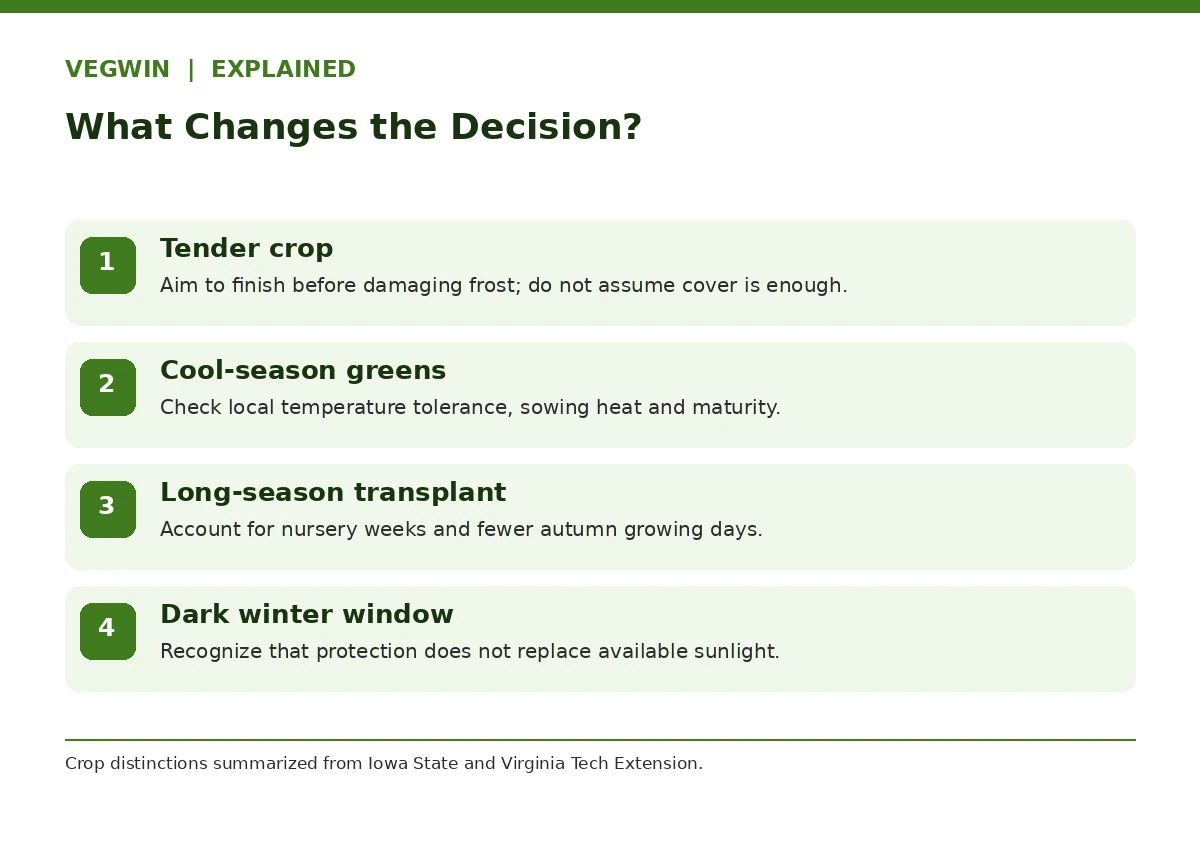
Many leafy greens and members of the cabbage family tolerate cool conditions better than tomatoes, peppers or summer squash. Iowa State and Virginia Tech list crops such as kale, turnips, mustards and brassicas as fall candidates, but success depends on location, cultivar and transplant readiness. A fast radish can fit an opening that a long-season heading cabbage cannot. Do not promise a particular planting date by USDA hardiness zone or assume all greens share the same frost tolerance.
The planting date and the germination environment are separate questions. A crop that thrives in cooler autumn weather may germinate poorly during a hot late-summer week. Consider starting certain seedlings in a protected location or using temporary shade and careful moisture management in a new direct-seeded row, according to local Extension guidance. Keep the seed packet’s spacing and depth instructions as your baseline rather than extending the spring schedule unchanged.
Prepare Summer Soil Without Overfeeding
Remove spent crops and diseased debris using locally appropriate disease-management practices. Pull roots only where needed; assess whether the soil has become compacted by foot traffic or cultivation. If you have a recent soil test, use it to judge nutrient additions. Virginia Tech suggests restoring nutrients after earlier crops, but that is not a license to add an arbitrary fertilizer dose. Too much nitrogen can cause lush growth at the expense of the actual harvest or increase nutrient runoff.
Dry summer soil may be hard to seed. Water the row before sowing when necessary and use thin, appropriate mulch after seedlings emerge if recommended locally. Keep seeds moist during germination without sealing the bed under waterlogged material. Row covers can reduce some insect exposure and improve the environment, but fabric also changes heat and airflow. Check for pests under covers and ventilate when conditions demand it instead of treating any cover as automatic freeze protection.
Protect the Crop Without Promising Winter Harvest
Light frost and a sustained deep freeze are not interchangeable. Some cool-season crops may survive a light frost; others suffer damaged leaves or roots. Virginia Tech notes that protection may extend production, and Maryland discusses row covers for fall greens. Even protected plants eventually grow more slowly as daylight decreases. Check forecast lows, wind and the limits of your covering material before deciding whether harvest is realistic.
Install supports for covers before a storm and secure fabric without crushing foliage. Remove or adjust them when midday temperatures become unsuitable. A cover that works for an established leafy crop is not proof that a frost-tender tomato can produce all winter. Harvest near-ready crops before severe weather, and avoid treating reduced winter sun as something a thicker fabric can fix. Plan for a useful autumn harvest first; extra winter pickings are a bonus.
| Crop decision | Planning consideration | Useful next check |
|---|---|---|
| Quick leafy crop | Potential shorter maturity; heat at sowing still matters | Packet maturity and germination conditions |
| Brassica transplant | Indoor nursery lead time may precede bed planting | Regional transplant window |
| Tender warm-season crop | Needs harvest before damaging frost | Frost cushion and realistic remaining light |
| Overwintered greens | Cover may help survival but growth slows | Local winter light and forecast |
Monitor Pests and Slowing Daylight
Autumn does not eliminate insects or plant diseases. Virginia Tech warns that some pests can be worse late in the season even as others fade. Check leaf undersides and developing heads before applying any product. Rotate crops between families where feasible and clean up confirmed diseased debris as local guidance recommends. Exact pest identification and edible-crop label rules still apply in fall; do not assume one spray can be carried over from a summer treatment.
Make a weekly field note: day length changes, germination success, leaf damage, dry soil, and the current weather forecast. If a sowing is clearly too late to mature, stop adding seed and switch to the crops you can actually harvest, or use the space for soil protection. The earliest frost is a risk marker, not a pass/fail date. Regular observation lets you adapt the bed before an approaching cold event.
Create a Reusable Two-Window Fall Plan
Divide your plan into an establishment window and a harvest window. In the first, specify which rows will open, how you will water germinating crops in the lingering heat, and where transplants will wait. In the second, track estimated maturity, local frost forecasts and protective-cover logistics. Add a crop-specific review step before each sowing. This works in regions with early frosts and where an extended mild season allows more flexibility, without issuing an identical national calendar.
At the end of autumn, compare your predicted harvests with what happened. Record which seed-packet maturity numbers proved optimistic, which crops benefited from shade at emergence and whether disease or frost ended production. Next year, adjust from those observations alongside fresh local Extension recommendations. This makes the calendar increasingly useful, while keeping a sensible distinction between a regional guide and your actual microclimate.
How We Research and What Could Change
We compared current and historical Cooperative Extension, university food-preservation, and public-agency instructions relevant to the specific decisions in this guide. References were checked on October 19, 2026. The diagrams are our original summaries of those sources, not photographs of tested procedures or results from a VegWin field trial. This article does not replace a local crop calendar, food-safety protocol, laboratory analysis, or manufacturer instructions. Local climate, crop cultivar, packaging and equipment, and new official guidance can change your safest choice.
Research references: [1] Virginia Tech Extension [2] Maryland Extension [3] Iowa State Extension [4] Kansas State Extension
Disclosure: This guide contains no sponsored recommendations, affiliate commissions or paid endorsements. See VegWin affiliate disclosure; the site owner must confirm that page is reachable before manual publication.
Often in mid-to-late summer, but calculate by crop and local first frost timing rather than choosing one national month.
No. Zones summarize average annual extreme winter temperatures, not autumn frost timing or soil temperature for annual vegetables.
Check whether the count starts from seed or transplant, then add appropriate fall growth allowances and any crop-specific frost cushion from local Extension.
Not necessarily. Covers can protect against some cold but cannot create daylight or erase severe weather limits.
Choose a locally recommended cool-season crop whose maturity and sowing requirements fit your remaining season and available bed space.