
Bitter melon is a warm-weather cucurbit with a conspicuously hard seed coat. It grows into a tendril-bearing vine and produces bumpy fruits that should not be confused with the bright orange ripe seed stage.
Check the seed name and identify the crop
Bitter melon is Momordica charantia, also called bitter gourd or balsam pear. It belongs to the cucumber family, but its fruit has distinctive ridges, bumps and a pronounced bitter flavor. Its seeds are not interchangeable with squash or cucumbers, even though the young vines all form cotyledons. Choose seed from a recognized food-crop supplier and identify the cultivar. The final shape can be long, slender, more ridged or comparatively compact, so do not insist on one fruit silhouette as the only valid kind. The thick rough seed coat is the first challenge for germination, while temperature and moisture govern the pace at which the embryo develops.
Wait for warm growing conditions
University of Florida IFAS notes that germination may be slow or fail when the soil is cool or dry, and gives a broad warm germination range. For a home garden, aim for stable warmth within the supplier’s recommendations, using a thermometer at seed depth rather than guessing from a pleasant afternoon. A frost-tender tropical vine cannot be hardened off into cold nights just because the seed sprouted indoors. Count back from a realistic outdoor planting date, and prepare to protect young plants from wind as well as low temperatures. Regional sowing dates printed for Florida are not universal planting dates for the rest of the United States.
Moisten the medium before sowing the thick seed
Use clean cells or individual biodegradable seed pots filled with draining seed-starting medium. Premoisten it so the whole root zone is evenly damp before the hard-coated seed is placed. Sow at the depth on the seed packet; avoid pushing seed into a deep waterlogged cavity. Cover with loose medium and water gently to make contact. A dark, cracked seed coat or protruding radicle is part of the germination process, but it should be surrounded by moist medium rather than shown floating over a tray. Pre-soaking is mentioned by some growers but is not necessary for every lot; excessive soaking in dirty standing water introduces preventable problems.

Inspect emergence without pulling on the seed coat
The young root extends downward and the shoot lifts cotyledons above the medium. If the seed coat remains stuck briefly, avoid yanking it off with fingernails; the tissue underneath can tear. Maintain suitable warmth and moisture and let the seedling progress. Set plants in strong light as soon as sprouts appear so the emerging stem does not stretch into a pale string. An elongated vine in a tiny cell is not a healthy transplant, even if it is green. When several seedlings emerge together, remove extras by cutting rather than pulling up the one whose roots may be intertwined with the best plant. Wash and sanitize reused trays before a new batch.
Recognize lobed true leaves and early tendrils
After smooth early leaves, bitter melon develops the recognizable lobed foliage described by UF IFAS. New growth comes from the stem tip and lateral buds, while slender tendrils form at nodes and curl around support. A tendril is not a root and should not be drawn beneath the soil. Look for its attachment to a vine node near the leaf, then guide the tip gently toward open mesh. Training before the stem gets heavy is easier than untangling an established vine. If a young leaf shows pale spots, inspect for real pest or nutrient symptoms rather than assuming every pale pattern belongs to the species.
Build the trellis before the vine sprawls
Bitter melon is a vigorous annual vine. University of Florida and University of California both recommend trellising for quality and to keep fruit off the ground. Install a stable frame or mesh that can withstand wet foliage and several hanging fruits, and keep the bottom accessible for irrigation and weed removal. Do not bind a tender growing tip tightly to the mesh. Guide the tip through an opening and allow tendrils to grip the support naturally. In a restricted garden, an adequately anchored vertical support prevents vines from covering neighboring beds. Inspect hanging fruits to ensure they are not wedged into wire where expansion may distort or damage them.

Transplant without injuring the root ball
A seedling that is established in its pot and has started making true leaves can be moved outdoors once nights and soil are reliably warm. Harden it gradually to sun and wind. Water the pot so the medium holds together, then support the root ball rather than lifting by the vine. Keep the soil level close to where the seedling originally grew, firm gently and water the root zone. If biodegradable pot sides protrude above the soil they can wick water away, so follow the pot manufacturer’s planting method. Do not loosen and spread delicate roots aggressively to imitate a bare-root tree. A temporary wind shelter can protect the first days without depriving leaves of needed light.
Give the vine steady water, not a flooded bed
Bitter melon produces substantial leafy growth and developing fruits in warmth, so it benefits from consistent moisture and drainage. Allow water to reach the root zone instead of merely wetting the vine. Avoid leaving a container sitting in stagnant water. Excessive nitrogen may create soft leafy growth without an equivalent fruit harvest; assess soil fertility and the planting’s vigor before feeding again. Keep leaf surfaces relatively dry when practical and open the canopy enough for light and air. If insects appear, identify the actual pest before selecting management. Cucurbit relatives can share pests, but a single hole in a leaf is not evidence of a specific disease or cause for harsh treatment.
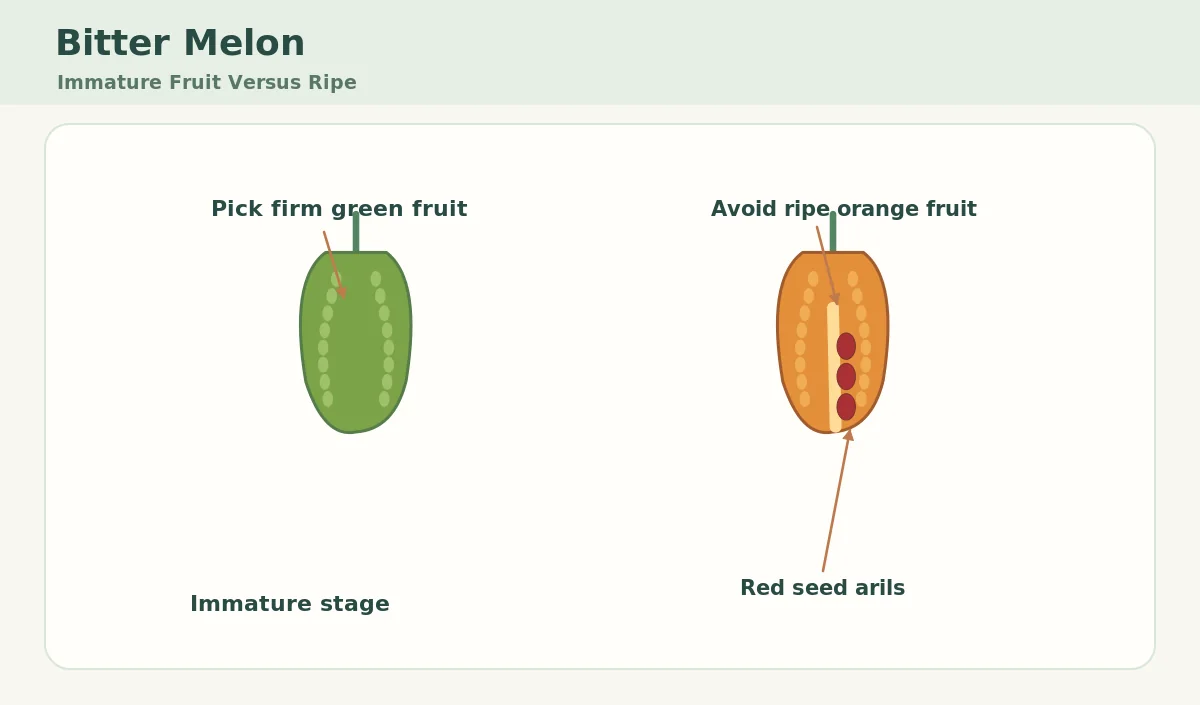
Separate the edible green fruit from orange maturity
UC and NC State explain that bitter melon fruits change from green or light green through yellow to orange as they mature. In ordinary culinary harvest, pick firm immature fruits before this color transition, using clean snips on the fruit stalk. Mature orange fruits may split open and expose seeds with bright red coverings; NC State warns that mature fruit and seeds are toxic. Do not depict a fully orange split fruit as the correct fresh eating stage. Wash and prepare food according to a trusted culinary guide, and never suggest raw mature seeds as an edible snack. Harvest preferences differ by cultivar and recipe, but the maturity distinction is the essential safety point.
Diagnose poor fruit set by checking flowers
Like other cucurbits, bitter melon produces male and female flowers. A small swollen ovary sits behind a female flower; male flowers lack that attached immature fruit. Pollination is necessary for successful fruit development, so a blossom that drops without swelling is not automatically diseased. Check whether the plant is old enough, flowering actively and visited by pollinating insects. High heat, cold stress or drought can influence fruit set as well. Do not call a male flower a failed fruit or tie a harvested fruit directly to a leaf blade in a diagram. Save a labeled photo showing the flower stalk and immature ovary for comparison as the season advances.
Related Guides
How We Research and Illustrate Plant Care
We reviewed the following horticultural sources on October 30, 2026: ask.ifas.ufl.edu; ucanr.edu; plants.ces.ncsu.edu. Their published cultivation and anatomical guidance informed the practical distinctions above; cultivar, climate and garden conditions may change results. The original drawings are explanatory, not measurements to scale.
VegWin provides independent educational gardening information. All three on-page navigation links go to VegWin information, are not affiliate offers, and create no paid relationship. Read the affiliate disclosure. For suspected disease, plant toxicity or identification uncertainty, ask a qualified local Cooperative Extension service.
Their hard coat plus cool or dry medium can delay emergence; maintain appropriate warmth and moisture.
A sturdy trellis generally improves access and keeps developing fruits off the ground.
UF IFAS describes early true leaves followed by the familiar deeply lobed leaves.
Usually while firm and green, before it turns yellow or orange.
NC State warns that mature fruit and seeds are toxic; do not treat them as an edible stage.