
Bitter melon (Momordica charantia) presents a useful contradiction: the green or pale immature bumpy fruit commonly harvested as a vegetable is not the best stage for mature seed. A fruit left on a healthy vine for seed turns yellow to orange, softens and can split from the blossom end, revealing seeds wrapped in vivid red fleshy arils. UC Master Gardeners and UF/IFAS describe that mature stage. The hard seed is beneath the red covering, which needs to be separated before dry storage. This guide shows how to select seed fruit rather than accidentally harvesting a green culinary fruit, and how to clean, dry, label and assess seed without promising genetic purity from an open-pollinated garden.
Know the Plant and the Two Different Harvest Goals
Bitter melon is a vigorous warm-season vine in the cucurbit family. It climbs with tendrils, carries palmately lobed green leaves, yellow flowers and ridged or warty elongated fruit. Depending on variety, young fruit may be green or light colored, but the seed-saving signal is continued maturation toward yellow-orange. UC Master Gardeners describe harvesting firm immature fruit for cooking before that change; UF/IFAS describes mature orange fruit for the reproductive stage.
Do not pick every fruit at the same stage if you need both cooking and seed. Tag healthy fruit reserved for seed so another gardener does not remove it while still green. Use labeled plants rather than unidentified volunteer cucurbits; many related vines have similar leaves and flowers.
Allow a Healthy Fruit to Turn Orange on the Vine
Select a vigorous, true-to-type fruit on a disease-free plant, ideally on a vine with enough time before frost. Let its surface change color and begin to soften rather than assuming the largest green fruit contains fully mature seeds. UF/IFAS states that fruits can open naturally at the tip as they ripen. Check frequently at this stage because hard seeds can drop out of a split fruit and be lost in soil. Position a clean tray or lightweight collection bag underneath if practical without tying or constricting the fruit.
Never rely on a fixed number of days for every cultivar and climate. Fruit size varies enormously. Color, softening and visible inner seed covering are stronger practical indicators than an arbitrary ruler measurement.
Recognize Red Arils Without Mistaking Them for Seed Coats
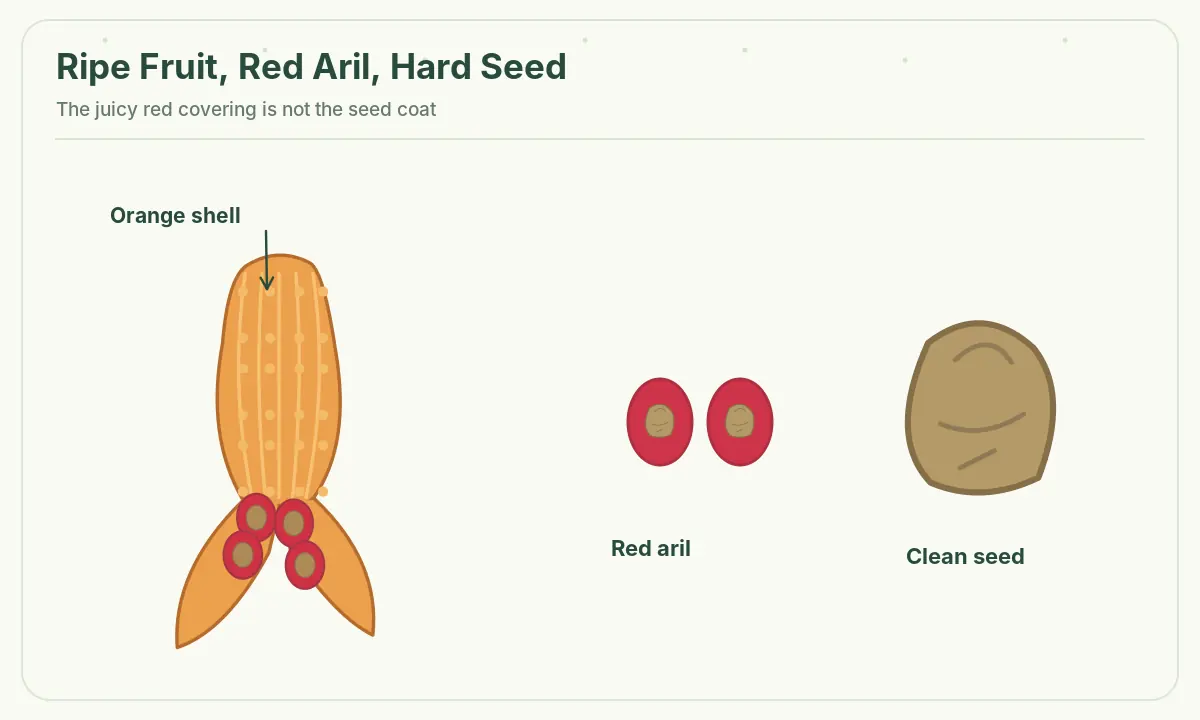
When a bitter melon opens, bright red tissue covers the mature seeds. This pulpy covering is the aril; the hard seed coat is beneath it. UF/IFAS makes this distinction in its mature fruit description. A useful educational cross-section shows a bumpy orange fruit wall, red material surrounding discrete seeds, and a clean pale-brown hard seed after the aril is removed. It should not show dozens of flat tomato-style seeds floating in a generic red pulp.
Do not use fruit color alone to judge whether internal tissues are healthy. Discard fruit with mold, putrid odor or rotted seed chambers. Handle messy red pulp on a washable surface; the color can stain cloth and hands.
Collect Seed Before the Split Fruit Drops It
Harvest a ripe splitting fruit directly over a clean tray. Use clean scissors to cut its stem if necessary and avoid shaking it near bare soil. Gently open the remaining fruit shell to expose seed with attached red arils. Transfer the seeds into a separate bowl and keep a written variety label with the batch. If multiple cultivars grew together, label each collection separately and record the possibility of crossing rather than merging everything into one packet.
A paper bag placed under the mature fruit helps catch loose seeds but should not remain wet and sealed around the vine. Recheck the garden daily while several ripe fruits are opening. Seed lying on damp soil may be contaminated or damaged and is not equivalent to clean seed harvested directly.

Remove Red Covering and Rinse Seed Clean
Separate the fleshy red aril from the firm interior seed using clean fingers and water, taking care not to cut or scrape into the hard coat. A fine sieve can retain the larger seeds while pulp is rinsed away. Replace dirty water and repeat gently until most of the sticky covering is gone. Drying seeds with a thick layer of moist pulp still attached can slow drying and foster mold, which is why the cleaning step matters. Do not use bleach, caustic cleaners or improvised fermentation recipes with unverified durations.
Check individual seeds for damage. A hard, intact cleaned seed is different from a soft seed that crushes between fingers. Discard broken or moldy material. This is practical seed handling, not a guaranteed laboratory viability test.
Dry, Label, and Store Seeds Without Condensation
Spread clean seeds in a single layer over a clean breathable screen or nonsticky surface in a protected place with good airflow. Keep them away from rain and condensation; do not bake them in a hot oven or seal them inside plastic while still wet. RHS general seed guidance emphasizes dry, ripe seed and careful storage. When surface moisture has disappeared and the seeds are thoroughly dry, place them in a labeled packet within appropriate cool, dry storage. Include species, named cultivar, season and whether neighboring varieties were flowering.
Avoid inventing an exact drying-day count, since humidity and seed condition differ. Check a small sample for retained moisture before closing the container and monitor stored seed for mold. Labels should remain readable even if you later place packets in a larger jar.

Account for Cross-Pollination and Seed Variability
A saved viable seed does not guarantee that offspring will match the parent fruit. Cucurbit pollination often involves insects, and nearby compatible varieties of the same species can exchange pollen. If retaining a named line is important, use an isolation or controlled-pollination method suited to bitter melon before fruit sets. Recording a cultivar after harvest cannot reverse genetic crossing. Do not assume an orange ripe fruit indicates genetic purity.
When sowing next season, compare germination and traits among saved plants. Store seeds separately from unrelated gourds or squash; a bitter melon seed packet should not be confused with edible pepo seeds. For food uses, always select properly identified fruits at the intended edible stage and follow local dietary safety advice.
Tell Normal Ripe Color From Trouble
Normal seed ripening progresses from a firm green edible-stage fruit to a yellow-orange soft fruit with red arils and possible splitting. Disease may instead cause dark sunken spots, foul odors, rapid tissue collapse or fuzzy growth. If the fruit looks infected, don’t rely on its colorful interior to justify retaining seed. A clear comparison image should contrast firm green harvesting with mature orange seed collecting and show a separate visibly moldy specimen to discard, without suggesting that every soft ripe fruit is diseased.
The complete process is selective mature fruit, orange split stage, red aril removal, gentle rinsing, thorough drying and honest labeling. Keeping those stages separate prevents the common mistake of saving immature seed from a market-ready green bitter melon.
Related Guides
How We Research This Guide
We reviewed the following botanical and horticultural sources on October 27, 2026: ucanr.edu — UC Master Gardeners distinguish immature green edible-stage bitter melon from orange ripe fruit with red seed arils and naturally splitting ends.; ask.ifas.ufl.edu — UF/IFAS documents mature bitter melon turning orange, opening at the fruit end and revealing seeds covered by red arils.; www.rhs.org.uk — RHS recommends collecting genuinely ripe seeds, drying seed carefully, and labeling clean lots before storage.. The recommendations describe documented plant traits and general methods; local soil, climate, cultivar and seed lot can change outcomes.
This article has no paid product recommendation. Read our affiliate disclosure for the site policy. We do not claim an unverified vendor partnership or sponsor relationship.
For best maturity, leave selected fruit until it turns yellow-orange and begins to soften or split.
It is the fleshy aril covering each seed, not the hard seed coat. Remove it before drying seed for storage.
That can be normal seed-ripening behavior; very mature bitter melons split and release seeds.
Clean most fleshy aril away first, then dry the hard seeds thoroughly in a single layer.
Not necessarily. Nearby compatible flowering bitter melon plants can cross, so preserve genetic purity with planned isolation.