
Common sorrel is a long-lived leafy herb with distinctive arrow-shaped foliage, not a cloverlike wood sorrel. A shallow but real seed covering, generous room for its basal crown, and restrained outer-leaf picking make a useful perennial patch. These illustrations show the leaf shape, seed depth and safe harvest point.
Identify Common Sorrel by Its Arrow-Shaped Blade
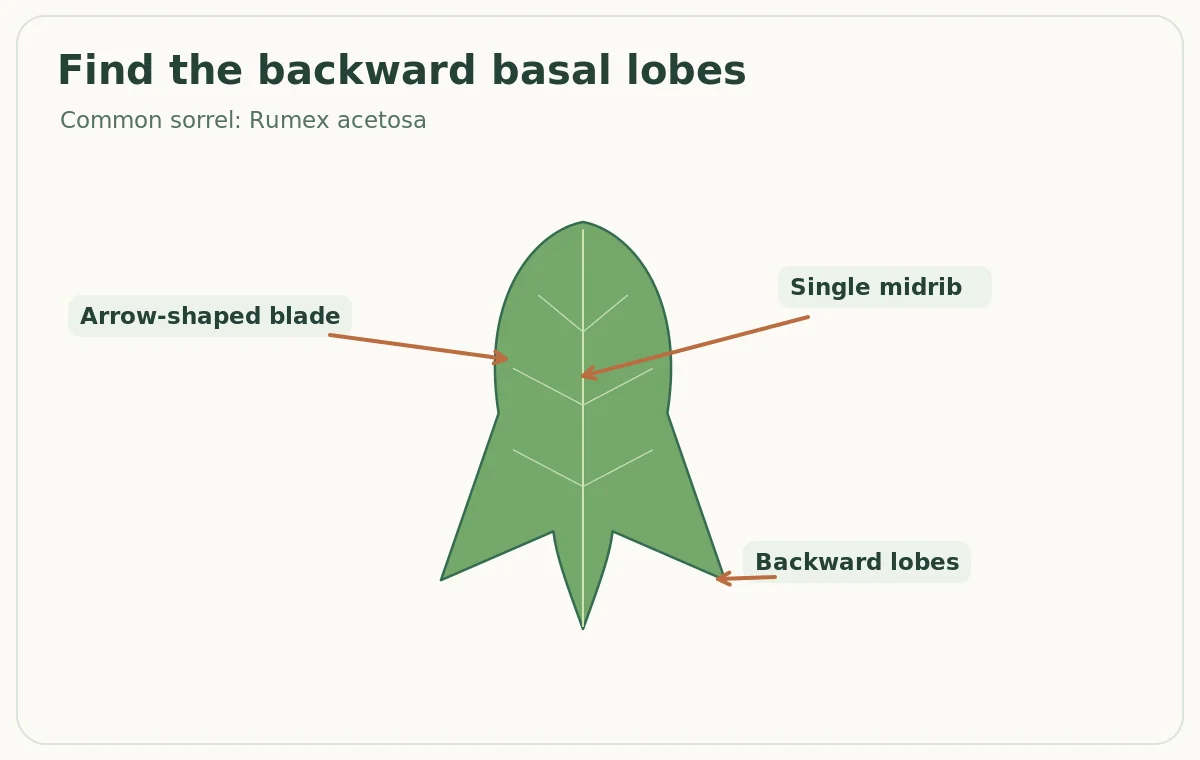
Common garden sorrel, Rumex acetosa, has an upright clump of bright green leaves that show a distinctive arrow-shaped base, including two backward-pointing lobes. It is not the same as French sorrel, which has more rounded shieldlike leaves, or red-veined sorrel, which displays striking dark veins. Plants sometimes called wood sorrel belong to Oxalis and typically have three separate leaflets. Label seed by botanical name rather than buying any packet marked only sorrel. The illustrated enlarged blade includes its lower lobes and a continuous central vein, useful details when young leaves are being checked.
Choose a Perennial Spot With Room for Clumps
Sorrel is a hardy perennial that regrows from its crown after a dormant period, rather than an annual to discard after one leaf harvest. RHS recommends sun or partial shade and fertile moisture-retentive ground. A dedicated herb bed edge can work, but remember that plants can self-seed if flowering shoots are left to mature. Choose a site that is easy to access for repeated leaf picking. In hot dry sites some afternoon protection can reduce stress. Do not plant into compact saturated soil; healthy roots still need oxygen. Containers can also be practical if you prefer to control the clump’s spread.
Sow at the Depth Recommended for Sorrel
RHS recommends sowing common sorrel roughly 1 cm, or about half an inch, deep in a fine soil surface. Make a shallow drill, distribute seeds sparingly, cover with fine soil and water gently. Unlike alyssum, this seed belongs under an actual layer of soil, not exposed on the surface. The planting cross section places seeds below the true soil line and indicates where emerging shoots will travel upward. Avoid burying them several inches below hard clods, or allowing rain to wash the covered row into a depression. Label the row, since young sorrel may resemble unrelated weeds at first.
Adjust Sowing Dates to Local Spring Conditions
RHS recommends indoor or outdoor sowing in spring, with outdoor seed generally set from mid-spring to early summer. Actual weeks depend on workable soil, frost conditions and local summer heat. A USDA winter hardiness zone is not a reliable seed calendar by itself. For indoor starting, use draining modules of damp fine mix and a bright location; pot seedlings on when they have several leaves and sufficient roots. For outdoor sowing, wait until soil can be prepared without smearing it into a hard crust. In hot regions, use local horticultural guidance to choose the cooler establishment season and protect seedlings from desiccation.
Identify Young Leaves Before Thinning the Row
The first seed leaves are small, so wait for true foliage before using leaf shape to confirm identity. On common sorrel, mature basal blades are typically elongated and arrowlike, with backward-pointing lobes near the petiole. Plants form a leafy clump from a low crown, not a climbing vine. RHS suggests thinning outdoor seedlings to about 20–30 cm, roughly 8–12 inches, apart. Snip surplus seedlings rather than ripping through neighboring roots if the row is densely crowded. If your plants have red-veined leaves, check whether you received Rumex sanguineus instead of common sorrel; growth and appearance are different.

Water New Plants and Watch Drainage
Young sorrel needs enough moisture to root into its bed. Water gently during dry spells and avoid crusting the soil above a germinating row. Established clumps tolerate ordinary garden conditions better, but unusually long dry spells can reduce leaf quality. Containers dry faster and need more frequent checks. A mulch around, not over, the crown can reduce weed competition and conserve soil moisture. Do not drown plants trying to keep leaves tender. If a crown remains soggy through winter, improve site drainage and consider moving the plant to a less saturated position when conditions are suitable.
Harvest Outer Leaves Without Destroying the Crown
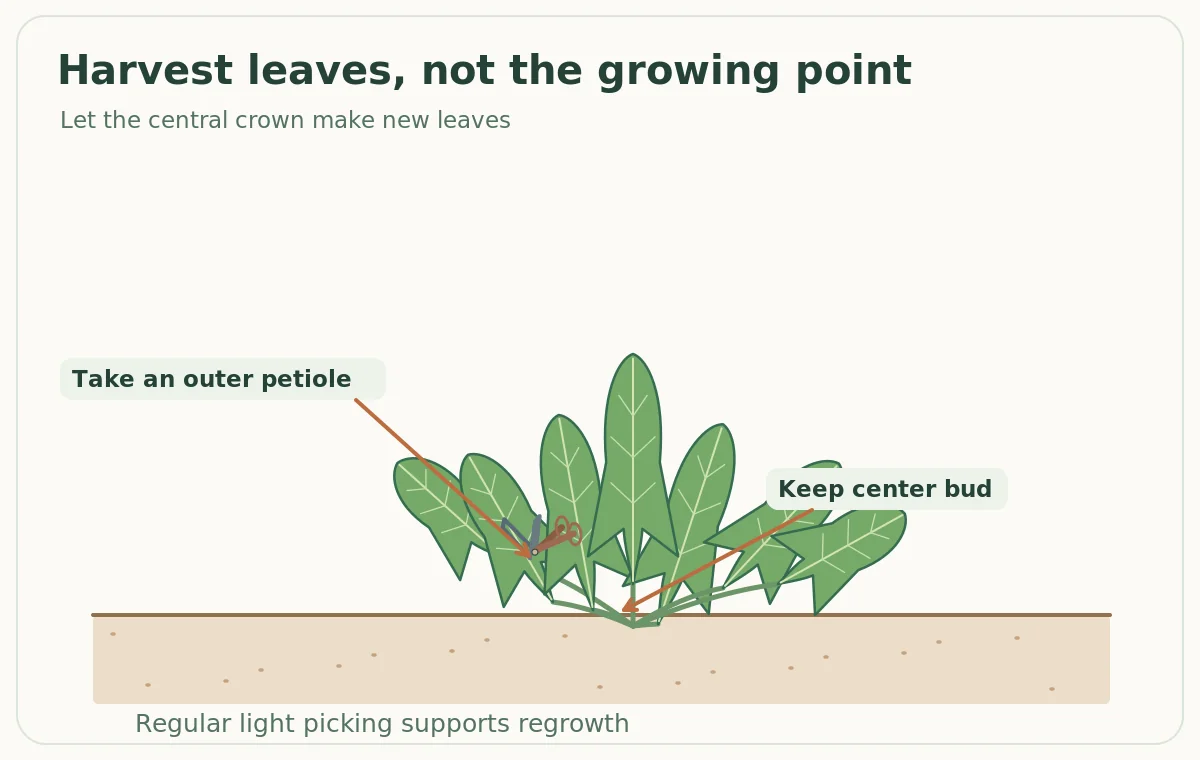
Choose healthy young leaves from the outside of the clump and snip their petioles without slicing through the compact central growing point. New leaves emerge from that crown, so a broad horizontal cut through it can weaken the plant. The close-up diagram separates the outer petiole from the protected central bud. Collect a small number of leaves at a time and return as growth resumes. Very old leaves may be tougher and more bitter. Repeated light harvesting spreads your supply across the season rather than stripping a small plant bare when its root system has barely established.
Remove Flowering Stalks if Leaves Are the Goal
As the plant matures, a tall flowering stem may rise above the basal leaves. Small greenish to reddish flowers develop in branching clusters and can eventually make seed. If your goal is young tangy foliage, remove flower stems before seed formation; RHS notes that this reduces unwanted self-sowing. Do not confuse a bolted plant with a different species simply because it looks taller than the neat spring clump. The original low crown remains important even when a flower shoot is present. Reserve a plant for seed only if you have suitable space and a reason to let it finish its reproductive cycle.
Use Sorrel Conservatively in Food
Sorrel’s distinctive sour taste comes in part from oxalates. RHS cautions that large quantities may be harmful, so use modest amounts rather than treating it as a bulk daily spinach substitute. People who have been advised to restrict oxalates for a medical reason should follow their healthcare professional’s guidance. Never forage unknown arrow-shaped leaves based on this article alone; several unrelated wild plants can be dangerous. Wash cultivated leaves appropriately before kitchen use and discard any with obvious contamination. For ordinary culinary use, a few young leaves can provide an accent without needing to harvest a whole crowded crown.
Divide Old Clumps and Check for Pests First
After several years a crowded sorrel clump may lose vigor. RHS suggests dividing established clumps periodically in spring or autumn so each division retains living crown tissue and roots. Do not tear all leaves away from a new division. Slugs, snails and aphids sometimes target tender growth; inspect the plant and use local integrated pest management advice rather than applying an unidentified pesticide. Leaf holes alone do not prove a disease. Remove weeds near the crown and observe whether sun, water or crowding has changed before blaming nutrients. Healthy plants in suitable positions often need little intervention.
Follow a Seed to Leaf Decision Sequence
The complete process is to confirm Rumex acetosa, sow seed in an actual shallow drill, thin the small plants, keep the basal crown at the soil line, and pick outer leaves as they mature. The three diagrams distinguish botanical identity, genuine seed depth and the protected growth point. If your seedlings differ sharply from the illustrated arrow-shaped common sorrel, stop and check the species rather than proceeding by assumption. Growth rate, winter dieback and leaf tenderness vary with soil and climate. A small planting log with dates and growing conditions helps you manage the same perennial clump for years.
Related Guides
How We Research and Verify Recommendations
This guide draws on plant-specific horticultural guidance from RHS RHS RHS, checked October 28, 2026. We compare the practical actions and diagrams against the described species, growth stages, planting depth, and pruning or harvest targets. Local climate, cultivar choice and soil conditions may change timing. This article is informational and does not promise a fixed yield or chemical treatment. See VegWin’s affiliate disclosure; no sponsorship or affiliate relationship is asserted here.
Rumex acetosa has elongated arrow-shaped leaves with backward-pointing basal lobes.
RHS recommends a shallow drill about 1 cm or roughly half an inch deep.
No. Take young outer leaves and preserve the central crown for regrowth.
No. Wood sorrels are generally Oxalis, usually with three leaflets, not Rumex acetosa.
No. Sorrel contains oxalates and RHS cautions against large amounts.