
Okra is a warm-season mallow, Abelmoschus esculentus, with large palmately lobed leaves and yellow, hibiscus-like flowers marked by dark burgundy near the center. Its edible pods form from fertilized flowers at the junctions where leaves meet the main stem or a branch. They typically grow upright or outward, not in hanging bunches like beans. The pointed, ridged green capsule eventually contains many rounded seeds.
Identify the Flower That Becomes Each Pod
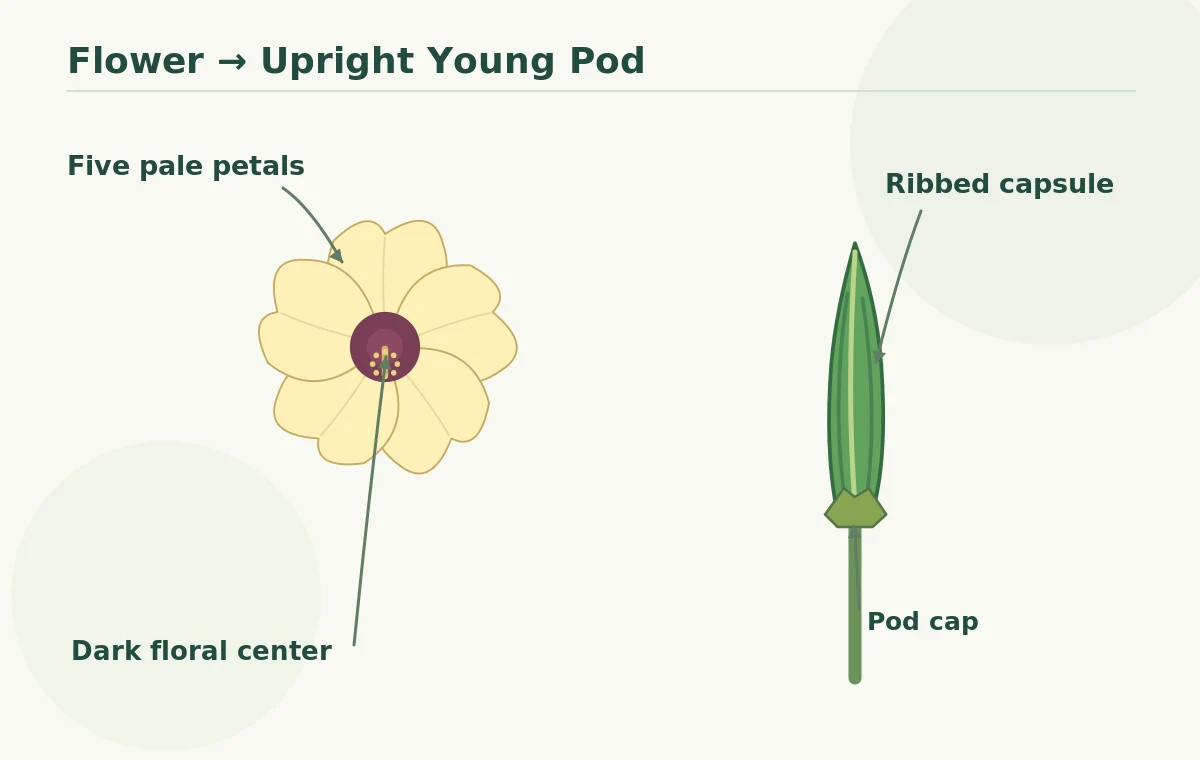
Watch a particular flower over several days. The petals open briefly, fade and drop, leaving the small developing fruit behind. Do not mistake an unopened flower bud for a harvestable pod; the bud is plumper toward its tip and protected by floral parts. A newly formed pod has longitudinal ridges and a distinct cap below its stalk. Looking at that transition is a more reliable guide than guessing from foliage alone.
Decide by Tenderness Before Pod Length Alone
For many standard green varieties, Iowa State University Extension recommends picking pods when they are roughly 2 to 4 inches long. Oklahoma State notes a common fresh-market target of around 3 to 4 inches. Those ranges overlap but are not a promise for every cultivar: long-podded types can stay tender at a greater length, and weather can speed growth markedly.
Feel and look for a firm but still youthful pod, with a smoothly tapering tip and modest seed ridges rather than large beads pushing outward. The usual edible stage is immature fruit, not a mature seed capsule. Thick, very large pods can become woody and fibrous. If your variety differs from the common garden type, test a representative small pod and use its texture together with the packet description.
Harvest Frequently While Flowers Continue Opening
Okra grows rapidly during hot, bright weather. Iowa State advises inspecting established plants at least every other day in productive weather; Oklahoma State reports fresh-market harvesting several times weekly. The exact rhythm depends on temperature, rain, vigor and how many flowers are opening. Make a short morning walk and check behind the large leaves where pods can hide along the upright stems.
An overlooked pod can enlarge surprisingly fast. Do not wait for a full basket before returning: picking a few young pods keeps quality consistent and reduces the number allowed to ripen seed. If a pod is already hard and stringy, remove it rather than treating it as the same food-quality stage as a young one. Leave healthy buds and leaves intact while you work.
Cut the Short Peduncle Without Bruising the Fruit
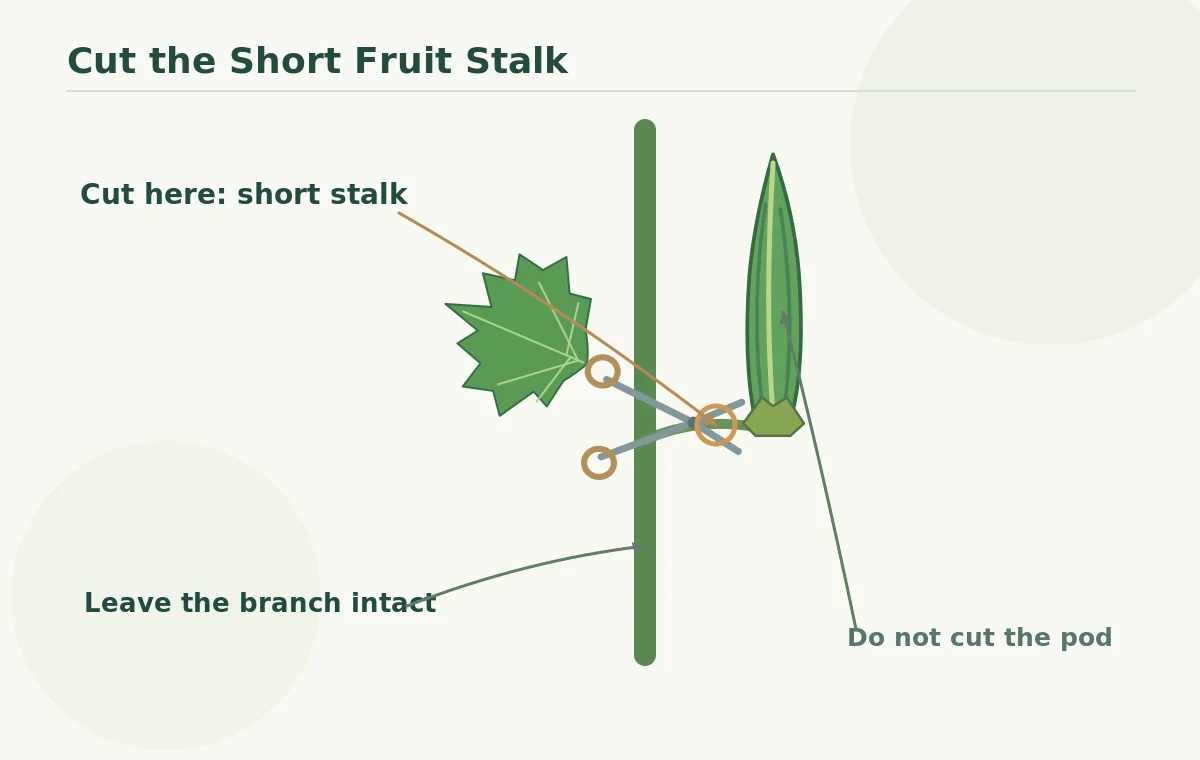
Use clean sharp pruners, harvest scissors or a small knife to sever the short stalk, called a peduncle, just above the pod cap. Keep the blade out of the green ridged body of the pod and away from the main plant stem. Gripping and pulling hard can tear tender branches or damage neighboring buds. A clean cut at the fruit attachment leaves most of the branching plant undisturbed.
Okra stems, pods and foliage may carry irritating little hairs. Gloves and sleeves are sensible when skin is sensitive, a point mentioned in both Extension guides. Do not tuck your bare hand into dense leaves without checking where the pod is attached. Hold the fruit gently, cut at the stem, and put it into a collection container without crushing other pods beneath it.
Understand the Difference Between Bud, Pod and Seed
Okra opens one showy, five-petaled flower at a time on many branches, with a dark central throat and a prominent fused staminal column. The long pointed immature capsule that follows is the vegetable harvested for cooking. Inside, small developing seeds sit in compartments along the fruit. The seeds are edible when immature but grow larger and harder as the pod matures, contributing to tougher texture.
The drawing shows the calyx-like cap near the attachment and the much shorter peduncle above it. It is not a bean vine, and the pod should not be drawn dangling from a long flower stalk. A side view can show ridges extending nearly to the tapered tip. This anatomy gives a repeatable checkpoint for harvesting quickly when several pods are clustered near fresh blossoms.
Handle the Fresh Pods With Care
Okra bruises easily. After cutting, place the pods in a shallow basket or small container rather than pressing down with a large pile. Keep them out of strong sun during harvest. Morning picking can help reduce heat in the gathered crop, as Oklahoma State explains. Unwashed pods can be stored cool for short periods, but their quality declines, so plan to use them soon rather than expecting weeks of storage.
Sort the harvest by condition. Discard or compost pods with obvious rot or extensive damage rather than relying on their length. Carefully remove any overly mature, woody ones to prevent the plant from diverting resources into ripening those seeds. Before preparing food, wash according to normal produce handling practices; washing and kitchen treatment are separate from harvest-stage selection.
Compare a Young Pod With a Mature Woody Capsule
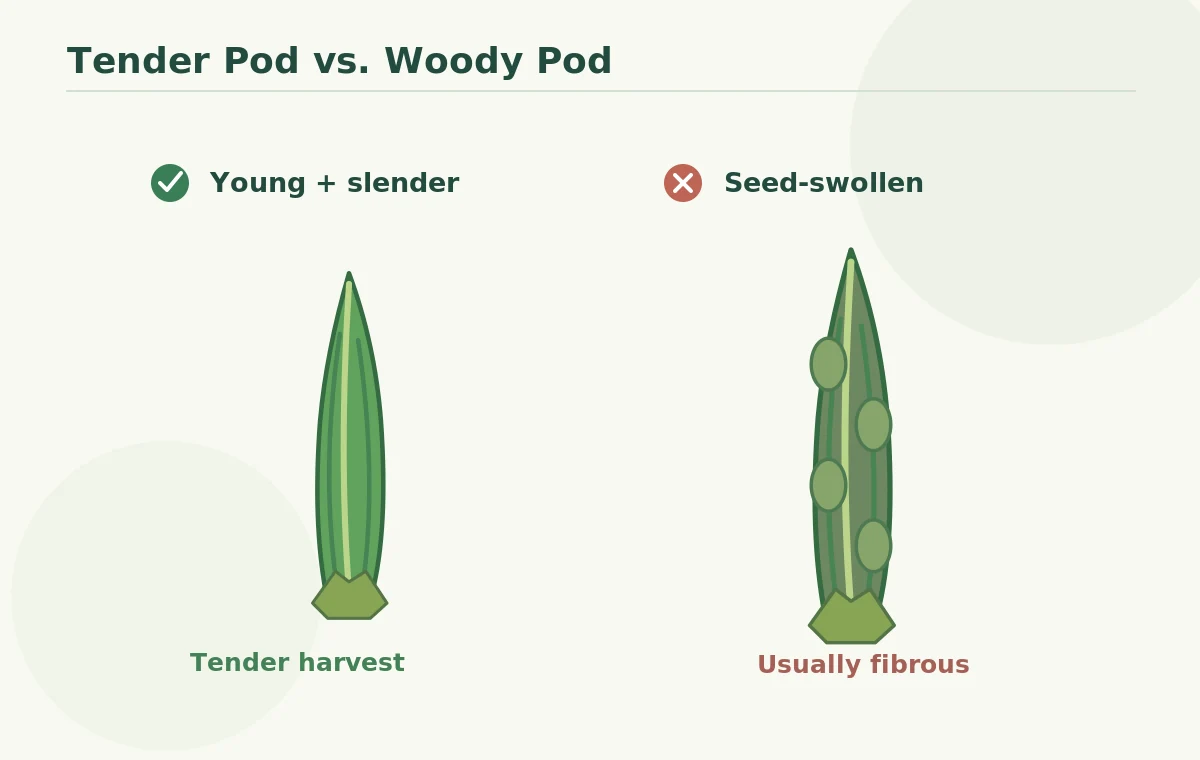
A young typical okra pod is relatively slim with ridges and a narrow pointed end. The cap is still recognizable, and there are no heavy rounded seed bulges distorting the fruit. An over-mature pod may be longer, thicker and stiff; some cultivars dry into brown, woody, split seed capsules. Color alone is not a sufficient test because some edible cultivars are red or pale rather than green.
For the comparison illustration, the immature pod and swollen older pod are displayed from the same general angle so shape can be compared fairly. A clean cut should be placed on the short stalk above the cap, not through either pod. If you are intentionally saving seed, mark a few healthy fruits separately and leave those to ripen fully. Do not mix dry seed pods with tender food harvests.
Adjust Picking to Climate and Plant Health
In long warm summers an established plant may keep flowering for many weeks, whereas a cool snap or prolonged stress can slow pod development. Okra is frost-sensitive, so local first-frost dates determine when the outdoor crop ends. A USDA plant hardiness zone describes average winter cold and does not give a suitable sowing date or guarantee how fast a pod grows.
Water sufficiently during flowering and fruit expansion, especially when rain is absent, and look for pest damage while harvesting. Do not assume every blemish requires a pesticide: identify the problem and ask local Extension resources for an integrated approach. The practical harvest decision remains simple: trace the pod to its own stalk, assess tenderness, and use a precise cut before the seed capsule becomes woody.
Related Guides
- When to Harvest Okra for Tender Pods Instead of Tough Ones
- Growing Okra: Warm-Soil Planting and Tender Pod Harvest Guide
- How to Save Okra Seeds From Brown Pods Before They Split Open
- How to Start Okra From Seed After the Soil Warms
How We Research and Verify These Field Diagrams
These instructions were checked against university horticulture publications on October 28, 2026. In particular, we used Iowa State University Extension okra growing guide; Oklahoma State University okra production. The drawings distinguish actual plant structures from generalized gardening symbols; conditions, cultivars, local climate and development stage can change exact timing.
This independent educational guide has no sponsored product recommendation or confirmed affiliate link. Read our affiliate disclosure. Consult your local Cooperative Extension for climate-specific advice and follow any applicable food handling or pest-control guidance.
Several days is common in warm weather; check developing pods frequently rather than relying on a fixed calendar.
Many standard cultivars are harvested at about 2–4 inches, but long-podded varieties can differ.
Cut the short peduncle immediately above the pod cap, taking care not to cut the fruit or parent branch.
Leave selected pods only if you are saving seed; remove unwanted mature pods to support continued fruiting.
The fine hairs on okra plants and pods can irritate sensitive skin.