
Love-in-a-mist is the ornamental annual Nigella damascena, a buttercup-family flower with finely divided green leaves, usually blue blossoms and striking inflated seed capsules. It is not interchangeable with culinary black cumin, Nigella sativa, just because both plants share a genus. Check the botanical name on your seed packet before assuming a garden flower is a spice crop or that its seed has a particular culinary use.
Choose the Right Nigella Species First
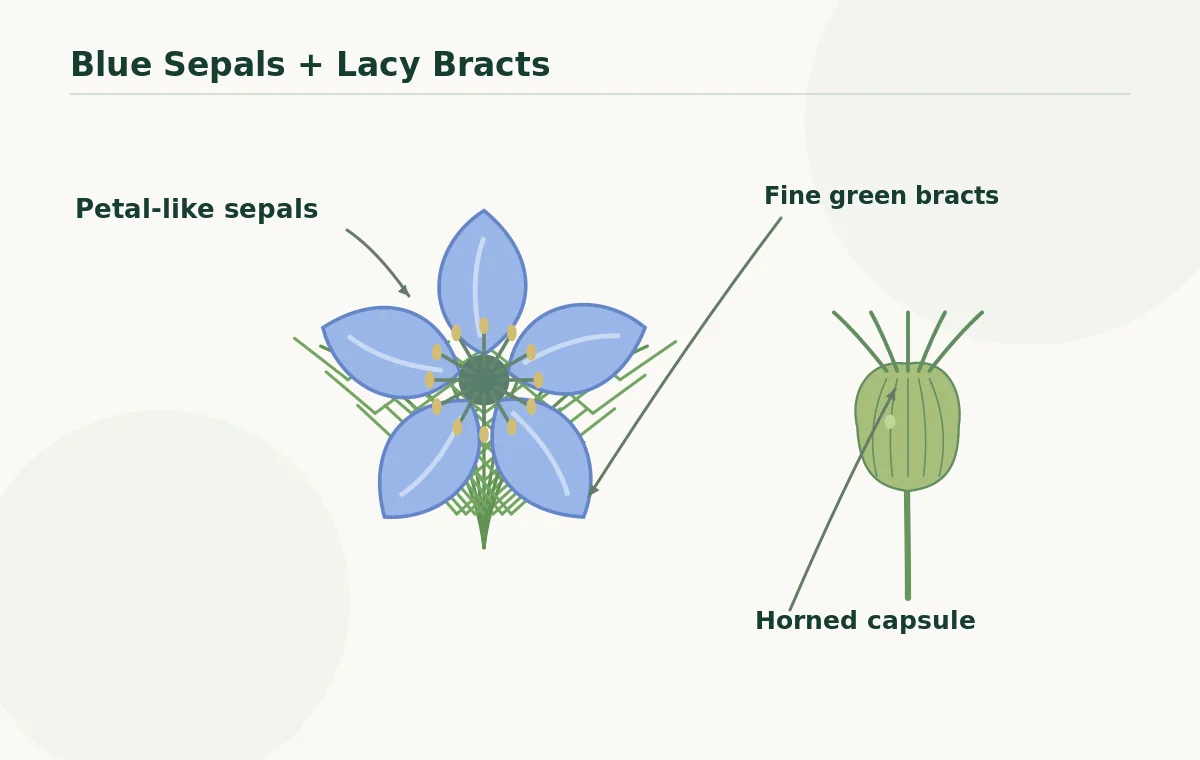
A typical love-in-a-mist bloom has five large, pale-to-vivid blue petal-like sepals around the central flower parts, framed by a misty ring of thin green bracts. Its true petals are small and less conspicuous. After flowering, the developing ovary swells into a rounded horned capsule, often streaked with bronze or purple, instead of forming a fleshy berry.
Match Sowing to Cool Local Weather
Nigella damascena thrives in comparatively cool growing periods and can lose performance in prolonged heat. Wisconsin Extension advises sowing when the soil can be worked in early spring and notes that fall sowing can work in many regions. NC State Extension also discusses fall and early-spring sowing. Use your local climate and forecast to choose between those options, not a universal date copied from another hemisphere.
Where winter is mild, autumn seedlings may establish and bloom early the following season. Where winters are severe, a spring sowing is often easier to manage. In very hot-summer locations, make use of the suitable cool season rather than forcing seedlings through midsummer. Seed availability, cultivar and local weather can move the window; a USDA hardiness zone by itself does not identify the best annual sowing week.
Sow Black Angular Seeds Shallowly in Place
The mature seeds are small, dark and angular rather than large smooth peas. Prepare a fine, weed-free bed in full sun with well-drained soil. Scatter the seed thinly or make a shallow drill so the seeds have soil contact. Wisconsin Extension recommends about one-eighth inch deep; cover with a fine film of soil instead of burying them in a deep hole.
Water gently so the seeds stay in place and the topsoil does not crust over. Newly emerging seedlings are delicate and can be displaced by a forceful hose. Label the row outside the illustration if needed in your garden; the young threadlike leaves can be confused with unrelated volunteers. Resist the urge to over-seed a tiny area simply because the grains are small.
Avoid Transplant Stress and Crowded Growth
Love-in-a-mist is usually better direct-sown because it develops a long central root and does not transplant readily. If you use a module or biodegradable container due to local conditions, handle the root system carefully and move plants while still small. For most home flower borders, direct sowing into the final location is simpler and avoids damaging roots during separation.
Once the seedlings have recognizable foliage, thin crowded groups so each remaining plant has room to branch. Wisconsin Extension describes thinning to approximately eight to ten inches in its growing advice, although dwarf cultivars and designs may differ. Do not treat a mass of tangled roots and stems as one giant seedling. Keep the soil reasonably moist during establishment without keeping it permanently soaked.
Recognize Feathery Leaves and Blue Flowers
Nigella foliage is deeply dissected into very narrow, almost threadlike segments. The tiny branches of green around each flower give rise to its common name, love-in-a-mist. A healthy plant can carry several upright flowering stems, often with solitary pale-blue blooms. Cultivars also come in white, pink or other purple-blue tones, so color alone is not an absolute identification test.
The large colored pieces on a typical bloom are sepals; a close drawing should not label them as ordinary broad true petals. At the center are numerous stamens and the developing female parts. This distinction is useful both for plant identification and for understanding the next stage: as the flower fades, the pistil develops the ribbed, inflated capsule rather than an edible fruit.

Leave Selected Flowers to Form Capsules
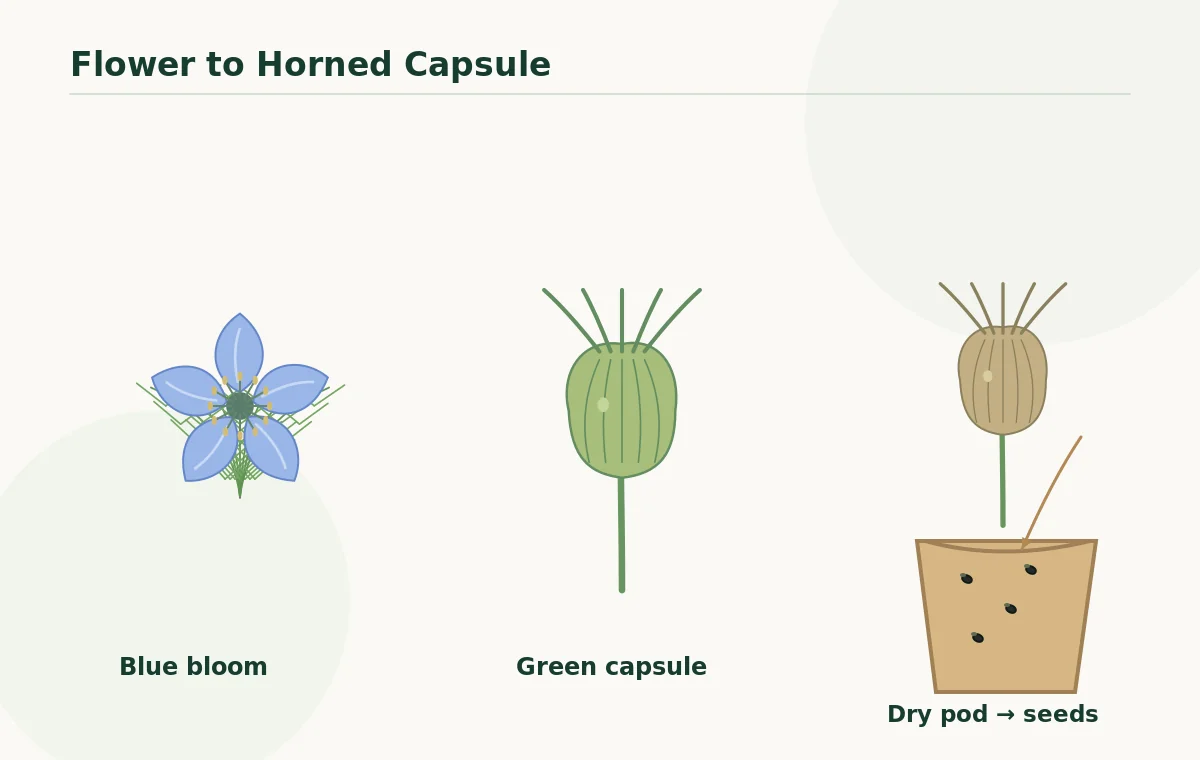
Removing fading flowers can prolong the flowering display, but it also prevents those flowers from producing ornamental pods and seeds. If you want both, deadhead some stems and leave selected healthy blooms untouched. University Extension sources describe the striking pod stage as one of the main reasons to grow Nigella damascena. The first green capsules can carry visible colored streaks and upward horn-like points.
The pods gradually dry and the enclosed seed can disperse, so plan before they split. If the goal is ornamental arrangements, choose the capsule stage that gives the desired form and then dry stems in an airy spot. If your goal is seeds for a future flower planting, allow selected pods to develop mature dry seeds and keep them identified as ornamental N. damascena.
Compare Seed, Flower and Mature Pod Stages
A genuine life-stage comparison begins with an angular black seed under a light layer of soil, proceeds through lacy foliage and a blue flower, and ends with a green then drying inflated capsule. The capsule is supported by a slender green stem and has several short horn-like projections; it is not a cluster of round berries or a long bean pod.
Do not confuse a still-green fleshy-looking pod with a mature dry storage seed. Browned, dried capsules may release seeds readily, and some gardeners contain drying stems in paper bags to catch any that fall. Put the bag below or around the drying pod cluster where gravity can carry seeds into it rather than displaying a bag far above the source.
Manage Volunteers and Save a Flowering Space
Love-in-a-mist often self-sows if seed capsules remain in the border. That can be welcome in informal plantings but unwanted in a small patterned bed. Remove or contain developing pods before seed shed where volunteers would be a problem. Small seedlings can be thinned early, while strongly established plants are less forgiving of root disturbance.
When one flush of flowers finishes, you can plan staggered sowings during weather favorable to this cool-season annual. Wisconsin Extension describes succession planting to stretch the display, but the idea is not a promise of continuous blooms through every hot summer. Keep a note of when your first flowers opened, when pods formed and when heat ended bloom to plan next season realistically.
Related Guides
How We Research and Check the Drawings
We compared university Extension and horticultural guidance with the plant’s visible structures rather than assuming all varieties behave alike. Sources checked October 28, 2026: Wisconsin Extension love-in-a-mist guide; NC State Extension species profile; RHS Nigella damascena profile. Where climate, variety, or growing conditions can change the answer, the observations below take priority over a single fixed calendar date.
This independent educational article contains no sponsored product endorsements or confirmed affiliate links. See our affiliate disclosure. Use local Cooperative Extension recommendations when your weather, soil, or pest pressure differs from the examples shown.
Usually in workable cool soil in early spring, or in autumn where local winter conditions suit seedlings.
Wisconsin Extension recommends about one-eighth inch, a shallow cover rather than a deep planting hole.
Transplanting is often difficult because of the long root; direct seeding into the final bed is generally preferred.
The five conspicuous blue flower parts are petal-like sepals; the true petals are small and less visible.
No. Ornamental Nigella damascena and culinary Nigella sativa are separate species; do not substitute seeds for culinary use.