
Cabbage looper larvae are not just any green worms on broccoli. The caterpillar Trichoplusia ni moves by raising its middle into a loop as it pulls the rear part of its body toward the front. Its particular arrangement of fleshy abdominal legs helps distinguish it from the imported cabbageworm. Learning to observe movement and inspect older leaf undersides helps avoid unnecessary insecticide use when a few chewing holes appear.
Start With Damage but Do Not Diagnose by Holes Alone
Broccoli leaves may develop ragged chewing holes from more than one kind of caterpillar, beetle or slug. The outer leaves can be affected while the developing central head still looks sound. UC IPM explains that cabbage loopers commonly chew holes and may be found primarily on older foliage. Look for fresh frass, recent feeding, and live larvae rather than assuming an old missing patch proves an active outbreak today. Photograph the same leaf if you cannot find the insect immediately. Major loss on very young plants deserves more urgency than a few small cosmetic holes on a mature robust plant, but correct identification still comes before a treatment recommendation.
Watch the Characteristic Arching Crawl
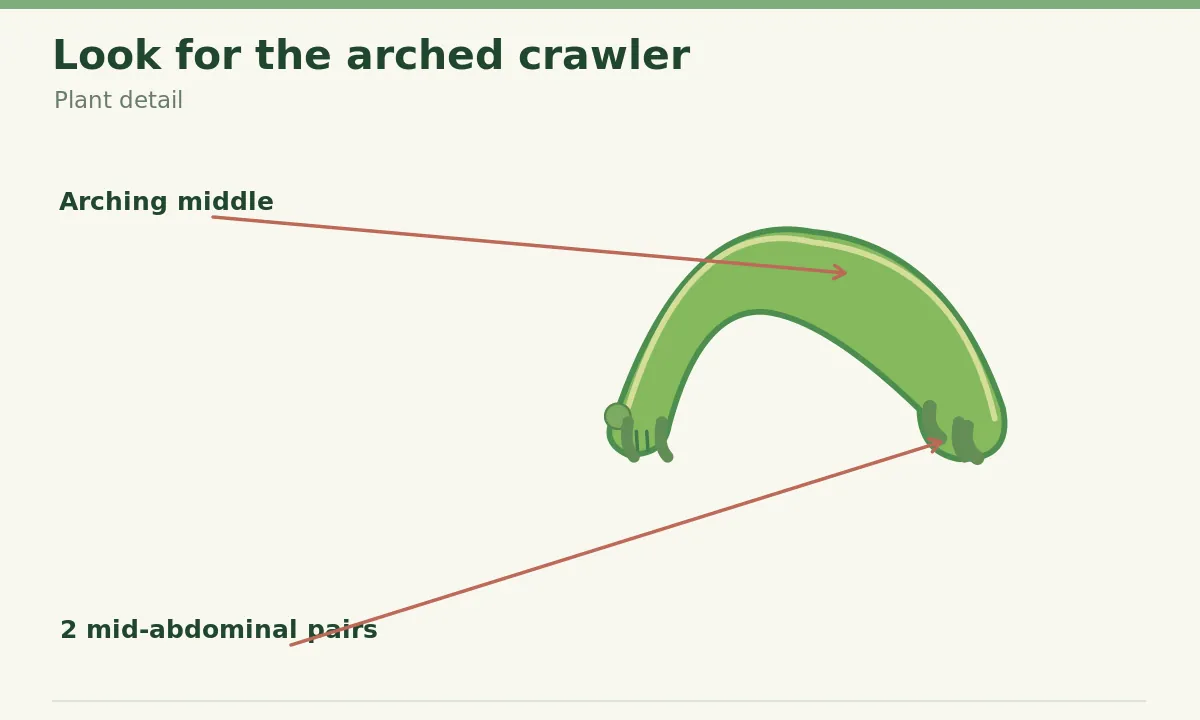
When a cabbage looper travels, the middle of its body rises into a hump as it pulls its rear legs toward the front. This gives the caterpillar its familiar looping motion. UC IPM and Clemson Extension both emphasize this highly useful field sign. Do not crush the first green larva you see before watching it walk for a few seconds. A still caterpillar can look similar to other species, while movement adds information without any equipment. Looping is most useful in combination with body stripes and abdominal legs, not as a lone guarantee; other larvae also bend their bodies when disturbed.
Count the Abdominal Prolegs Carefully
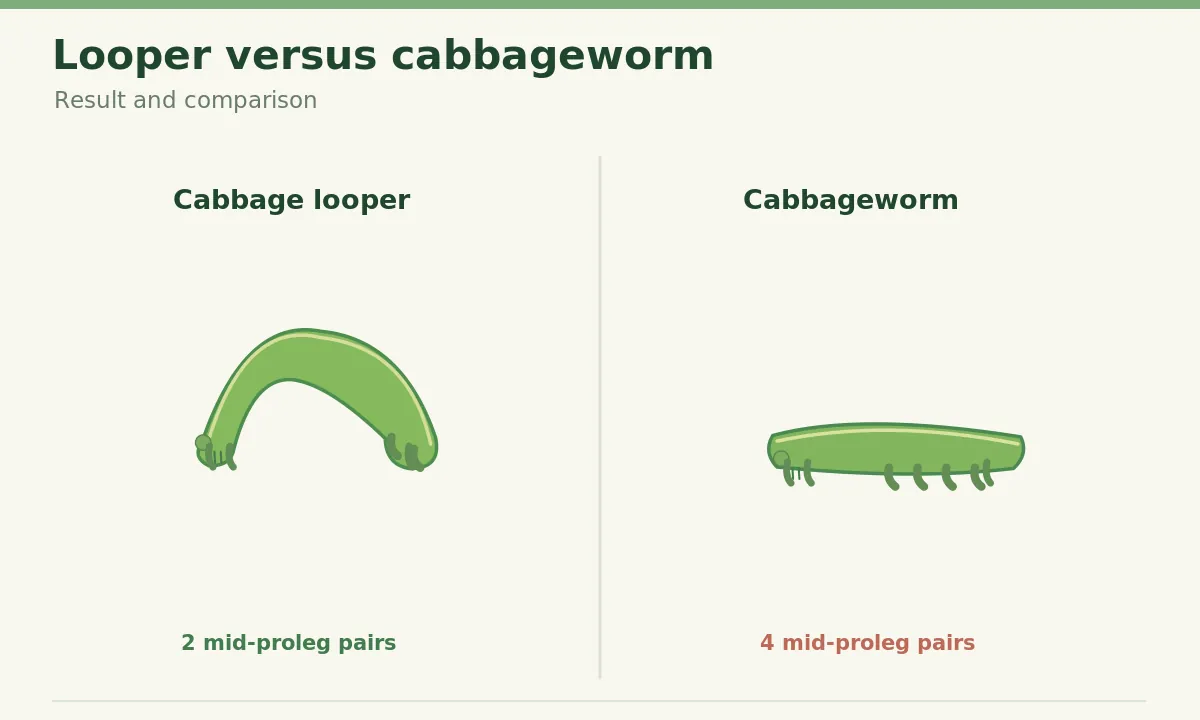
True caterpillars have three pairs of jointed legs near the front and may have fleshy abdominal prolegs farther back. Clemson and UC IPM describe cabbage loopers with two pairs of middle abdominal prolegs, on the fifth and sixth abdominal segments, in addition to rear prolegs. Imported cabbageworms have four pairs of middle prolegs. In a tiny moving larva these structures can be hard to see without a hand lens. If identification is uncertain, photograph the side of a resting larva and compare with a university IPM guide. Never force an insect open or use bare fingers near irritating plant residues just to count leg structures.
Inspect Green Color and Narrow Pale Stripes
Cabbage looper larvae are typically green, relatively smooth and may have thin pale longitudinal stripes along the sides and back. Mature larvae are often thicker toward the rear end than near the head. Color alone does not identify a looper: imported cabbageworms are also green, and some larvae vary with age. Clemson notes that caterpillar size and shape are useful clues, but growth stage changes the appearance dramatically. Look for a set of matching characteristics: pale green body, longitudinal stripes, arched walk and two pairs of abdominal prolegs. If you find dark bristly or spotted larvae, they may be a different species that merits another identification guide.
Look Under Older Leaves for Larvae and Eggs
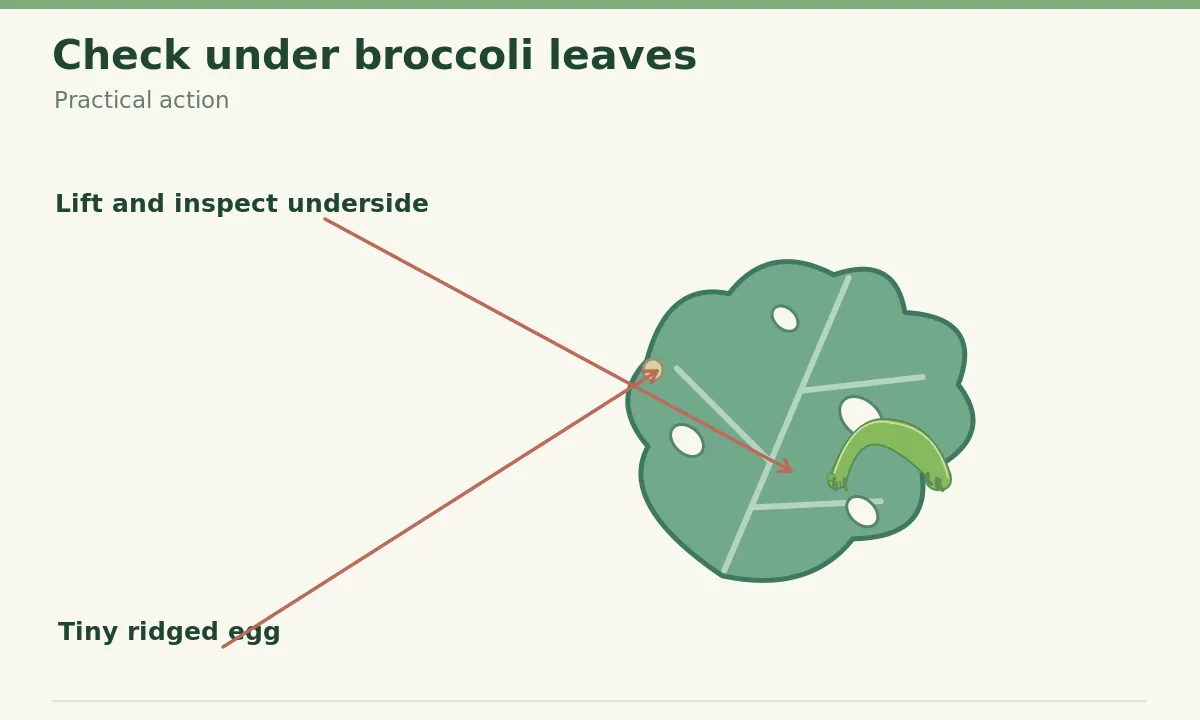
Turn a broccoli leaf gently while supporting its stem, especially on older leaves nearer the outside of the plant. UC IPM notes that eggs are generally laid singly and have a ridged dome shape; larvae frequently feed beneath leaves where casual overhead checks miss them. Use a small magnifier to inspect an apparent speck without scraping it off. Eggs are far smaller than a mature caterpillar and are not always easy to identify to species by sight. Check several plants across the row rather than examining only the most damaged leaf. Return the leaf to its natural position afterward to avoid tearing or exposing the developing plant head unnecessarily.
Recognize Silken Cocoons and Helpful Natural Enemies
Mature cabbage loopers pupate in a loose silken cocoon, often attached to the leaf underside or sheltered plant material. That differs from an actively feeding green larva. Infections, predators and tiny parasitoid insects can reduce caterpillar populations, so not every insect presence warrants a spray. UC IPM highlights natural enemy activity as important to integrated pest management. Leave unidentified cocoons or beneficial insects alone until the stage is clear. Some parasitoid evidence can be mistaken for a pest egg mass; learn which object you are seeing before scraping it off. Avoid broad-spectrum pesticides that may remove the insects already suppressing the problem.
Assess Crop Stage and Real Feeding Pressure
A single small looper on a vigorous established broccoli plant can be handled differently from many large loopers on transplants with only a handful of leaves. A developing central broccoli head can be contaminated with frass or caterpillars if an infestation is ignored. Inspect a representative sample of plants and record how many live larvae are present, their approximate size and whether damage is advancing. UC IPM publishes monitoring thresholds for commercial cole-crop settings, but a home gardener should not copy agricultural economic thresholds blindly. Use them as evidence that crop stage matters, while taking garden-scale practical steps and consulting local Extension for serious damage.
Handpick When Numbers Are Small
For accessible garden plants with only a few identified loopers, careful hand removal can be a straightforward first response. Use gloves if preferred, inspect both leaf surfaces, and dispose of larvae appropriately. Avoid accidentally removing the central growing point or breaking leaves during a hurried search. Floating row covers can prevent egg laying when installed early and used correctly, but do not trap existing caterpillars inside; inspect plants before covering. Cover management also needs to account for the crop’s stage and any locally necessary pollinator access for other plants. Row covers can create a different microclimate, so check temperature and ventilation during warm weather.
Do Not Spray an Unidentified Caterpillar
If there are many damaging larvae and physical or cultural methods are inadequate, contact local Cooperative Extension for currently permitted products labeled for broccoli. UC IPM discusses caterpillar-specific microbial options such as Bacillus thuringiensis and notes that small larvae respond differently from large ones. This is not a reason to invent dosage, mixing instructions or a harvest interval. Check the actual product label for the intended crop, formulation, location and timing; labels can change. Some products injure useful insects or require protection around bloom and water. Broad pesticide application merely because a leaf has holes can be ineffective and can undermine the predators already keeping looper populations low.
Compare Cabbage Loopers With Similar Brassica Pests
Imported cabbageworms often have a more even-body shape and four middle pairs of fleshy abdominal prolegs. Diamondback moth larvae are usually smaller and react differently when disturbed. Flea beetles make many tiny shot holes but are beetles, not caterpillars. Slugs can leave irregular damage and slime trails, often feeding at night. One broccoli plant can host more than one pest at the same time, so identifying the first caterpillar does not prove all damage belongs to it. Use the plant’s feeding marks, larval behavior and location together. If a specimen does not match, do not label it cabbage looper for convenience; seek confirmation.
Check the New Growth After Management
Review the same plants in several days, looking at both fresh feeding and newly enlarged green leaves. Existing holes will not repair; improvement is evident when little additional damage appears and new leaves remain intact. Continue to protect beneficial predators and avoid repeated applications without reassessing the cause. Remove spent infested crop debris when a planting finishes, manage nearby brassica weeds, and consider netting for the next planting if recurring moth pressure is severe. Record the date, crop stage, number of loopers found and changes after hand removal. Such garden observations are more meaningful than promising that one universal remedy will permanently exclude every caterpillar.
Related Guides
- How to Identify Cabbage Aphids on Broccoli Before Heads Fill
- How to Identify Cabbage Worms and Protect Brassicas With IPM
- How to Identify Cabbage Aphids on Kale and Manage Colonies
- How to Recognize Flea Beetles on Radishes and Protect Young Seedlings
How We Research and Verify Plant Advice
Sources checked on 2026-10-26: ipm.ucanr.edu; hgic.clemson.edu; ipm.ucanr.edu. We reviewed each institution’s plant identification, correct growth stage and relevant cultural recommendations before adapting them into an independently written step-by-step guide. Where sources are region-specific, their calendar details are not applied universally. Pictures use simplified teaching shapes and should be compared with living specimens; they are not a substitute for laboratory disease diagnosis or local climate guidance. The relevant advice is paraphrased rather than reproduced.
Safety and Independent Editorial Disclosure
This independently prepared educational article does not claim sponsorship or affiliate approval. Our category reading links are informational, not product endorsements. See the VegWin affiliate disclosure. Clean sharp tools before cutting plants, protect hands from thorns and blades, and keep cut plant material away from children and pets where appropriate. Use only locally registered plant treatments labeled for the actual crop, and observe the product label. Do not rely on unsupervised home remedies or unverified harvest-safety promises.
It draws the rear part toward its front, raising its midsection in a distinctive loop as it crawls.
Cabbage loopers have two pairs of middle abdominal prolegs; imported cabbageworms have four, among other differences.
Small dome-shaped ridged eggs are often placed singly on leaves, including the undersides.
No. Identify the active pest and its abundance first; hand removal and prevention may be enough.
No. Monitor new growth and whether additional feeding occurs, rather than expecting old holes to close.