
How to Prune an Established Fig Bush Without Removing Too Much Fruitwood starts with the living plant, not a one-size-fits-all calendar. Look for the exact stem, leaf, root or symptom before using scissors, moving soil or changing how you care for the crop. The practical checkpoints below draw on named University Extension, RHS and IPM resources as relevant. Weather, cultivar, stage of growth and regional conditions may require a different schedule; a clear observation is safer than an assumed date. Use the diagrams as learning aids and check the real growing points on your own plant.
Identify the Common Fig and Its Growth Form First
A common edible fig is Ficus carica, and it can form a tree or a many-stemmed bush depending on climate, cultivar and care. Older fig bushes often send strong shoots from near the base, which can become replacement leaders or crowd the center. University of Georgia Extension describes bush form as practical where winter injury makes a tall single-trunk tree less dependable. Do not apply apple-tree central-leader diagrams directly to figs. Identify which stems are main framework leaders and which are new shoots, crossing branches or dead wood. Photograph the whole dormant plant from several sides before cutting: the apparent tangle often becomes easier to assess from a distance.
Choose Pruning Timing for Your Region and Crop
Dormant-season pruning is widely discussed for figs, yet its exact timing is not universal. UC IPM describes selective dormant pruning for structure, while UF/IFAS notes that some Florida crops rely on terminals of prior-year wood and warns against heavy winter cutting. In freeze-prone areas, wait until likely injury can be judged rather than cutting before late freezes and discovering more dieback afterward. In warm regions with dependable early figs, preserve the wood that carries the intended crop. Never adopt a calendar date from another state without considering cultivar, winter injury and whether the plant produces a breba crop on older wood or a main crop on newer shoots.

Find the Strong Leaders Worth Retaining
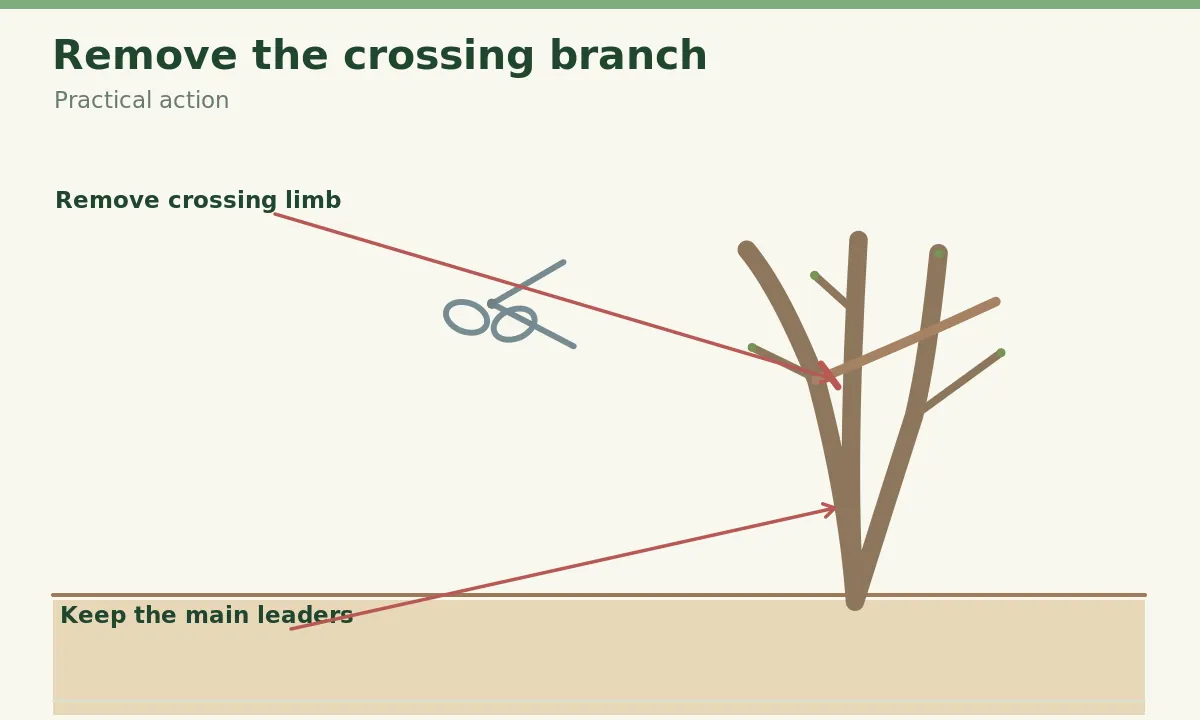
University of Georgia Extension recommends keeping several widely spaced main shoots in a bush, rather than a dense bundle competing at the base. On an established plant, the goal is not to force every bush back to the small size of a new transplant. Look for leaders with healthy bark, firm attachment and enough room for future thickening. Choose those that distribute weight and light around the plant. A stem that bends out into open space may be more valuable than a perfectly vertical shoot pressed against another. Mark the most useful leaders with loose temporary ties before making any cuts, and remove those ties when the work is complete.
Remove Dead and Broken Wood Before Shaping
Start with limbs that are completely dead, cracked or broken. A live twig may show green beneath a small test scrape, but avoid stripping long sections of bark to test every branch. Winter-killed fig tips often appear brown and brittle while sound wood farther down remains alive. Cutting back to a living lateral or suitable bud prevents leaving long stubs, which University of Georgia warns can admit decay organisms. Use clean sharp bypass pruners for small wood and a suitable hand saw for larger branches. Wear eye protection around springy twigs. Where there is uncertainty about winter damage, reassess once healthy buds begin opening rather than removing substantial living wood by guesswork.
Thin Crossing Branches Without Cutting the Collar
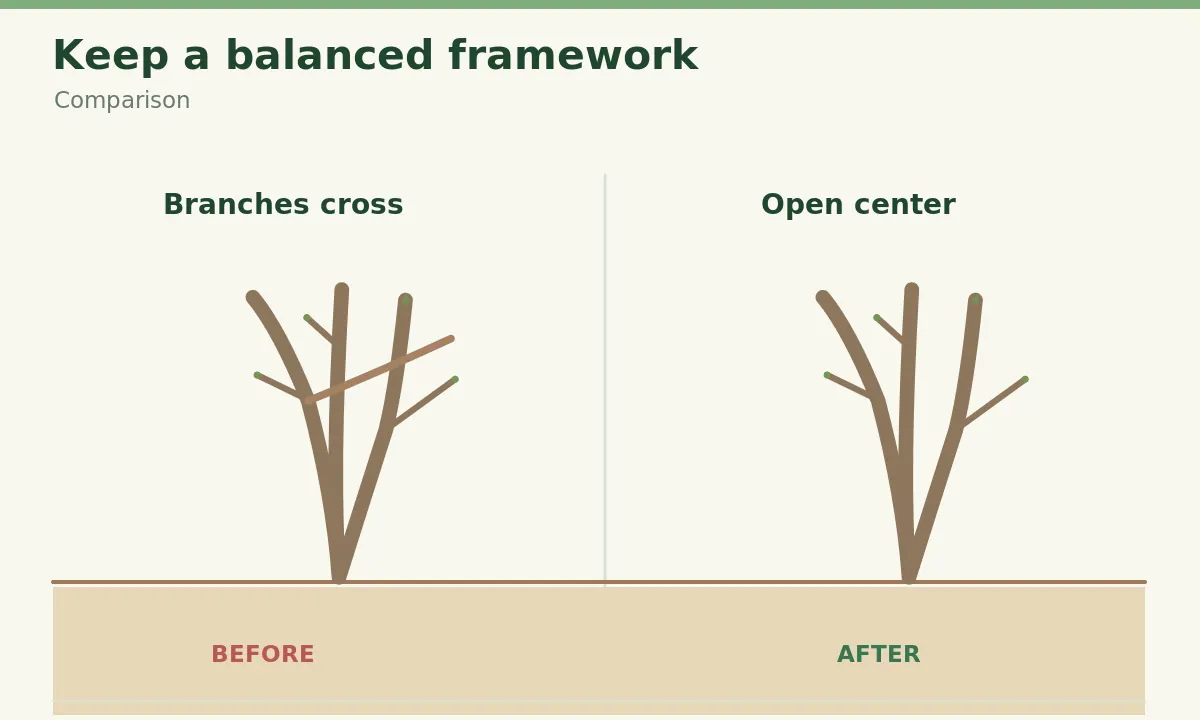
Look into the center for branches that rub or repeatedly strike another when wind moves the shrub. Keep the sounder branch with better outward direction and remove the other at its point of origin. UC IPM cautions against injuring the branch bark ridge: the raised junction and collar contain tissues needed for wound closure. Cut just outside that natural swelling, not flush against the trunk, and do not leave a long peg. For a heavy limb, use the proper multi-cut method so falling wood does not tear bark below the junction. A useful diagram must put the cut at the true branch attachment, not halfway along both crossing branches.
Avoid Unnecessary Heading of Every Fig Shoot
Heading a stem shortens its tip and can stimulate branching, but heading every leader indiscriminately can remove potential fruiting wood and encourage a thicket of vigorous shoots. UC IPM notes that mature fig pruning usually becomes less vigorous with age. Remove the specific branch that conflicts with space, access or structural health rather than automatically cutting all stems at the same height. Some established bushes need little pruning beyond damaged and interfering wood. The pruning intensity should respond to actual branch placement and fruiting habit. If the bush is very overgrown, consider a gradual multi-season plan instead of attempting to remake the entire structure in a single afternoon.
Understand Where Figs Produce Their Crops
Figs can bear a main crop on current-season shoots, while some cultivars also make an earlier breba crop on wood produced the previous season. UC IPM emphasizes the role of newer growth in many mature common figs; UF/IFAS stresses the risk of losing a crop through heavy cutting in Florida conditions. Those statements apply to different production situations and should not be flattened into a single rule. Learn your cultivar and observe where last year’s fruit appeared. Keep some healthy one-year wood when an early crop matters. Do not assume that every apparent fig-shaped bud or small knob on a dormant shoot is expendable.
Maintain Safe Access and an Open Working Space
A bush should be manageable for harvesting and inspecting fruit, but open structure does not mean stripping all interior growth. Remove low laterals only when they obstruct paths, touch wet soil or interfere with chosen leaders. Keep a stable tool footing, never work from an unstable ladder, and have a professional handle large overhead limbs near electrical service or structures. Clean up sharp twigs and fallen fruit underfoot after pruning. Consider how the canopy will look at full summer leaf size, not only in winter. A few carefully selected cuts can improve light and access more effectively than cutting every vigorous shoot back to bare wood.
Respond Differently to Freezing Injury
A fig that has died back above ground may regrow strongly from its crown or roots, making the shrub form especially useful in cold-prone locations. Wait until live growth can be identified before deciding how far to remove damaged wood. Choose new replacement leaders over time rather than tying weak shoots into a fake single trunk. Severe winter dieback is not the same as routine shaping, and the main priority is preserving healthy regrowth and plant survival. Check the variety’s local performance and ask Extension before copying cold-protection or annual hard-pruning regimes. Root condition, planting site and how long hard cold persists can change the outcome from year to year.
Recheck the Bush During Its Growing Season
After pruning, take a matching photograph from the original viewing angle to confirm that the center is less crowded while the chosen framework remains intact. As leaves emerge, identify shoots that cross again or grow into footpaths. Make small, purposeful corrections if needed without reflexively removing strong productive branches. If fruit set is disappointing, consider spring weather, cultivar, irrigation, pests and winter injury as well as pruning. A light cut is rarely the only cause of a small crop. Keep a note of branch positions and which wood carried fruit; this record makes next year’s winter decisions much more accurate than following a generic fig pruning picture.
Related Guides
- When to Prune Fig Trees Without Losing the Early Breba Crop
- How to Root Dormant Fig Hardwood Cuttings With Buds Above the Mix
How We Research and Verify Plant Advice
Sources checked on 2026-10-26: ipm.ucanr.edu; extension.uga.edu; gardeningsolutions.ifas.ufl.edu. We reviewed each institution’s plant identification, correct growth stage and relevant cultural recommendations before adapting them into an independently written step-by-step guide. Where sources are region-specific, their calendar details are not applied universally. Pictures use simplified teaching shapes and should be compared with living specimens; they are not a substitute for laboratory disease diagnosis or local climate guidance. The relevant advice is paraphrased rather than reproduced.
Safety and Independent Editorial Disclosure
This independently prepared educational article does not claim sponsorship or affiliate approval. Our category reading links are informational, not product endorsements. See the VegWin affiliate disclosure. Clean sharp tools before cutting plants, protect hands from thorns and blades, and keep cut plant material away from children and pets where appropriate. Use only locally registered plant treatments labeled for the actual crop, and observe the product label. Do not rely on unsupervised home remedies or unverified harvest-safety promises.
No. Established bushes often need selective thinning; severe uniform heading can remove fruitwood and trigger excessive regrowth.
Remove the unwanted branch just outside its natural collar where it joins a larger branch, without leaving a long stub.
Many figs bear a main crop on current-season shoots; some also bear a breba crop on the previous season’s wood.
Assess damage after major freeze risk passes or live buds are visible, then cut dead wood back to sound growth.
No. Winter dieback, harvest timing, cultivar and fruiting pattern can lead to different appropriate cuts.