
Dormant figs can be propagated from pieces of woody stems rather than green tip cuttings. The most consequential details are keeping the branch oriented in its original upward direction, including healthy nodes, setting the basal end in a moist porous medium and allowing new roots time to develop before exposing the cutting to excessive sun or drought. A hardwood stick with swelling buds is not automatically rooted; roots and new leaves develop on different schedules.
Start With a Healthy Dormant Fig Plant
Choose a disease-free common fig, Ficus carica, showing firm, intact one- or two-year-old shoots while the plant is dormant. Avoid branches with sunken cankers, rotting bark, unexplained dieback or insect galleries. Rutgers Cooperative Extension recommends straight vigorous dormant wood, not a soft actively growing tip. In an unheated climate, dormancy often falls in late winter; in warm regions figs may enter only a partial rest, changing the best time for collecting material. Label the parent tree if you want to keep cultivar identity. Seed-grown figs are not automatically identical to the parent, whereas stem cuttings can clone it if successfully rooted.
Choose Practical Length and Thickness
UF/IFAS describes dormant cuttings about six inches long and under an inch across. Rutgers suggests approximately nine inches and pencil-size to around three-quarters of an inch for many home methods. These are compatible ranges, not conflicting mandatory numbers. Choose pieces with several intact nodes and a length you can fit securely into a deep enough pot. Very short fragments with one uncertain bud are hard to orient and more vulnerable to drying. Excessively thick old wood takes up space and may not be as manageable as firm, straight previous-season growth. Collect a few extras rather than promising every cutting will strike roots.

Locate Buds and Mark the Top
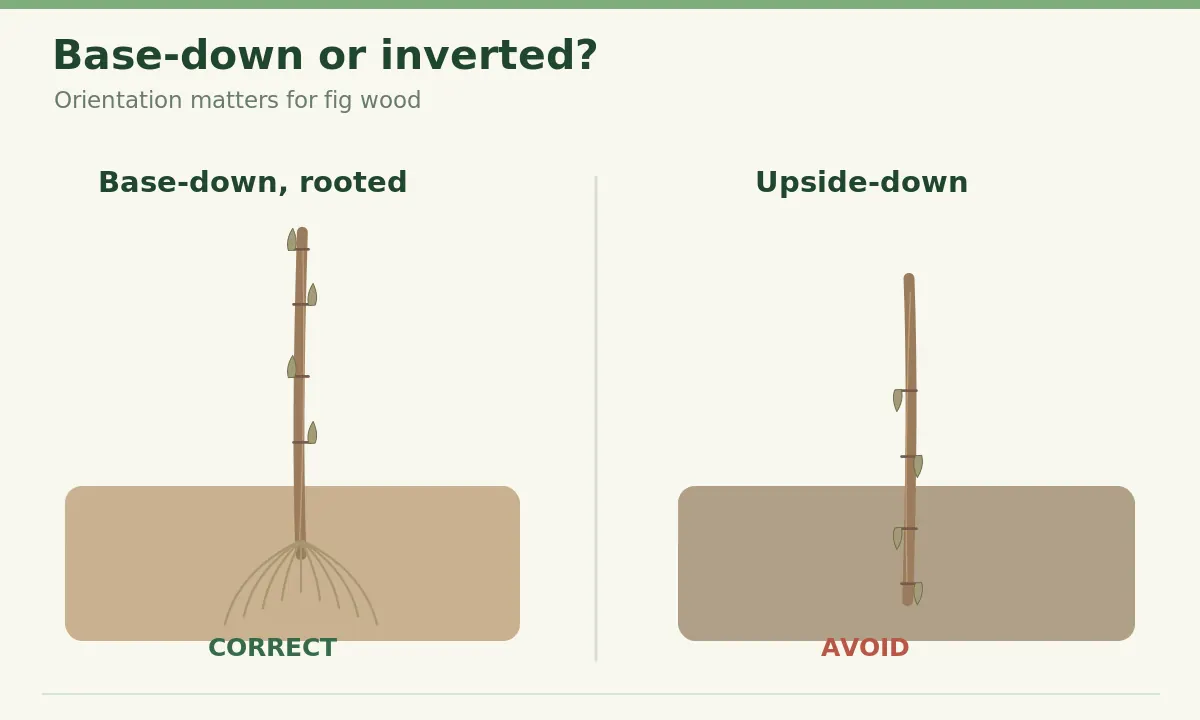
Before cutting a long twig into pieces, inspect buds at nodes. They tend to point upward and sit in a slightly raised area of bark; leaves once attached at these nodes. Mark the natural top with a label or make a consistent top cut that you can recognize later. Stem sections that are set upside down may fail or root irregularly. The detail illustration distinguishes the narrower upper tip, several intact nodes and the wider basal end. A cutting has no leaves during dormancy, so do not draw active foliage as a requirement before rooting. Handle all pieces so their original orientation remains known.
Make a Basal Cut Immediately Below a Node
Rutgers instructs making the lower basal cut just below a node. Use a clean, sharp bypass pruner for a smooth cut rather than crushing wood with a dull blade. Keep at least one sound node where root initiation can occur and enough length below the media surface to hold the cutting upright. Make a different upper cut just above a bud so you can distinguish ends, but do not slice off that bud. No need to peel large strips of bark to prove cambium is green; injuring the stem can admit pathogens. Keep cuttings labeled and sheltered as you prepare the rooting container.
Use a Free-Draining Rooting Medium
UF/IFAS recommends moist but not wet perlite or another moist porous medium. Rutgers also allows good, well-drained potting media. Fill a clean container that has real drainage holes, and dampen the medium before inserting wood. Avoid compacting wet native clay into a pot; that can exclude oxygen around the basal end. A container that drips freely after watering is safer than one with standing water in a sealed decorative saucer. Pot size depends on cutting length and how long roots will develop before repotting. Prevent the stem from rocking because repeated movement can damage new root initials.
Insert the Base First and Leave Upper Buds Exposed
Position the cutting with the original basal end pointing down. UF/IFAS says at least half of the length should be below the soil level, and Tennessee Extension shows one bud remaining above the surface. The diagram uses these as complementary checkpoints rather than a universal inch mark. Firm the medium gently around the buried nodes and keep a viable upper bud in open air. Do not invert the stick to make its thinner end fit better. The buried portion must remain moist enough to callus while exposed buds remain protected from desiccating wind. If you need to move the pot, hold the container rather than tugging the cutting to test its grip.

Keep Moisture Steady Without Waterlogging
The rooting stage needs oxygen as well as water. Touch the medium and water only as needed to keep it lightly moist; if liquid pools around the stem, improve drainage instead of adding more water. UF/IFAS discusses callus development under moderate rooting temperatures, but an exact calendar cannot be imposed on all climates and cultivars. Avoid placing the pot on a hot radiator or in freezing wind. A bright protected location with indirect light is practical as buds start swelling. If you use a clear humidity cover, vent it to discourage mold and overheating and ensure the stem is not constantly touching wet plastic.
Understand Callus, Bud Break and Rooting
The pale callus that forms near a cut is wound tissue; it is not a full root system. Fig cuttings may show green leaves before enough roots exist to support them, especially when stored carbohydrate reserves fuel early shoot growth. UF/IFAS warns that leafy shoots require more careful irrigation until roots function well. Be patient and watch for stable growth rather than assuming a bud equals a thriving new tree. Avoid repeated lifting of the cutting to check roots. A gentle tug can also snap delicate initials. A transparent pot or a drainage-hole view may offer evidence later without tearing the new root system apart.
Avoid Common Failures and Rot
Dark mushy tissue and a sour smell at the basal end suggest excessive moisture or infection, while a shriveled brittle cutting suggests severe drying or nonviable wood. Not every failed cutting is caused by the same factor. Check drainage, temperature swings, original wood condition and polarity in that order. Rooting hormone may help under some conditions, but UF/IFAS describes it as an enhancement, not as a substitute for sound material and correct moisture. If using an approved product, follow its label and avoid kitchen ingredients promoted as guaranteed rooting agents. Sterilize tools between suspicious pieces and dispose of clearly rotting cuttings.
Grow On Before Planting Outside
Once you have good evidence of roots, gradually allow the young fig more light and air and move it into a container suitable for longer growth. Roots formed in porous perlite can be brittle; support the entire plug rather than shaking it clean. Rutgers suggests allowing a rooted plant to establish before normal watering and placement; avoid abrupt hot sun or a freezing night. Many cultivars need winter protection in cool regions, while warm humid regions bring different disease challenges. A small leafed-out cutting is not ready to face the conditions tolerated by a mature fig tree. Follow regional Extension guidance for eventual site and cultivar choice.
Record the Cutting Method and Results
Label each container with cultivar, collection date and rooting medium. At the end of the attempt, compare how many sticks formed true roots, not merely how many produced leaves. If you tried two lengths or rooting media, record the outcome so you can adapt next season without repeating uncertain assumptions. Draw the orientation arrows on the label if several people will handle the batch. The successful result is a stable rooted young fig in a well-drained container; the unsuccessful example is an inverted, saturated or dried section. Do not guarantee survival from the appearance of a single green bud.
Related Guides
How We Research and Verify Plant Advice
Sources checked on 2026-10-26: ask.ifas.ufl.edu; extension.rutgers.edu; uthort.tennessee.edu. We reviewed each institution’s plant identification, correct growth stage and relevant cultural recommendations before adapting them into an independently written step-by-step guide. Where sources are region-specific, their calendar details are not applied universally. Pictures use simplified teaching shapes and should be compared with living specimens; they are not a substitute for laboratory disease diagnosis or local climate guidance. The relevant advice is paraphrased rather than reproduced.
Safety and Independent Editorial Disclosure
This independently prepared educational article does not claim sponsorship or affiliate approval. Our category reading links are informational, not product endorsements. See the VegWin affiliate disclosure. Clean sharp tools before cutting plants, protect hands from thorns and blades, and keep cut plant material away from children and pets where appropriate. Use only locally registered plant treatments labeled for the actual crop, and observe the product label. Do not rely on unsupervised home remedies or unverified harvest-safety promises.
Make the basal cut just below a node on firm dormant wood, keeping the original stem orientation.
UF/IFAS suggests at least half, while leaving healthy buds above the medium.
No. Stored reserves can produce leaves before an adequate root system forms.
Moist porous perlite or a similarly well-drained clean potting medium is recommended.
Take healthy wood from a known fig cultivar and adapt timing to local dormancy and plant health.