
Blackcurrants (Ribes nigrum) fruit well on vigorous young shoots, so annual pruning is mainly a renewal job rather than a haircut over the top of the bush. The simplest method for a well-established free-standing shrub is to identify several of its oldest, darker stems and remove some from their point of origin near the ground. Leave a strong mix of younger wood to carry future crops. This is not the same technique as pruning redcurrants, which bear heavily on short spurs on older wood. Use the diagrams to find dark old stems, protect basal shoots, and avoid turning an ordinary winter cleanup into severe unnecessary removal.
Confirm the Bush Is a Blackcurrant, Not a Redcurrant
Blackcurrants typically form multi-stemmed bushes with shoots arising from near ground level. Their mature fruit clusters are dark and their crushed leaves have a distinct scent. Redcurrants have different fruiting-wood patterns, and their pruning is often more spur-focused. Oregon State Extension contrasts blackcurrants that crop mainly on young wood with redcurrants and gooseberries that bear on older spurs. If a bush label is missing, use leaf, fruit and growth traits from the prior season to identify it before pruning. Applying the wrong framework can sacrifice a healthy crop. Do not infer species from the absence of fruit in winter alone.
Select Winter Dormancy for Major Renewal Pruning
RHS recommends winter pruning for established blackcurrants. In temperate regions, work after leaf fall while the plant is dormant and before growth resumes, adjusting the timing to local winter conditions. Inspect the branch structure without leaves blocking your view. Avoid pruning wet stems in conditions that make tools slippery or breakable, and postpone work during severe freezes when stems may be brittle. A newly planted bare-root bush has a different establishment-cut plan from a mature shrub; the steps here are for an established bush, generally four years old or older. Do not apply the mature-bush removal fraction to young plants automatically.
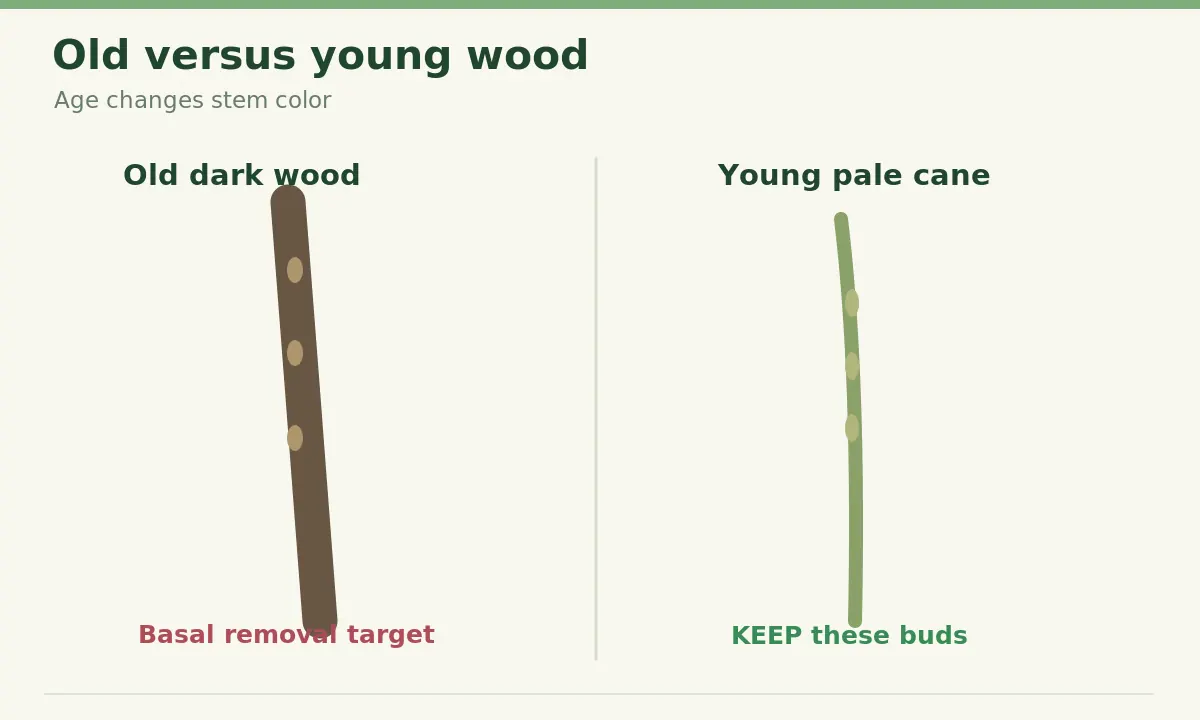
Recognize Thick, Dark Older Stems at the Base
Older blackcurrant stems tend to become darker, rougher, and thicker than the smooth pale or light-brown younger shoots. Trace a candidate stem from its upper branches to the crown before deciding to cut; several branches may join into one old basal stem. Observe any dead, damaged, crossing, or low-growing wood too. An old dark stem is a candidate for removal, but appearance alone is not a reason to clear every dark stem in one winter. The purpose is balanced renewal over successive years. Mark each chosen stem with a temporary tag so that cutting does not accidentally take a vigorous replacement shoot.
Remove Up to a Third of the Oldest Stems
The RHS guide advises taking up to one-third of the oldest stems each winter from established bushes, making room for new growth. This is a proportion of selected existing stems, not a command to remove one-third of all leafy tips at random. Stand back and choose old, unproductive, crowded basal stems distributed through the bush. A younger bush or one recovering from drought may need much lighter work. The exact number varies with branch count and vigor; do not force a fraction when only a few stems exist. The aim is a continuously replenished framework of productive young wood.
Make the Renewal Cut at the Stem Base
Use clean, sharp loppers or a pruning saw suitable for the wood diameter. Follow the chosen old stem to where it arises near ground level and cut it close to its base without gouging adjacent crown tissue or young shoots. Avoid leaving a long dead-looking stub that crowds the center. Support a heavy stem as the cut finishes to prevent tearing bark down a neighboring branch. Wear eye protection and gloves because old wood can whip back when released. The practical diagram marks a basal cut on a thick dark cane and highlights the lighter young cane that must stay.
Keep Strong Young Shoots and an Open Structure
Newer shoots are the next fruiting framework, so retain vigorous upright stems with sound buds. The RHS describes established blackcurrants as often having about six to ten upright stems, though growth form varies with cultivar and training. Remove weak, awkward or crossing pieces when appropriate, but resist thinning every lateral until the plant looks decorative. An open arrangement helps light and access while preserving enough productive wood. Do not top all stems to an even height as a substitute for renewal pruning. Cut selectively from the base and preserve healthy young replacement growth.

Treat New Plants and Weak Early Growth Differently
RHS recommends hard establishment pruning for newly planted dormant blackcurrants in suitable circumstances, but that approach is not the annual routine for an established fruiting bush. Young plants in their first three years may require light cleanup or specific corrective work depending on growth strength. Label your shrub age and training form before you begin. A standard-trained blackcurrant on a single trunk also needs different attention from a natural bush with several stems from ground level. If a plant was recently transplanted, frost damaged or heavily diseased, tailor removal to recovery rather than blindly applying the mature-bush schedule.
Distinguish Blackcurrants From Blueberries and Summer Raspberries
Blackcurrants, blueberries and raspberries all benefit from some form of cane or wood renewal, but their growth cycles and exact cuts differ. Raspberry floricanes may be completely removed after fruiting because of their two-year cane life, while blackcurrant stems can crop over several years and are replaced gradually. Blueberries have a distinct perennial crown and species-specific pruning balance. This article is confined to blackcurrants: find and remove selected dark old basal stems during dormancy, not every cane that fruited last summer. Avoid reusing a diagram from a different shrub just because the word cane appears in both instructions.
Clean Tools and Dispose of Suspect Wood Responsibly
After cutting, gather branch pieces away from the crown to reduce tangles and improve access. Keep clearly diseased or infested wood out of propagation supplies and follow local plant-disease disposal rules. Clean blades between suspect plants to reduce cross-contamination. If you observe unusually enlarged buds, severe shoot distortion, or dieback, obtain regionally relevant advice rather than assuming pruning alone will cure a pest or disease. Do not move infested material to another garden. Mulch and feeding are separate practices that should reflect soil condition; this renewal method does not require an invented universal fertilizer dose.

Review the Bush Shape Without Overpruning
Step back and count remaining young, middle-aged and old stems. There should still be a robust plant with open access and several younger shoots poised to replace harvested wood. If the bush now appears drastically hollow or has lost most healthy buds, too much was removed. Stop; do not try to correct this by shortening every remaining young stem. Take a photo and record the number of old stems removed, then adjust next winter’s selection based on vigor and crop quality. The annual rhythm is modest renewal, followed by patient observation, not one dramatic reshaping every year.
Related Guides
How We Research and Verify Plant Advice
Sources checked on 2026-10-26: rhs.org.uk; extension.oregonstate.edu. We reviewed each institution’s plant identification, correct growth stage and relevant cultural recommendations before adapting them into an independently written step-by-step guide. Where sources are region-specific, their calendar details are not applied universally. Pictures use simplified teaching shapes and should be compared with living specimens; they are not a substitute for laboratory disease diagnosis or local climate guidance. The relevant advice is paraphrased rather than reproduced.
Safety and Independent Editorial Disclosure
This independently prepared educational article does not claim sponsorship or affiliate approval. Our category reading links are informational, not product endorsements. See the VegWin affiliate disclosure. Clean sharp tools before cutting plants, protect hands from thorns and blades, and keep cut plant material away from children and pets where appropriate. Use only locally registered plant treatments labeled for the actual crop, and observe the product label. Do not rely on unsupervised home remedies or unverified harvest-safety promises.
During winter dormancy, after leaf fall and before vigorous spring growth, adjusted for local weather.
Choose some of the oldest, darkest and least productive basal stems, plus clearly damaged growth.
RHS suggests removing up to one-third of the oldest stems each winter in established bushes.
They fruit strongly on relatively young growth, so renewal encourages replacement productive stems.
No. Redcurrants rely more on fruiting spurs on older wood and need different pruning.