
Rhubarb has edible leaf stalks, but its large leaf blades should never go into a pie, smoothie, or animal feed. The plant also depends on a long-lived crown that can be weakened by careless pulling or by stripping every leaf. The safest harvest starts by identifying the stalk base and feeling how a mature outer petiole separates from its crown. Use a small outward tug and twist rather than sawing indiscriminately through the center. The right technique matters more than the redness of a stalk, because many healthy varieties are partly green. Here is a step-by-step field method with harvest limits and handling checks that protect both this year’s kitchen produce and next season’s rhubarb growth.
Identify the Edible Petiole and the Poisonous Leaf Blade
The thick red, pink, or green stalk is a petiole, the support that connects the leaf blade to the crown. It is this petiole that gardeners use as rhubarb. The broad leaf blade at the top is not edible: University of Minnesota Extension specifically warns that it is toxic. Look for the junction where the stalk meets the expanded blade before bringing any harvest indoors. Never confuse the leaf blade with chard or another edible leafy green. Young leaves are not a safe exception. The diagram separates three landmarks—the broad leaf, edible petiole, and permanent crown—so the removal point is clear.
Wait for an Established, Vigorous Crown
University of Minnesota advises postponing the normal harvest until the second growing season after planting, or the third when plants were started from seed. That waiting period allows a young root system to accumulate resources. Check vigor rather than assuming that a stalk appearing in a newly planted division means the plant is ready for repeated removal. An established clump has multiple substantial leaves and a firm center. If winter injury, rot, or serious drought has reduced growth, take less or none that season. Do not turn a transplant-year rhubarb plant into a full kitchen crop simply because a few stalks are long.

Judge Stalk Maturity by Length and Firmness, Not Red Color
Harvest stalks when they have reached the characteristic full length for the variety and are firm. Rhubarb petioles may be green, red, or mottled without that color alone signifying maturity. University of Georgia’s harvest reference describes useful stalks at approximately 8 to 15 inches, but some named varieties naturally grow longer, as Minnesota notes. Check the plant label if known. Very thin young stalks leave the crown with little food-producing surface; old very fibrous stalks are less pleasant to cook. Evaluate several outer petioles, not one unusually shaded stalk, before choosing what to pull.
Grip Close to the Base and Pull Outward with a Small Twist
Select an outer petiole; hold it firmly near where it meets the crown. Apply gentle outward pressure while twisting or rocking the petiole at its natural attachment. It should release with a small pale heel at the base. Do not yank the whole clump upward, and do not push a knife into the crown. Minnesota Extension specifically recommends a firm pull and twist and discourages cutting stalks from the plant. If the stalk resists, choose another mature one or try the motion more gradually. Support the adjacent petioles with your free hand and keep your footing secure on damp soil.
Protect the Central Growing Area and Keep Remaining Leaves
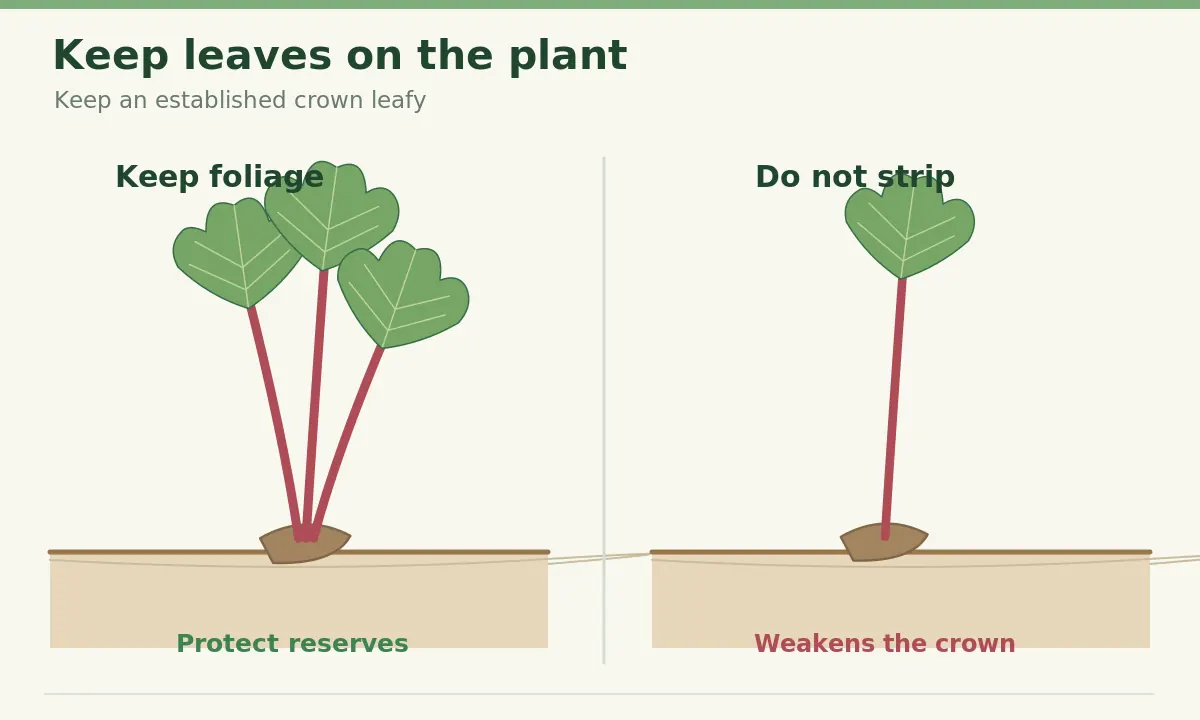
The crown contains growing points that form future leaves and flower stalks. Work from the outside rather than levering a crowded petiole against the young center. The goal is to remove individual stalks without gouging the underground crown or uprooting surrounding shoots. A mature plant needs a substantial leafy canopy after harvest; never strip it bare for the sake of a single large dessert. For declining, newly established, or drought-stressed plants, harvesting fewer petioles is a sensible adjustment. Avoid snapping off newly emerging leaves to make room for your hands. Healthy retained leaves drive photosynthesis and refill underground reserves.
Trim Off the Leaf Blade Immediately and Dispose of It Safely
Once a stalk has been pulled, use a clean kitchen-safe knife to cut away the large leaf blade, making sure no leaf tissue remains in produce meant for people. The petiole is the edible part, but rhubarb leaves are toxic; do not taste them, turn them into pesto, or offer them to livestock or pets. Minnesota Extension recommends trimming leaves immediately because intact leaves accelerate stalk wilting. Keep discarded leaves separate from cut produce, and wash your hands and tools after handling garden material. Store harvested petioles in the refrigerator promptly instead of leaving them warm in the sun.

Know When to End the Main Harvest Season
In a northern temperate climate such as Minnesota, the principal rhubarb harvest commonly ends around late June, after which the remaining foliage is left intact to restore reserves. Other regions have different growing conditions, so a date should not replace observation of growth and heat stress. Extension guidance notes that the plant does not suddenly become entirely poisonous after this date—a few later petioles are not automatically toxic—but they may be tougher. The more important limit is conserving enough healthy leaf area and avoiding continuous stripping. Establish a seasonal stopping rule appropriate to your local Extension and plant vigor.
Distinguish Flower Stalks from Harvestable Leaf Petioles
Flower stalks emerge more upright and carry buds or flower clusters rather than the familiar broad edible leaf blade. If a seed stalk forms, Minnesota Extension advises cutting it off to limit energy diverted into seed. This flower-stalk removal is distinct from harvesting edible leaf petioles: it is appropriate to use clean snips on the flower stalk, even though leaf petioles are normally twist-pulled. Identify the structure before cutting. Do not put a fibrous flowering stem into the food bowl with harvestable rhubarb, and do not remove the leafy crown accidentally while searching for flowers.
Check Each Petiole, Then Refrigerate or Freeze Promptly
Inspect every stalk for decay, obvious pest tunneling, mold, or physical damage. Discard spoiled tissue rather than relying on cooking to fix rot. Remove any remaining leaf blade, rinse the usable stalk under clean running water, trim tough ends, and refrigerate promptly. For longer storage, follow a safe freezing guide after trimming and preparing rhubarb. Stalk acidity and skin color can vary considerably, so flavor should not be predicted only from red pigmentation. Document how much you picked and whether the plant retained abundant leaves; that simple habit prevents an enthusiastic first harvest from diminishing next year’s production.
Run a Final Safety Check Before Bringing Rhubarb Indoors
Ask four questions at the bed: Is this an established plant? Is the chosen outer stalk firm and mature? Did it separate without crown damage? Was the entire toxic leaf blade removed from the food harvest? An affirmative answer to each is more reliable than harvesting every red stalk in sight. Keep pets and children away from discarded leaves, and remember that rhubarb is different from Swiss chard even though both have impressive petioles. Where local climate changes the harvest window, use local Extension guidance rather than a national calendar. Leave a lush crown to feed future harvests.
Related Guides
- How to Harvest Rhubarb Stalks Safely and Keep Plants Productive
- When to Divide Rhubarb Crowns: Keep Buds and Strong Roots
- How to Germinate Rhubarb Seeds in Modules and Grow Healthy Crowns
How We Research and Verify Plant Advice
Sources checked on 2026-10-26: extension.umn.edu; extension.uga.edu. We reviewed each institution’s plant identification, correct growth stage and relevant cultural recommendations before adapting them into an independently written step-by-step guide. Where sources are region-specific, their calendar details are not applied universally. Pictures use simplified teaching shapes and should be compared with living specimens; they are not a substitute for laboratory disease diagnosis or local climate guidance. The relevant advice is paraphrased rather than reproduced.
Safety and Independent Editorial Disclosure
This independently prepared educational article does not claim sponsorship or affiliate approval. Our category reading links are informational, not product endorsements. See the VegWin affiliate disclosure. Clean sharp tools before cutting plants, protect hands from thorns and blades, and keep cut plant material away from children and pets where appropriate. Use only locally registered plant treatments labeled for the actual crop, and observe the product label. Do not rely on unsupervised home remedies or unverified harvest-safety promises.
No. Rhubarb leaf blades are toxic and must not be eaten; use only properly identified petioles.
For ordinary petiole harvest, grasp near the base, pull outward and twist gently rather than cutting into the crown.
No. Mature stalk color is strongly affected by variety; evaluate length, firmness and plant vigor.
Avoid regular harvest in the establishment year; wait until the second season, or longer for seed-grown plants.
No. The seasonal stopping point protects plant reserves, and stalks may become tougher; leaves remain toxic at every stage.