
A flowering crabapple needs far less correction than many gardeners assume. Its flowers, small fruit, and branch structure make the tree attractive for much of the year, and indiscriminate shearing can remove both beauty and useful wood. For routine work, the clearest pruning window is usually late winter or very early spring before leaves expand. This guide helps you decide which branches really need attention, make the correct cut just outside the branch collar, and avoid turning a naturally shaped tree into a topped trunk. It also separates ordinary pruning from suspected fire blight, which may require different sanitation decisions and local professional guidance.
Check the Tree's Age and Health Before Cutting
First identify the plant as an ornamental Malus, not a decorative cherry, pear, or other flowering tree. Look for spring flowers and small applelike fruits, but use a nursery label or reliable identification when uncertain. A newly planted crabapple may need only corrective care while roots establish. University of Maine Extension advises restraint for a tree in its first growing year, especially if it has struggled. Walk around the tree and observe its overall architecture before reaching for tools. Mark any dead, rubbing, broken, or inward-crossing branches. If there are only a few, a limited treatment may be enough. Do not impose a rigid round silhouette on a naturally spreading or weeping cultivar without understanding its growth habit. If you are starting from scratch, read When to Prune Rose of Sharon for Summer Blooms Without Topping the Shrub.
Use Dormant-Season Timing for Routine Pruning
Maine Extension recommends very late winter or early spring while ornamental crabapples are dormant. At this time the leafless canopy shows crossing wood clearly, and pruning is less likely to stimulate poorly timed growth than a heavy late-summer cut. The exact month depends on local temperature patterns: do not assume March works equally well from Florida to Minnesota. Avoid working through severe cold snaps when brittle wood and winter damage are concerns. Disease emergencies differ from normal calendar maintenance. If you have no urgent structural defect, waiting for a suitable dormant day usually produces cleaner planning. A small broken branch may be removed when safety requires it, but a major redesign is not a routine emergency. If you are starting from scratch, read When to Prune Fig Trees Without Losing the Early Breba Crop.
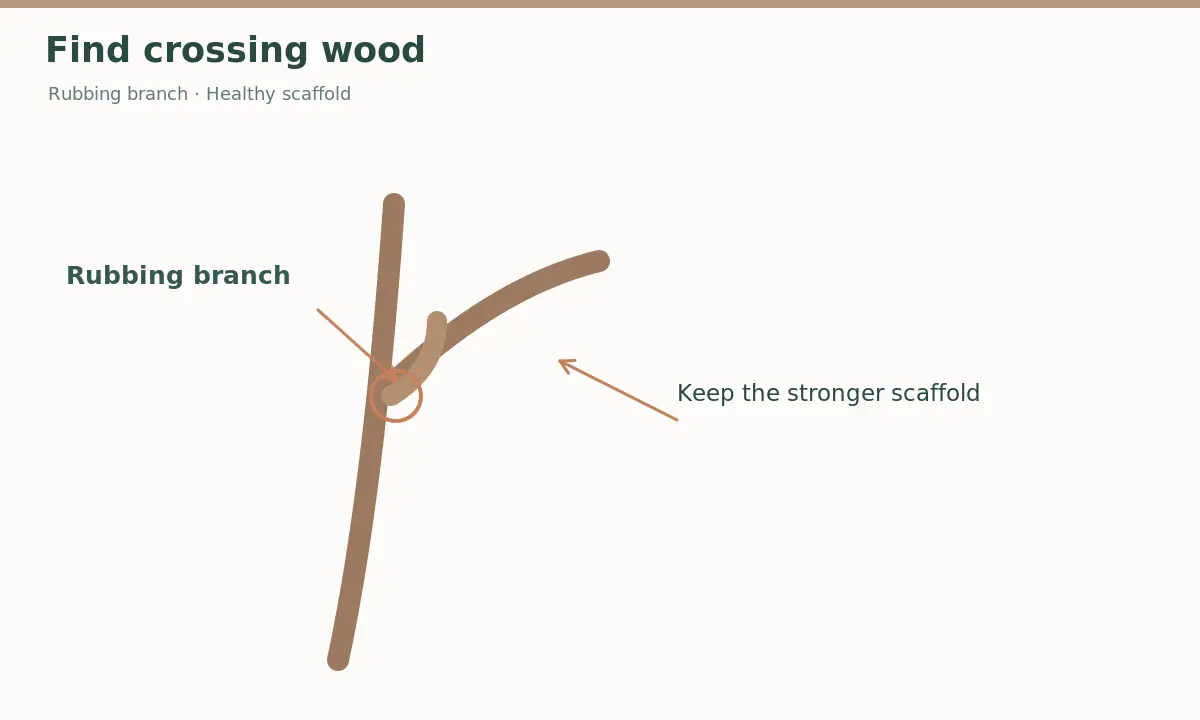
Prioritize Dead, Broken, and Rubbing Branches
Remove clearly dead or broken wood and identify limbs whose bark is actively rubbing against one another. Rubbing creates wounds and compromises structure; keep the better-positioned branch and remove the competing one when appropriate. A vertical shoot growing straight through the center may also justify selective thinning, especially when it crowds a major scaffold. However, healthy upright young shoots are not all defects; overremoving them can trigger vigorous replacement growth. Look from multiple directions before choosing. Maine Extension’s crabapple guidance favors limited removal of damaged, crossing, and basal sucker growth instead of an annual major makeover. For a large or mature tree, a certified arborist can assess load-bearing limbs and hidden cracks safely. For the basics, see our guide: When to Prune a Plum Tree.
Locate the Branch Collar Before Making a Cut
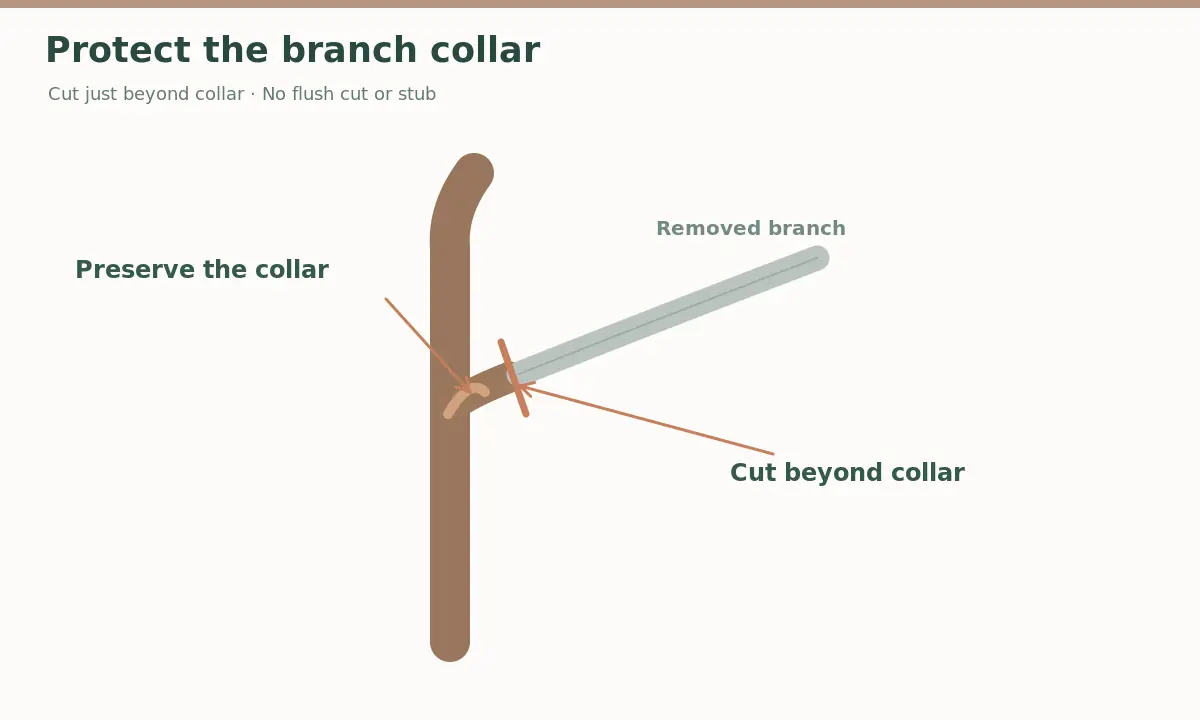
A branch collar is the slight swelling or ridge of tissue where a branch meets its parent limb. Above it lies the bark ridge in the crotch. Maine Extension explains that both structures help a tree compartmentalize pruning wounds. Remove a branch just beyond the collar, without cutting flush into the trunk and without leaving a long dead stub. On a small twig, clean sharp bypass pruners can make the cut. For a heavy limb, remove most of the weight first with staged cuts, then make the final cut at the collar; do not let bark tear down the trunk. Never draw a straight-line cut through the swollen collar simply because it looks tidy in a diagram. For the basics, see our guide: When to Prune a Magnolia.
Use a Thinning Cut Instead of Topping
Thinning removes a selected branch at its point of origin, opening the canopy without shortening every tip to the same height. A heading cut shortens a shoot and stimulates growth below the cut. Both exist in pruning practice, but repeated heading across the top of a crabapple creates dense upright shoots and damages its natural shape. If you want a flowering tree, make only the reductions needed for safe clearances and healthy structure. Avoid chainsaw topping, which produces large wounds, weakly attached regrowth, and an unattractive canopy. If a tree has outgrown a narrow site, consider professional reduction pruning or a longer-term replacement plan instead of trying to keep it miniature through brutal annual cutting.
| Situation | Useful action | Avoid |
|---|---|---|
| Dead or rubbing branch | Thin at branch collar | Cut flush into trunk |
| Healthy flowering wood | Preserve natural branch architecture | Top all branches evenly |
| Black hooked shoots | Seek disease identification and sanitation | Treat as routine shaping |
Respect the Flower and Fruit Display
Crabapples flower on buds that formed in the previous growth cycle, so heavy pre-bloom removal can reduce the spring show. Cutting fruit-bearing twigs also reduces the small apples that feed wildlife and ornament the tree through cooler months. Some dead twig removal may be necessary, but distinguish cosmetic pruning from a genuine hazard. If you value persistent fruit, inspect branches before eliminating them just because they are messy-looking. Maine’s wildlife-focused apple guidance notes that crabapples generally need less attention than productive orchard apples. Avoid promising a specific blossom count after pruning, since cultivar, previous season, drought, and winter injury also affect bloom. Preserve balanced, healthy branches whenever possible.
Recognize Possible Fire Blight Before Routine Work
If twigs have blackened, wilted ends that curl into a shepherd’s crook, dead leaves remain attached, or branch cankers appear, consider fire blight among possible causes. Penn State Extension identifies these symptoms in crabapples, but other disorders can resemble them. Do not casually drag contaminated pruners from suspicious wood to healthy branches. Management of an actively affected tree requires precise diagnosis and sanitation, and Extension guidance may differ on how far to cut beyond infected tissue, depending on season and conditions. Record symptoms and consult local Extension or an arborist before major removal. Do not apply an unregistered home pesticide or assume the tree needs all infected-looking foliage stripped. This is distinct from ordinary dormant shaping.
Use Sharp Tools and Avoid Unnecessary Wound Treatments
For healthy small twigs, sharpened bypass pruners give cleaner cuts than dull blades that crush bark. Loppers and saws should match the branch diameter; if leverage feels unsafe, stop and use proper equipment or a professional. Clean tools routinely and disinfect between suspect disease cuts using locally recommended procedures. Wear eye protection, avoid standing below loaded branches, and keep ladders away from power lines. Most clean pruning wounds do not need paint or household sealants. Maine’s tree pruning advice says trees naturally compartmentalize wounds; sealing is not a replacement for a correct cut. Never climb a tree with a running chainsaw or attempt large scaffold removal without training and equipment. If you are starting from scratch, read When to Prune Pear Trees.
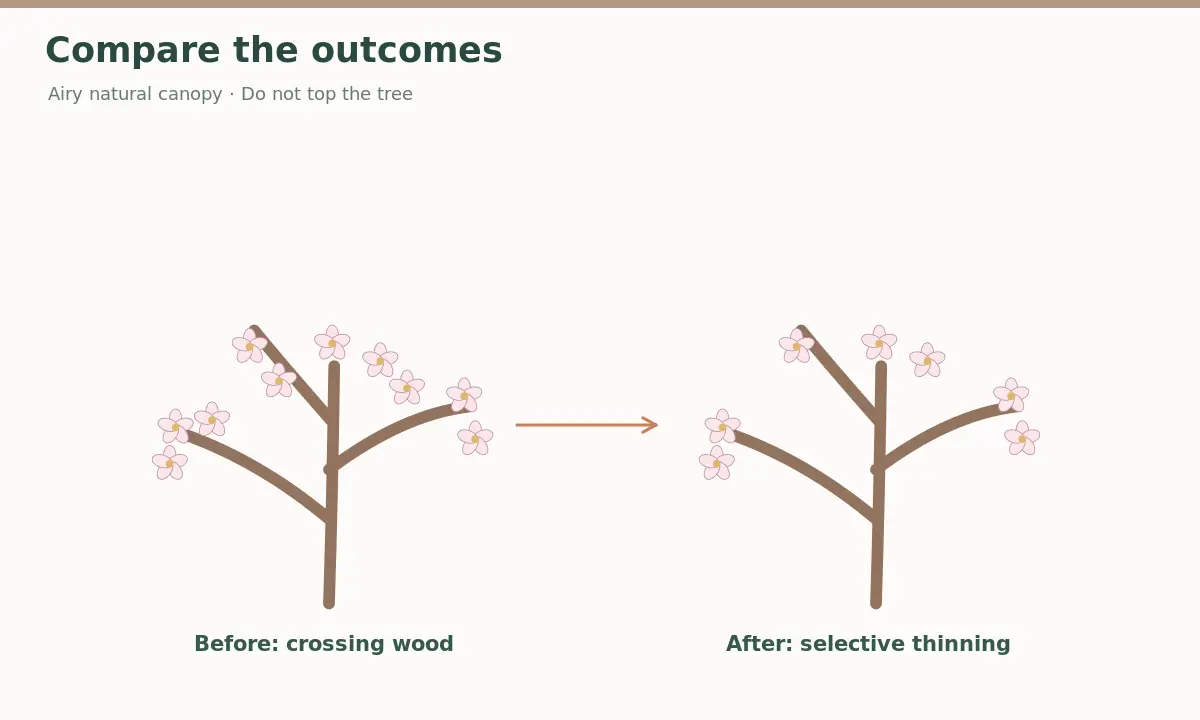
Thin a Little, Then Step Back and Reassess
Begin with the branch whose removal is most clearly justified. Step back across the lawn and study the silhouette before removing the next one. This prevents the common spiral where one cut creates an asymmetry that leads to ten more cuts. A compact crabapple with balanced scaffolds, filtered interior light, and sound limbs is a better outcome than one with a wide empty trunk and tufts of vigorous sprouts. Spread substantial renovations across years rather than removing a large portion of canopy all at once. Maine Extension suggests crabapples often need only limited pruning. If the tree is near a roof or driveway, consider a site-specific clearance plan with an arborist rather than making cuts that compromise structural support. For the basics, see our guide: When to Prune a Mulberry Tree and Why Fewer Cuts Are Better.
Monitor Regrowth and Disease Without Overreacting
After pruning, observe how spring leaves and shoots develop. A little upright growth is normal; many fast vertical shoots can reflect overly vigorous previous cutting. Monitor for fresh injury, water stress, and signs of fire blight or other disease, especially where the tree has a known history. Pruning does not cure all diseases or replace disease-resistant cultivar selection, good root-zone care, and sanitation. Continue to avoid late-season heavy heading, which can encourage poorly hardened shoots. Photograph the same branch unions each year to see whether a structural problem is actually improving. If a large wound develops decay or a limb becomes unstable, arrange a professional inspection instead of improvising another hard cut.
How We Research and Verify These Steps
Sources were opened and cross-checked on 2026-10-24: extension.umaine.edu — Maine Extension specifies dormant late-winter to early-spring timing for crabapples; extension.umaine.edu — Maine Extension explains branch collar and bark ridge protection during pruning; extension.umaine.edu — Maine Extension emphasizes limited pruning for ornamental crabapples and retaining natural structure; extension.psu.edu — Penn State Extension distinguishes fire blight symptoms and diseased-wood removal; extension.umaine.edu — Maine Extension advises caution for newly planted ornamentals and isolated crossing limbs. We compared seasonal advice, exact plant anatomy, growing methods, and differing regional conditions, and used those findings in the accompanying illustrations. Botanical drawings are explanatory, not to scale. Your local Cooperative Extension and specific cultivar or seed-packet instructions take priority when conditions differ.
Disclosures, Safety, and Regional Differences
These are educational gardening guidelines, not personalized agricultural or medical advice. No sponsorship or partnership is claimed. Read VegWin’s affiliate disclosure. Follow all local plant, food safety, and pesticide regulations and current product labels. USDA hardiness zones describe winter minimum temperatures rather than exact sowing dates. The diagrams are simplified to emphasize the relevant plant structures.
Usually very late winter or early spring while dormant, adjusted to local weather and before leaf expansion.
Use restraint; newly planted trees often benefit from establishment time unless a broken or rubbing branch needs attention.
Just outside the branch collar without cutting flush into the parent limb or leaving a long stub.
Heavy removal of bud-bearing wood can reduce the spring flower and later fruit display.
Possible fire blight warrants proper identification and local sanitation advice rather than routine shaping alone.