
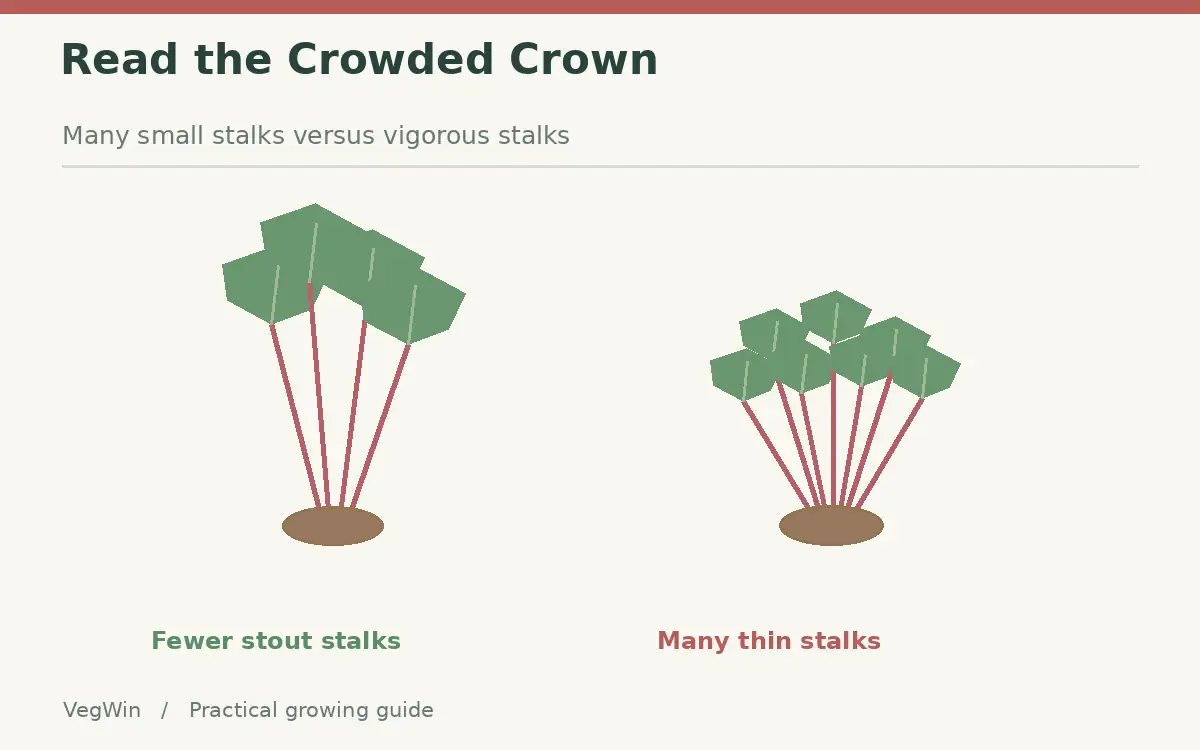
Rhubarb can occupy the same bed for years, but a very old crown sometimes starts producing a crowd of thin stalks where it once made a smaller number of stout ones. That does not mean the plant needs more fertilizer or a deeper hole. The crown may be crowded enough to divide—if you act during dormancy and each resulting piece retains both a living bud and useful roots.
Oregon State Extension describes a change toward many smaller stalks as a useful signal for division, often after five or six years. Iowa State Extension recommends early spring while plants are dormant and the ground is workable. Use those principles to decide whether you should divide at all, and to avoid turning one healthy large plant into several weak fragments.
Decide whether the clump actually needs dividing
Count the general pattern of stalks over the past season, not a single spindly leaf on a dry day. Oregon State Extension notes that a clump producing roughly 25–30 smaller stalks rather than 12–18 larger stalks may be due for division. Those figures are observations, not a strict test every variety must pass. Compare stalk size, crown crowding, and the plant’s age.
A younger rhubarb with strong upright stalks generally benefits from being left alone. Small stalks may also result from shade, drought, poor nutrition or recent harvesting. Inspect those causes before digging. Dividing merely because the plant seems large can interrupt a perfectly productive clump.
Use dormancy and soil workability for timing
In cold climates, early spring before new shoots elongate is usually the simplest opportunity: the plant is dormant, buds are visible and soil can be worked without making sticky clods. Iowa State calls early spring the best time. South Dakota Extension also allows late fall while the plant is dormant in suitable conditions.
Fall division needs enough time for roots to settle before persistent freeze, but not conditions that force a flush of tender growth. Do not divide an actively growing plant during summer heat merely because it is convenient. Regional dates vary: look for dormant buds, workable soil and an appropriate local forecast rather than using USDA zones as a calendar.
Find crown buds before reaching for a spade
Rhubarb regrows from a fleshy crown with swollen growing points near the surface and thick roots descending below. The most important part of a division is a healthy bud connected to sufficient living root tissue. A root fragment without a growing bud may not make a reliable new plant; a bud with hardly any roots may struggle to establish.
Brush loose soil gently so the buds can be seen. Healthy crowns are firm, not slimy or foul smelling. If rotten or diseased portions are visible, do not blindly distribute them around the garden. Clean tools between suspect material and healthy pieces, and seek local diagnosis for unusual crown deterioration.
Lift the clump without shredding every large root
Loosen soil in a broad circle beyond the crown. A garden fork can lift around the edges with less cutting than immediately driving a sharp spade through the center, although thick old roots may still break. Work deliberately and keep the bud-bearing top upright so you can identify orientation after lifting.
Shake or brush off enough soil to see the divisions, but avoid leaving the exposed roots in wind and sun. Prepare replanting holes before lifting the parent if possible. If a crown is too heavy to manage safely, divide it in place with an appropriate spade rather than straining to lift an entire large root mass.

Cut pieces with buds and substantial roots attached
Iowa State advises each piece to have two or three buds or shoots and a substantial piece of root system; Oregon State identifies at least one strong bud as a baseline for viable sections. For a home-garden transplant, aiming for several healthy buds on a robust rooted portion is a conservative choice. Use a clean sharp knife or spade to split between natural crown divisions.
Avoid splitting a crown into the maximum number of tiny pieces just to give away more plants. A very woody, decayed center may be discarded while healthy outer pieces are retained. Label the sections if they came from different cultivars. Keep the root surfaces shaded and replant as soon as the bed is ready.
Replant at the former crown depth
Set rooted pieces with buds upward in fertile, well-drained soil. Iowa State specifically recommends placing divisions at the same depth as the original crown. This is more useful than an arbitrary extra-deep burial of the growing points. Firm soil gently to remove large air gaps and water thoroughly so the soil settles around the roots.
Rhubarb is a long-lived perennial, so allow future spreading space and avoid a site where rain stands for days. Mulch around the plant for moisture retention if needed, but keep thick wet organic matter off the crown. Good drainage and stable moisture support establishment more effectively than a heavy immediate fertilizer dose without a soil test. If you want the full process, read how to harvest rhubarb stalks without weakening the crown.

Protect the recovery year instead of taking a full harvest
A newly divided crown spends energy making roots and leaves. Treat it much like a young planting: let the foliage develop so the root system can regain reserves. Harvest restraint after division is especially important if the pieces were small or spring was dry. Observe the plant’s vigor rather than demanding the same crop from a just-divided crown as an old established one.
Rhubarb leaves are not edible because they contain toxic oxalates; keep discarded leaf blades away from food preparation and do not offer them as greens. Use only edible stalks from healthy, adequately established plants following regional Extension guidance. Flower stalks can be removed as appropriate so the plant continues vegetative growth. If you want the full process, read how to harvest rhubarb stalks safely and keep plants productive.
| What you observe | Best next step |
|---|---|
| Old crown with many thin stalks | Check for crowding and consider dormant division. |
| Young vigorous crown with strong stalks | Leave it alone; division is unnecessary. |
| Piece with firm buds and ample roots | Suitable candidate for immediate replanting. |
| Loose root without a visible growing bud | Do not assume it will become a new plant. |
| Recently divided crown growing leaves | Prioritize establishment over heavy harvesting. |
Track the clump for several seasons
Document the division date, number of buds left on each piece, planting depth and watering conditions. Count healthy stems over the following seasons, rather than drawing a conclusion from the first few spring leaves. If some sections lag, compare drainage, sun exposure, and root-zone moisture before resorting to repeated feeding.
A successful rhubarb renovation creates fewer but stronger clumps with room to expand. If one division fails, do not immediately dig all the others up. Let established crowns recover, and consider a fresh rooted transplant next dormant season if a gap truly needs replacement.
Related Guides
- How to Germinate Rhubarb Seeds in Modules and Grow Healthy Crowns
- How to Pull Rhubarb Stalks Without Injuring the Crown or Eating Leaves
How We Research This Gardening Advice
Research checked on October 23, 2026. We consulted the named university Cooperative Extension and/or Royal Horticultural Society materials and compared the recommended growing decisions. Numerical recommendations and seasonal windows are regional examples where noted, not guaranteed dates for every garden. The botanical sketches simplify plant structure rather than depicting a particular cultivar to scale.
Sources consulted: extension.oregonstate.edu; yardandgarden.extension.iastate.edu; extension.sdstate.edu. Where advice differs by local climate or plant variety, follow your local Extension office or the specific plant label.
Editorial disclosure: These instructions are educational and contain no claim of paid endorsement or verified partner recommendations. For site-wide information, see our affiliate disclosure.
Use early spring while the crown is dormant and soil is workable; late fall can also work where local conditions allow.
Aim for two or three strong buds with substantial healthy roots when possible; at least one healthy bud is essential.
Replant at about its previous growing depth; do not bury the buds arbitrarily deep.
It is safer to let divided crowns rebuild foliage and root reserves rather than taking a full harvest immediately.
No. Rhubarb leaf blades are toxic and must not be used as edible greens.