
Lupines have impressive flower spikes, but their seed-starting reputation can feel contradictory. One guide tells you to rub the seed coat with sandpaper, another recommends a soak, and a packet for a different species gives neither instruction. Those differences matter because ‘lupine’ describes a large genus, not one uniform garden plant. A seed technique that helps a hard-coated seed absorb water can damage one that is already permeable or has begun to swell.
The safest starting point is to identify the species or seed mix and read its supplier’s instructions. The University of Washington’s Miller Library describes scarification as a technique for hard-coated lupine seeds; North Carolina State Extension emphasizes species and regional differences in heat tolerance and growth. Once the seed germinates, the next challenge is preserving its quickly developing root system. This article connects the seed, growing site and transplant decision into one practical sequence.
Identify the lupine species and local suitability
Common garden labels include Russell hybrid lupines, native regional species and mixes sold simply as Lupinus. They do not all behave alike. Some prefer cool summers and struggle in humid heat; some are short-lived perennials, while others behave as annuals under difficult conditions. Check the botanical name on the packet, the local Extension planting information, and whether the species is suitable or potentially problematic outside its native range.
Do not introduce an ornamental lupine into a natural area without checking regional invasive-species guidance. Native restoration projects may require local-ecotype seed, not a bright garden hybrid. Lupine seeds also contain alkaloids and should not be treated as edible beans: store packets away from children and pets. Seed selection is not a decorative detail; it determines the later advice on sowing season, long-term survival and safety.
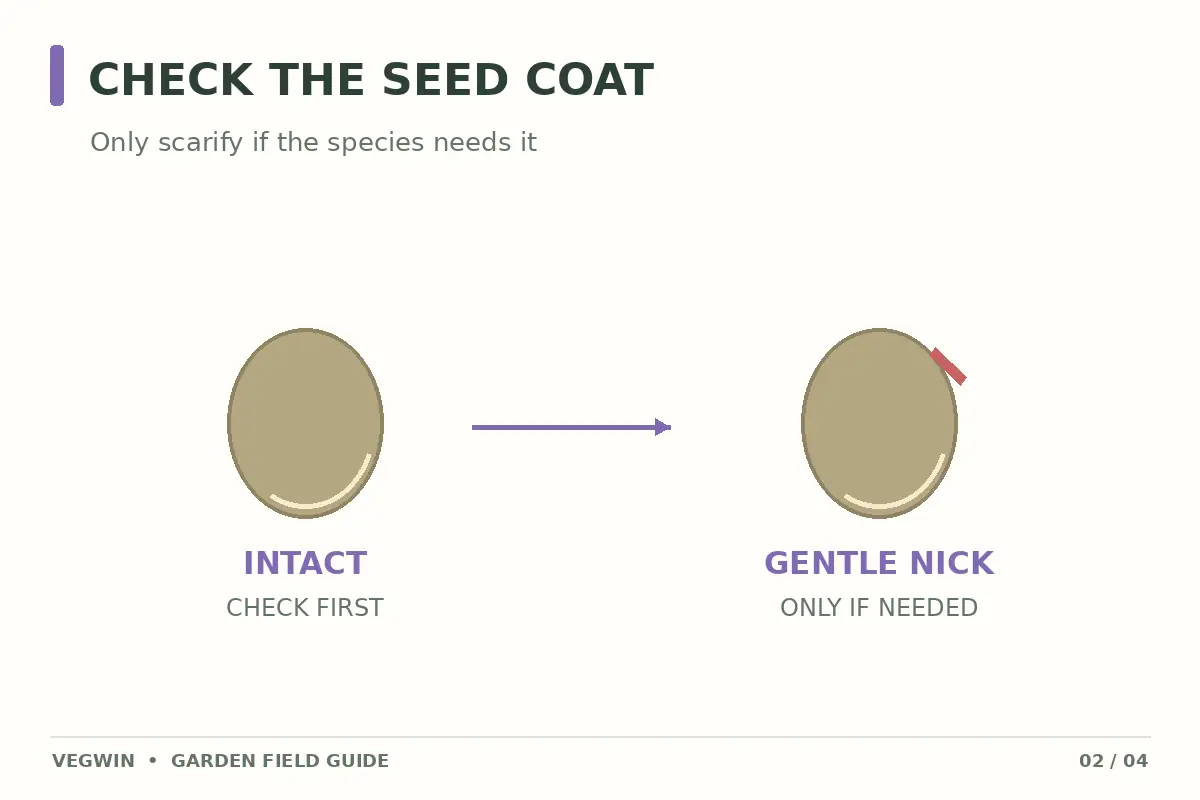
Decide whether the seed needs scarification
Some lupine seeds have a hard outer coat that delays water entry. Scarification creates a small weak point in that coat; carefully nicking or gently abrading it can help hydration. The University of Washington Miller Library cites this approach for lupines. However, do not aggressively sand every seed by default.
When scarification is recommended, work on a tiny area away from the visible embryo, using gentle pressure rather than cutting deep into the seed. A short soak may be part of a supplier’s protocol, but standing water for days invites decay. Label a small trial of treated and untreated seed if you are uncertain. Compare whether both groups swell and germinate; resist rewriting the whole packet’s instructions from a single general article.
Choose outdoor sowing or early individual pots
Many lupines tolerate cool conditions, and some species are commonly sown in fall while others are started in spring. Choose timing from your species guidance and local weather rather than the USDA hardiness zone alone. A frost-tolerant lupine seedling still needs a suitable seedbed and drainage. Mark the planting area so that small germinating plants are not mistaken for weeds during slow early growth.
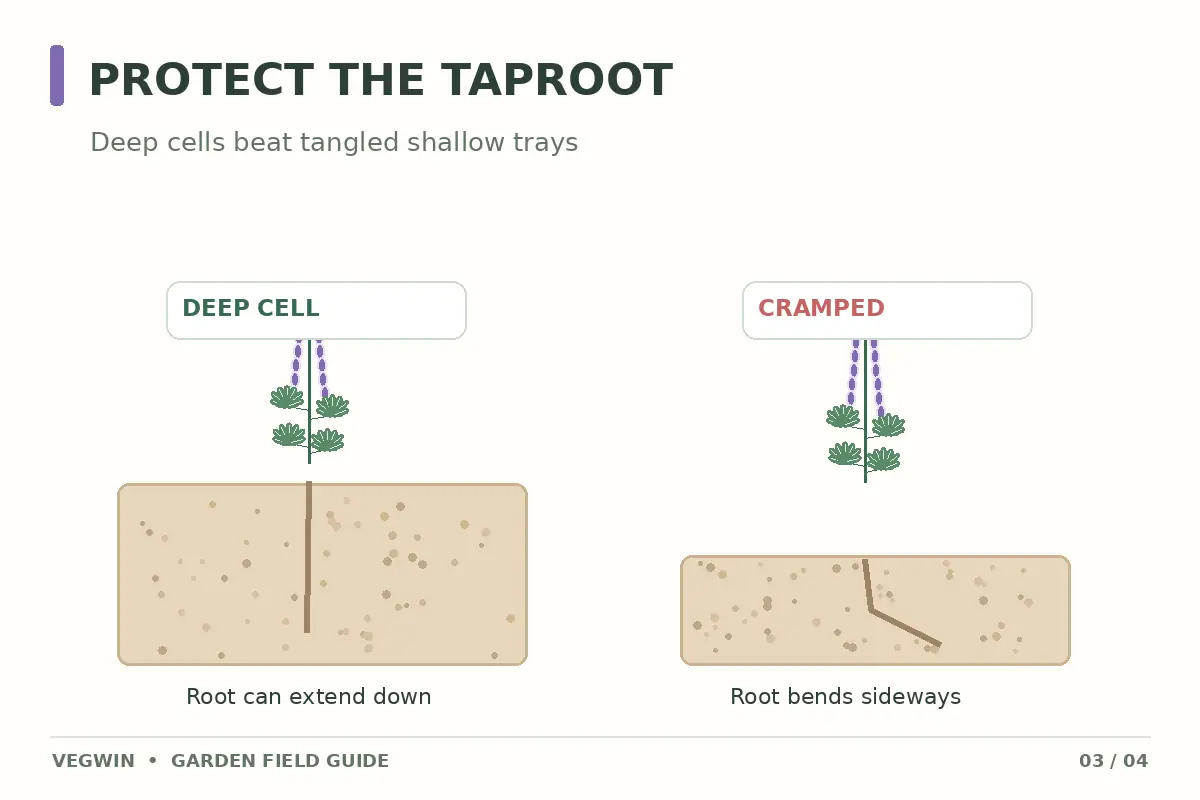
Direct sowing avoids the transplant disturbance that can injure a growing taproot. If animals, heavy rain or competition make direct sowing impractical, choose individual deep cells or pots with sufficient room for initial root growth. Begin with a clean, free-draining seed-starting medium. Do not start dozens of plants in a shallow shared tray and plan to pull them apart once roots have tangled. What looks like convenient indoor sowing can become a difficult root-separation job.
Maintain seedbed moisture without waterlogging
Moisten the medium thoroughly before planting, then follow the seed packet for depth and light requirements. Firm soil gently around seeds; a loose, fluffy pocket can dry out just where germination is starting. During establishment, check moisture under the surface instead of watering on autopilot. A wet, airless medium can rot both seeds and newly emerged roots, even though the uppermost layer sometimes looks dry.
Outdoor sowings may need protection from heavy rain or birds, but avoid a sealed cover that overheats as the weather changes. Thin seedlings by snipping extras at soil level rather than pulling their roots through neighboring plants. Use fresh, labeled seed and record when each batch was planted. Germination time varies with species, treatment and temperature; don’t discard a cool seedbed merely because it is slower than an indoor vegetable tray.
Transplant before the taproot becomes distorted
The first root is often much longer than the small top growth suggests. When a pot is nearly full of young roots, moving the seedling becomes more risky, not less. If you must transplant, do so while the root ball can remain intact, usually when the plant is still small and actively growing. Water the container beforehand so the medium holds together, but do not soak the roots into mud.
Prepare the destination before lifting the plant. Make a planting hole deep enough that the young root can extend down naturally, with no curling or folding, and set the crown at the same level as before. Handle by the root ball and a leaf rather than pinching the stem. Backfill gently and check settling after watering. Do not repeatedly dig up the seedling to see whether the root is growing; watch the leaves and new growth instead.
Give established lupines the conditions they need
Choose a site with light and drainage appropriate to the selected lupine. Many garden varieties flower best in sun with cool roots, while some species tolerate partial shade in hot regions. Pooling water around the crown is a warning. Mulch can buffer the surface, but keep it away from the plant’s center so the crown is not buried under constantly wet material.
Lupines are legumes, but that does not mean a new planting automatically supplies its entire fertility requirement or improves every neighboring crop. Avoid heavy nitrogen fertilizer without a reason; focus on suitable soil, moisture and species fit. Slugs, aphids and mildew can be issues, so identify the actual cause of damage before applying any treatment. In climates poorly suited to the plant, annual performance may be more realistic than a permanent perennial clump.

Troubleshoot failures before starting again
If no seedlings emerge, first consider seed age, hard seed coat treatment, drying, temperature and birds. A handful of excavated seeds can sometimes show whether they are still firm, swollen or rotted, but do not excavate an entire row. If germination succeeds yet seedlings collapse, inspect moisture, circulation and the medium before concluding that more fertilizer is needed. Disease and unsuitable growing conditions may look similar in early stages.
If plants grow but never flower, check their age, seasonal exposure, light and whether the species is adapted to your summer heat. Some lupines flower in a later season after establishment, while annual types may perform differently. Retain the original packet and record which method worked at your site. That local record is more transferable to next year’s sowing than the claim that all lupine seeds must receive exactly the same soak or chilling period. Our walkthrough on how to start lupines from seed without damaging their young taproots sets out each step.
A practical decision table for your next step
| Decision | Better starting choice | Why it matters |
|---|---|---|
| Unknown lupine species | Identify species or supplier mix | Cold tolerance and seed treatment differ |
| Hard, water-resistant seed | Use packet-directed gentle scarification | Avoid embryo damage |
| Fragile young taproot | Direct sow or start in individual deep cells | Less root disturbance |
| Warm, wet summer location | Check local adaptation and drainage | Plant survival varies by species |
How We Research and Verify This Guidance
This article was prepared from the university Extension and university-library materials identified below, checked October 22, 2026. That is a title- and intent-level overlap review, not a complete comparison against the full text of every published post. The original WebP illustrations are simplified teaching diagrams, not photographs or exact botanical measurements. Always apply local Extension guidance and the named species or cultivar before making climate-sensitive decisions. No paid affiliate relationship is verified for this article; read our affiliate disclosure.
University research references, checked October 22, 2026: depts.washington.edu — University of Washington library guidance on hard-coated lupine seeds and scarification.. plants.ces.ncsu.edu — Species diversity, regional growing conditions and seed toxicity.. ask.extension.org — Extension advice on sowing seasons, drainage and delicate young taproots..
No. It is useful for some hard-coated seeds, but follow species and supplier instructions rather than damaging all seed.
Chilling requirements vary by species and seed lot; do not substitute one universal stratification schedule for a specific packet.
Yes, but individual, sufficiently deep cells and early careful transplanting reduce the risk of tangled taproots.
No. Ornamental lupine seeds may contain toxic alkaloids and should not be confused with properly processed edible lupin products.
Check species fit, heat, humidity, drainage and watering before assuming the seeds were bad.