
Edging lobelia (Lobelia erinus) produces fine stems and small two-lipped blue, violet, white or pink flowers, but its seedlings are especially easy to damage during pricking out. The practical answer is to wait until true leaves appear, loosen a tiny root ball, hold a leaf rather than the stem, and replant at the same soil level. This guide concerns L. erinus, not the upright native perennial cardinal flower.
Check the species before moving small seedlings
This article is about Lobelia erinus, often sold as edging or trailing lobelia, not Lobelia cardinalis or other unrelated lobelias. NC State describes a low, delicate plant, with spreading or mounding forms and showy two-lipped flowers in a range of colors. A typical seedling does not show its final flower shape immediately. Keep the pot labeled while it develops; mixing multiple batches makes it hard to know which compact plant belongs in a hanging basket versus a border. NC State also notes that the species has poisonous characteristics, so keep seed trays and plant scraps away from pets and small children.
Recognize cotyledons and the first true leaves
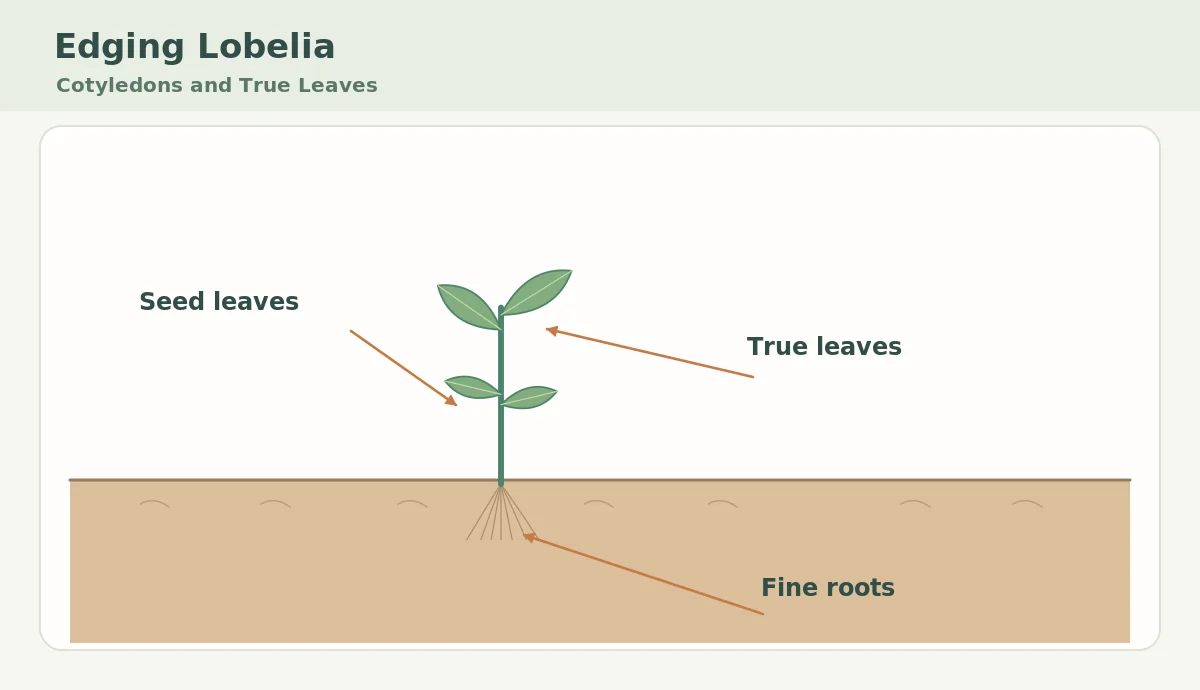
Two small cotyledons are the first seed leaves; they do not yet resemble all mature foliage. Wait until one or more true leaves appear between or above them before pricking out a tightly sown group, as UNH Extension advises for general seedling transplanting. Look for a living center where the stem continues to new growth. The thin threadlike stem is the part most easily bruised by fingernails or forceps. Plan your move while seedlings are still small, before roots form a thick tangled mat, but do not rush when nothing more than a seedling loop has emerged from the medium.
Prepare small cells before lifting anything
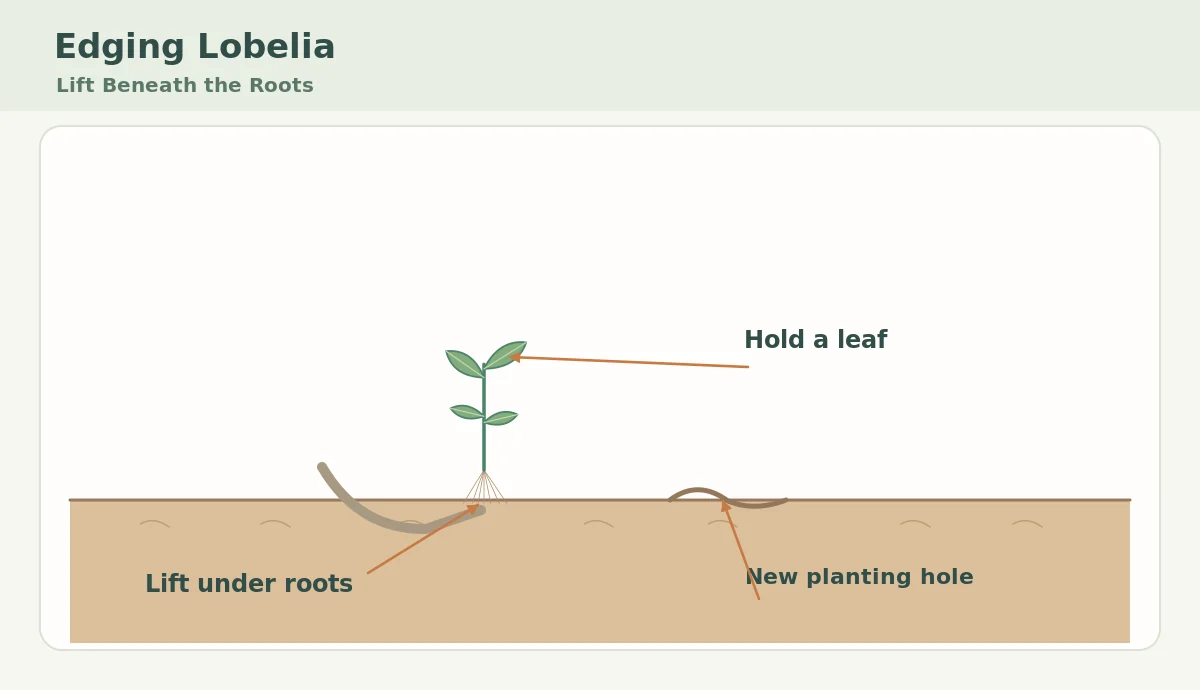
Fill clean cell pots with a fresh, evenly moist seedling medium that drains freely. Make a hole with a dibber or pencil before taking a plant from its seed tray; the roots should not be exposed while you search for supplies. The hole should accept the root system at its natural length rather than folding it into a hook. Use individual pots for especially fragile plantlets or a few adequately spaced seedlings when managing a bedding cluster. Label the containers. UNH Extension notes that moving seedlings too late can stunt them; preparing the receiving medium first reduces handling time and physical stress.
Loosen underneath with a dibber, not the stem
Slip the tip of a narrow tool into the medium beside, not through, the small root system. Lift a little soil with the seedling as the roots release. Hold a cotyledon or true leaf very gently if handling is needed; UNH Extension specifically warns against holding tender seedlings by the stem. If a leaf tears, a healthy growing point may still continue; a crushed stem at the soil line is far more damaging. Separate tangled roots gradually and only as much as necessary. Never yank one plant directly upward through a knot of roots while squeezing its base.
Set the root system below the original soil line
The fine roots belong in damp medium and the leaf crown stays above it. Lower the seedling into the prepared hole so its original growing level is preserved. Do not bury most of the leaves to make a weak seedling look compact; correct insufficient light instead. Firm soil very lightly along the sides of the roots with the dibber, not with a hard push onto the crown. Give a gentle watering that settles the medium without washing soil over the central growing point. In a proper diagram, the tool supports the root zone and the top leaves remain free in the air.
Keep light strong but shelter a fresh transplant
For a few days after pricking out, give bright appropriate light without direct scorching heat. UNH recommends protecting new transplants from heat and intense sunlight while their roots settle. Provide air movement that is mild enough not to whip the stems. If seedlings stretch, move lighting closer within the fixture maker’s safe recommendations rather than planting them deeper. Do not keep a saturated humidity dome over established seedlings indefinitely; poor circulation encourages damping off. An intact, green growing point and leaves held above the medium are signs that the tiny plant is recovering.
Moist means moist, not a standing-water tray
RHS and NC State describe Lobelia erinus as preferring reliably moist but well-drained conditions. Small cells can dry quickly, yet they can also stay wet and airless if the tray has no outlet. Check the weight of the pot and the medium beneath its top skin. Water gently from below where practical and empty accumulated drainage water. Sudden collapse at the soil line deserves inspection for damping-off conditions, whereas dry crisp leaves may signal dehydration. Do not respond to every pale leaf with fertilizer until light, roots and water have been checked.
Harden off before placing edging lobelia outdoors
RHS notes Lobelia erinus is tender; in many regions it is grown as a seasonal annual. Move established seedlings outdoors gradually when local temperatures suit them. Start in a sheltered, brighter-shade position, increase sun and wind exposure, and bring plants back under cover if frost threatens. UNH recommends gradual hardening before transplanting into the garden. Plant at their previous growing level and support each small root ball instead of pulling on the stem. Shallow baskets and containers still need proper outlets and enough medium to buffer drying between checks.
Understand the real lobelia flower and growth habit
A mature Lobelia erinus flower has a two-lipped shape, with a wider lower lip rather than five identical petals radiating as a perfect daisy. Flowers are attached to small stalks arising from leafy shoots, not floating dots above the foliage. Edging cultivars may form a compact mound; trailing cultivars spill over a basket edge. Both retain small stems and fine roots. When managing a decline in hot weather, NC State describes possible flowering reduction and recovery after light cutback. Avoid severe pruning of weak or recently moved seedlings just to force an instant fuller shape.

Use a short recovery checklist after moving
Check the seedling center, leaf color, the soil line and whether roots remain below the surface. A flattened stem is a handling injury, not a request for stronger fertilizer. If many seedlings collapse, review sanitation, waterlogging and air circulation before starting another tray. Record the seed packet and the stage at which you transferred the plants, so you can adapt spacing next year. Successful pricking out leaves a small, uncrushed plant with its crown at the old level, able to develop a compact habit and characteristic small lobelia flowers later.
How We Research and Check Botanical Details
This guide was researched on October 30, 2026 against plants.ces.ncsu.edu; www.rhs.org.uk; extension.unh.edu. We cross-checked the named species, the growing operation and the parts of the plant shown in the diagrams. Regional schedules and cultivar traits vary; check local Cooperative Extension and the actual seed or planting-stock label before adapting precise timing. Illustrations are explanatory botanical drawings rather than scale models or pesticide instructions.
VegWin publishes independent informational gardening guidance. The internal navigation links here are not paid placements and no affiliate relationship is claimed. Our affiliate disclosure explains the site policy. If a plant may be toxic, grown for food or affected by an uncertain disease, confirm identification and relevant safety advice before using or treating it.
When the first true leaves appear and the roots can be lifted carefully; avoid lifting at the earliest stem-loop stage.
No. Handle gently by a leaf or support the soil and roots with a dibber.
Plant at the original growing level with roots below the medium and the central crown exposed.
Keep media evenly moist and draining, not saturated or sitting in stagnant water.
No. This guide is about Lobelia erinus, a delicate annual bedding and trailing plant in many climates.