
How to Train a Young Peach Tree to an Open Center Without Crowding starts with the living plant, not a one-size-fits-all calendar. Look for the exact stem, leaf, root or symptom before using scissors, moving soil or changing how you care for the crop. The practical checkpoints below draw on named University Extension, RHS and IPM resources as relevant. Weather, cultivar, stage of growth and regional conditions may require a different schedule; a clear observation is safer than an assumed date. Use the diagrams as learning aids and check the real growing points on your own plant.
Use a Peach-Specific Training Plan
Standard peach trees, Prunus persica, often perform well when trained to an open center or vase shape. This is different from the central-leader structure commonly used on pears and many apples. Penn State Extension explains that low, spreading scaffolds allow light and air into the canopy and keep fruiting wood more accessible. Before pruning, identify whether your tree is a standard peach, a highly dwarfing form or one managed under another orchard system. A newly planted whip is not pruned exactly like a three-year-old tree. The first aim is to develop strong future structure, not simply remove the largest amount of wood.
Locate the Scaffolds That Form the Vase
A young open-center tree develops several primary branches arising from the trunk and radiating in different directions. Penn State typically describes three or four widely angled scaffolds, with some variation by tree and local conditions. Look for solid attachments without included bark, limbs that are not stacked tightly at one height and an overall balanced arrangement. Avoid selecting all the branches on a single side, because that leaves the framework lopsided. Not every young tree offers an ideal set immediately; a careful gardener can keep viable candidates and adjust through the following growing season rather than making indiscriminate cuts.

Understand Branch Angles and Narrow Crotches
The union where a scaffold meets the main trunk determines its long-term strength. A wide, well-attached branch generally resists splitting better than two co-dominant vertical stems pressed into a sharp V. Penn State warns that included bark in narrow crotches contributes to weak connections. Step back to inspect the actual branch origin, not just where its tip is pointing. A wide branch that later curves upward may still have a stronger attachment than a straight vertical shoot pinched against the trunk. Do not use a stake or rigid tie to force an older brittle limb into a new angle in one motion.
Adapt Pruning Time to Cold and Disease Risk
Peach pruning is highly regional. Penn State’s Pennsylvania guidance favors late winter into the spring, and its open-center instructions caution against pruning during deep winter when cytospora canker and cold injury are concerns. Wait until the appropriate local window, especially where freezes are still likely, and seek regional Extension advice rather than copying dates from another state. Remove obviously hazardous dead limbs with appropriate safety precautions, but do not interpret ‘late winter’ as the same day throughout the United States. New trees and older bearing trees also differ in their pruning needs.
Choose Where the First Main Branches Start
The future framework should be high enough to clear ground operations but low enough to harvest and maintain safely. Penn State offers planting-year examples with low scaffold placement and pruning of the central stem according to tree size. Those measurements are examples, not universal instructions for a container-grown nursery tree already trained for a different system. On a branched young tree, evaluate candidate limbs before removing the central extension. Do not top a mature tree just because the diagram shows a short newly planted peach. Respect the graft union; shoots originating below it may belong to the rootstock.
Remove Strong Upright Shoots From the Middle
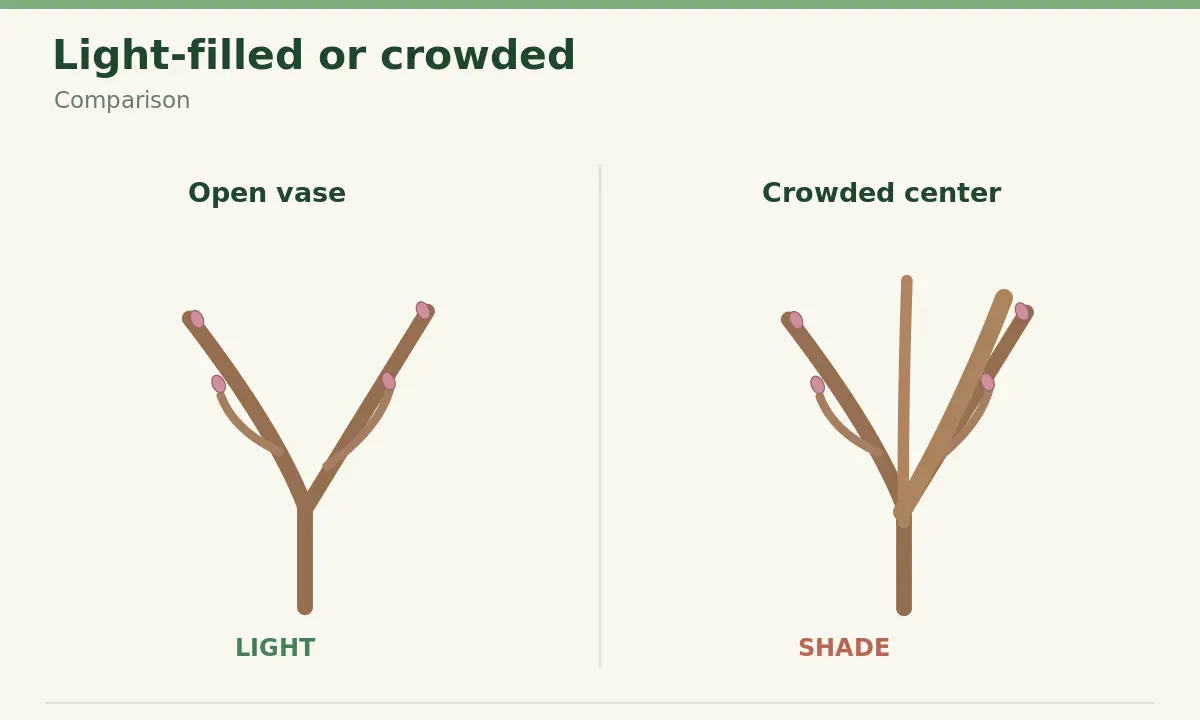
Once suitable scaffolds are established, vigorous inward shoots can crowd the vase, intercept light and rub neighboring branches. Penn State recommends opening the center while keeping productive lateral wood on the retained scaffolds. Trace an unwanted upright down to its origin; make an appropriate thinning cut without leaving a long stub or slicing through the parent limb collar. Do not cut the scaffold itself by mistake simply because its tip grows high. The practical illustration distinguishes a vertical watersprout rising in the middle from a wide outward main limb that must remain.

Use Clean Cuts Without Flush-Cutting Collars
A removal cut should be placed just outside the branch collar at the branch’s point of attachment, where a collar is present. A flush cut against the trunk wounds supportive tissues; a long stub can die back. Where a heading cut is necessary, use an outward-growing bud or lateral according to the desired direction of growth. Clean sharp tools minimize ragged tearing, and large limb work may require a trained arborist. Avoid cutting from a ladder you cannot safely secure. Fruit tree pruning aims to guide living growth, not produce diagram-perfect geometry regardless of what the tree can support.
Protect the Fruiting Wood You Already Have
Peaches bear much of their crop on shoots formed during the previous growing season, so excessive removal of smaller lateral growth can also remove future fruiting sites. Penn State stresses maintaining younger fruitful wood within reach and avoiding an empty outer shell of growth. After selecting scaffolds, look for well-spaced shoots positioned along them. Preserve enough vigorous healthy laterals while reducing dense inward competition. This balance differs from trimming a decorative hedge. If the tree is weak, recently transplanted or damaged by winter, consider reducing the pruning intensity and addressing basic water and soil conditions first.
Assess the Structure From Several Sides
Walk around the tree after a few cuts and view it from different angles. A flat photograph can make two branches look far apart even though they cross in three dimensions. Look for three or four directions of outward growth, space in the middle and a reasonably balanced canopy. Check for crossing branches, broken wood and narrow attachments likely to become weak under fruit load. Do not try to correct every defect in one season. If the tree has only two acceptable main branches, Penn State notes that a workable open framework can still be developed rather than forcing poorly attached extras to meet a fixed count.
Plan Gradual Training Through Several Seasons
Open-center structure is maintained, not completed with one severe cut. Review the tree after summer growth and before each appropriate seasonal pruning window; new uprights may have formed, and scaffolds may change direction. Keep a simple sketch marking major branches and the place each strong shoot was removed. Thin peach fruit appropriately as the crop develops using separate Extension guidance; heavy fruit loads can break even a well-trained young scaffold. A low open center improves access but cannot eliminate all weather damage or disease. Good training combines structural choices, restraint, timing and ongoing observation.
Related Guides
How We Research and Verify Plant Advice
Sources checked on 2026-10-26: extension.psu.edu; extension.psu.edu; extension.psu.edu. We reviewed each institution’s plant identification, correct growth stage and relevant cultural recommendations before adapting them into an independently written step-by-step guide. Where sources are region-specific, their calendar details are not applied universally. Pictures use simplified teaching shapes and should be compared with living specimens; they are not a substitute for laboratory disease diagnosis or local climate guidance. The relevant advice is paraphrased rather than reproduced.
Safety and Independent Editorial Disclosure
This independently prepared educational article does not claim sponsorship or affiliate approval. Our category reading links are informational, not product endorsements. See the VegWin affiliate disclosure. Clean sharp tools before cutting plants, protect hands from thorns and blades, and keep cut plant material away from children and pets where appropriate. Use only locally registered plant treatments labeled for the actual crop, and observe the product label. Do not rely on unsupervised home remedies or unverified harvest-safety promises.
Many standard peaches are trained to an open vase with several outward scaffolds, unlike a central-leader pear.
Three or four good wide-angled, well-separated main branches are common; the individual tree may require a different number.
Use your regional Extension timing; in cold climates, pruning too early in winter can increase damage and canker risk.
Remove vigorous branches that crowd the center, but retain well-positioned fruiting shoots on the main scaffolds.
No. Young-tree training diagrams are not a safe template for severe renovation of large mature trees.