
Scarlet sage seed can produce upright summer beds of showy red spikes, but the botanical name on the packet matters. This guide concerns Salvia splendens, not the separate plant Salvia coccinea, which also shares the common name scarlet sage.
Read the botanical name before opening the packet
Two distinct salvias are sold as scarlet sage. Salvia splendens is a Brazilian species commonly grown as a tender bedding annual; Salvia coccinea has a different flower arrangement and cultural range. Do not combine their sowing advice just because their flowers are red. This guide is about S. splendens with dense upright spikes, two-lipped tubular flowers and brightly colored calyces. A photograph of a scarlet flowering stem is not sufficient for seed identification. Check the complete scientific name and whether the seed is a compact bedding cultivar or a taller form. Flower color alone is not diagnostic: S. splendens cultivars also bloom pink, lavender and white.
Sow on the medium surface where light can reach the seed
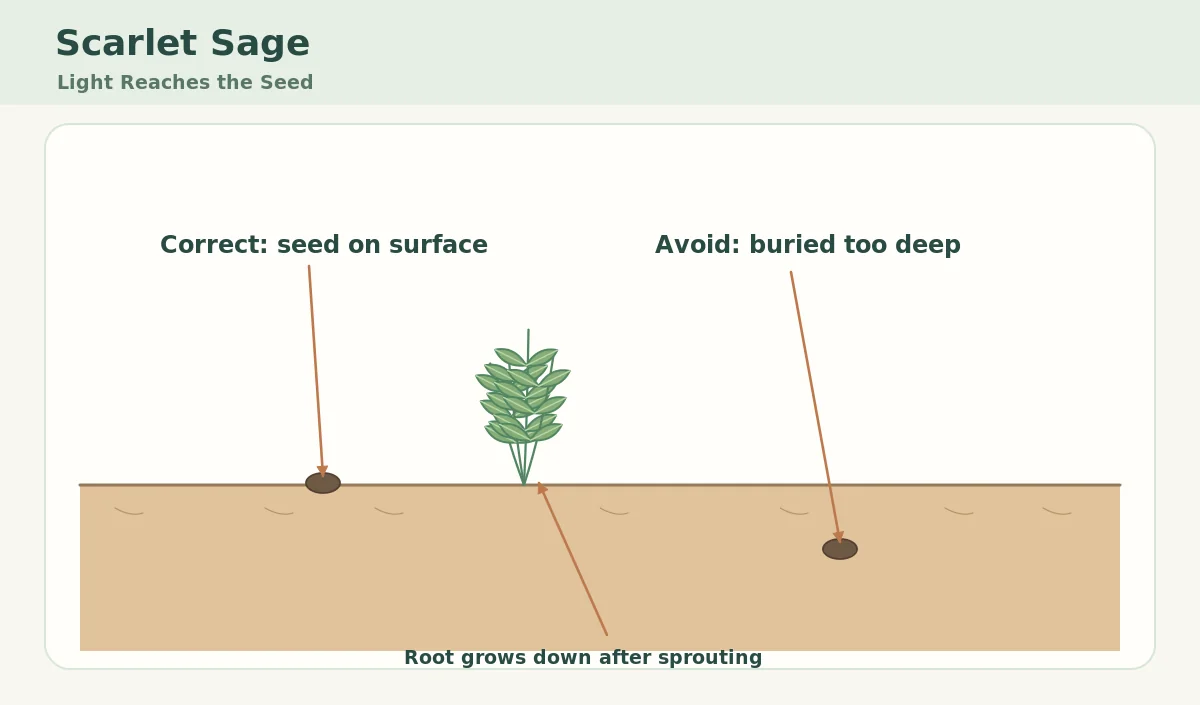
NC State’s plant guide specifically says the seeds need light and should not be covered with soil. Fill shallow, clean cells with moistened seed-starting mix and level the surface gently. Place seeds where you can see them and press lightly for good contact; do not push them into deep holes. A clear cover can reduce rapid evaporation before germination, but leave space for air and remove it after seedlings appear. A fogging spray is safer than a hard stream that can wash seeds into corners. In the sowing diagram, the dark seed sits on the soil line, while the young root grows down only after germination.
Keep germination warm without cooking a sealed tray
Salvias benefit from consistent warmth when starting indoors, although exact germination time varies by variety and seed lot. The University of Minnesota describes warm germination conditions for commonly grown salvias; use the packet range if it is specific to your cultivar. Place the tray under suitable lights instead of inside a dark closet. Check moisture once or twice daily as conditions require: a slick, permanently soaked surface can encourage fungal problems, while a dried crust can stop small emerging roots. Never put a closed clear dome in direct sun where the temperature can rise quickly. Record the sowing date and the first true leaves rather than promising emergence on an exact day.
Move new seedlings into strong, gentle light
The pair of first seed leaves is not the plant’s mature foliage. When true leaves develop, the stem begins to show its characteristic paired, opposite leaves. Put young plants under bright supplemental lighting or in a sufficiently bright protected setup, adjusting the fixture to avoid heat or scorch. Plants stretched toward a window may form thin stalks that fall over during watering; simply adding fertilizer will not correct low light. Thin multiple seedlings in one cell by cutting the weaker ones at medium level, keeping the strongest root system undisturbed. Raise the light or shift the container as plants grow so that foliage receives light without touching a hot surface.
Pot on by the root ball rather than the soft stem
Scarlet sage seedlings are easily bruised when handled by their tender stalks. Wait until they have several true leaves and a coherent root ball. Gently lift the plug from below, support the leaves, and set it at the same growing depth in a draining potting medium. Do not bury the basal leaf joints to solve leggy growth. Water the root area, then allow excess moisture to drain rather than leaving the pot standing in a saucer of water. The objective is a rooted, compact young plant that withstands outdoor conditions, not the biggest seedling produced with heavy feeding. Watch the new growth for a week before applying any additional fertilizer.
Harden off before warm outdoor planting
A plant raised under controlled lights is not ready for full midday sun, drying wind and cool nights in one afternoon. Gradually expose young salvias to longer outdoor visits in shelter, returning them indoors when conditions are too harsh. University of Minnesota advises planting salvias into warmed soil; use the local frost and soil-temperature situation rather than a generic calendar month or USDA hardiness zone. Prepare a bed with good drainage, or a roomy container with real drainage holes. Transplant without crushing the root ball and keep water available while it establishes. Exposing weak seedlings immediately to hot wind creates preventable wilting and can be confused with root disease.
Understand which red parts you are seeing
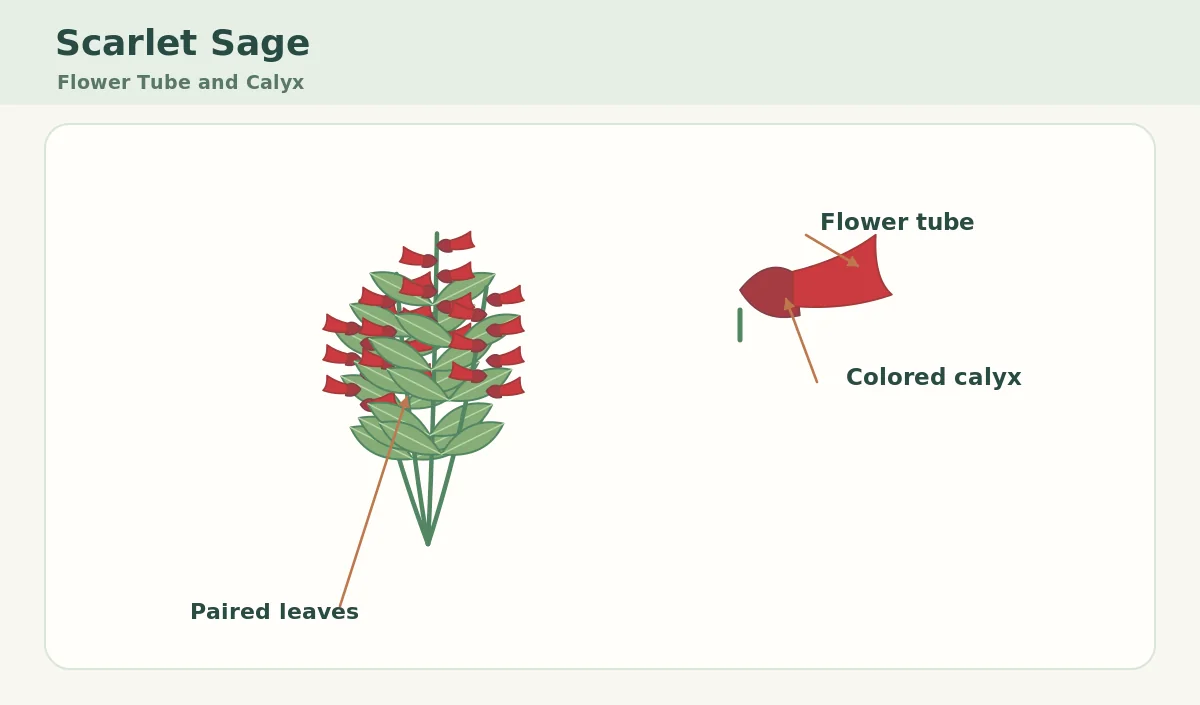
What looks like a red tower is a sequence of flowers, not one continuous petal. A scarlet sage flower has a tubular, two-lipped corolla with a colorful calyx just behind it; in S. splendens the calyx can remain showy as flowers age. Each bloom attaches to a flowering axis through its base. The close-up illustration labels the flower tube, the colored calyx and the flower spike separately. The paired leaves belong at stem nodes below the blooms, not inside the flower tube. Learning these parts helps you identify spent spikes while retaining leafy branches capable of producing the next round of growth.
Water the root zone and remove tired spikes
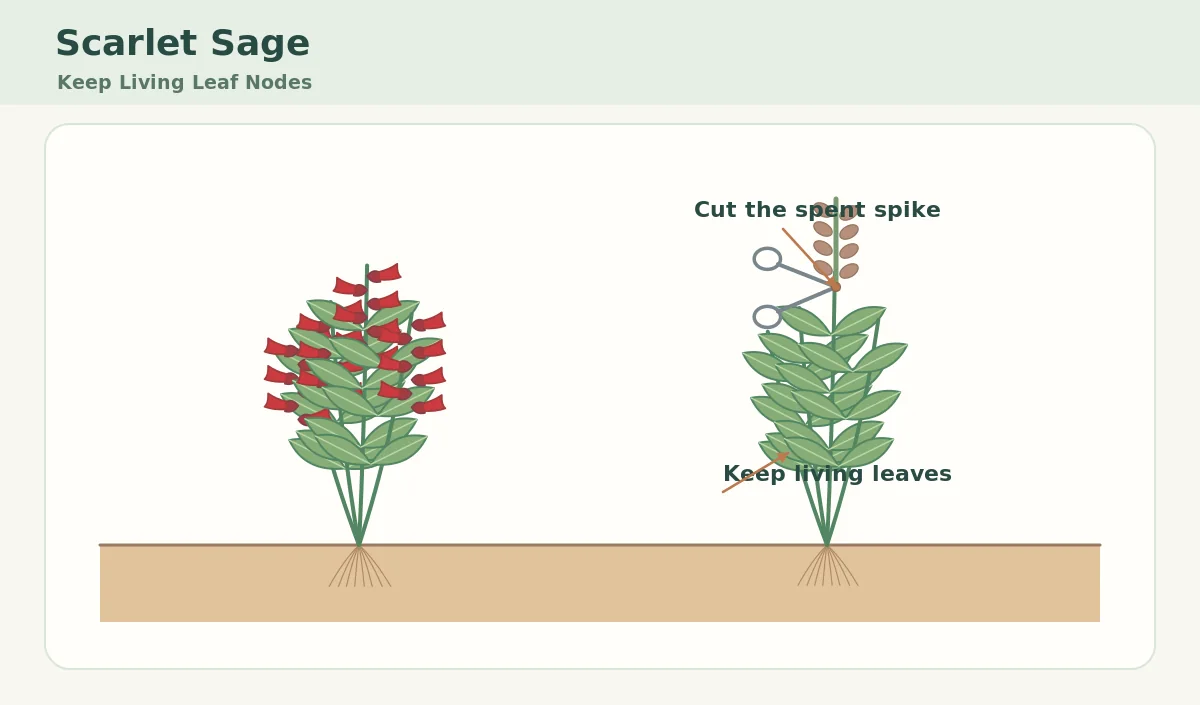
During active growth, keep scarlet sage from staying severely dry for long periods, especially in pots. It is not a cactus and NC State does not describe S. splendens as highly drought tolerant. At the same time, a pot with no drain hole traps water at its roots. Test the medium before watering and empty standing runoff. When a flower spike is clearly exhausted, cut its stalk back above a healthy living leafy node instead of clipping a random length of the main stem. Avoid stripping off every green leaf during heat. A precise pruning cut retains active tissue, while the plant’s performance still depends on light, moisture and nutrition.
Set reasonable expectations for hummingbirds
Bright red tubular flowers may attract hummingbirds and butterflies. However, NC State cautions that many modern bedding cultivars bred mainly for visual effect offer little or no nectar. Do not advertise every scarlet sage packet as guaranteed pollinator habitat. Pair flowers with species known to provide pollen or nectar locally, untreated clean water where appropriate, and varied blooms through the season. A garden with a single dense bedding cultivar is not the same as a diverse habitat. Avoid prophylactic insecticide spraying while visitors are foraging. Inspect an unfamiliar insect before reacting, and use a relevant local Extension IPM source for genuine outbreaks.
Compare successful transplants with common failures
Healthy young scarlet sage has true leaves with normal color, short sturdy internodes, and roots that grow into an aerated medium. A thin leaning stem can indicate insufficient light; a constantly wet medium can cause damping-off or weak roots; scorched foliage may reflect abrupt exposure outdoors. Those symptoms overlap, so check the conditions and the root zone before deciding on a remedy. Keep records of germination, pot-up dates and flowering, especially when testing a new cultivar. The most useful sequence is accurate seed identification, light at the seed surface, steady warmth and moisture, adequate light after emergence, and gradual outdoor acclimation.
How We Research and Illustrate Plant Care
We reviewed the following horticultural sources on October 30, 2026: plants.ces.ncsu.edu; extension.umn.edu; extension.umn.edu. Their published cultivation and anatomical guidance informed the practical distinctions above; cultivar, climate and garden conditions may change results. The original drawings are explanatory, not measurements to scale.
VegWin provides independent educational gardening information. All three on-page navigation links go to VegWin information, are not affiliate offers, and create no paid relationship. Read the affiliate disclosure. For suspected disease, plant toxicity or identification uncertainty, ask a qualified local Cooperative Extension service.
Salvia splendens seed needs light; press it onto moist medium rather than covering it with soil.
No. It is a different species that shares the common name.
It is the colorful calyx surrounding the base of a tubular corolla.
After gradual hardening and when local frost and soil conditions are suitable for a warm-season salvia.
No. Some bedding cultivars have little or no nectar despite colorful flowers.