
French meadow rue is a tall, delicate-looking perennial that rises from a living crown in spring. Its divided foliage and clouds of tiny flowers deserve a different seed-starting approach from quick annual bedding plants.
Choose French meadow rue, not an unnamed mixture
Thalictrum is a large genus containing very different garden plants. This article follows Thalictrum aquilegiifolium, often sold as French or columbine meadow rue. Its compound, blue-green leaves resemble columbine foliage, while its flowering stems carry soft airy heads of small blooms with conspicuous stamens. Do not infer that all meadow rues reach the same height or tolerate identical soil. Some species are low mat-formers, while others rise well above surrounding perennials. Read the species name on the packet and keep the tag after sowing. Hybrid seed may not repeat a named parent cultivar exactly, so treat offspring as variable rather than guaranteed copies.
Use a fresh seed batch or spring sowing window
RHS recommends sowing seed as soon as it ripens or in early spring for T. aquilegiifolium. Collect only mature seed from a positively identified healthy garden plant, or buy clearly labeled seed. Tiny seeds do not benefit from being buried in a deep trench. Prepare a clean container with open drainage and a fine but airy seed-starting medium. Follow the source-specific depth instructions on the package; if using the RHS cold-frame method, a light surface covering is preferable to heavy burial. The objective is stable contact with moisture, not packing the seed under wet peat. Keep labels outside the sowing area so they cannot shade sprouts.
Give the container a protected cool-season home
Unlike a quick warm-season vegetable, meadow rue can respond more slowly to seasonal change and may benefit from a cool frame in the regions described by RHS. Do not move it from cold outdoor weather straight into extreme bottom heat to force an artificial deadline. A cold frame should protect the pot from fierce rain and drying wind while still allowing ventilation. Check the mix regularly for moisture: fresh germinating roots require water, yet a sealed pot can lose the oxygen they also need. Germination rates and timing vary with species and seed handling, so one empty-looking week does not prove failure. Photograph the labeled tray rather than stirring it to inspect seeds.
Recognize true foliage before moving seedlings
The first seed leaves may offer little clue to the finished plant. Wait for recognizable true leaves divided into smaller rounded leaflets, then distinguish your seedlings from volunteer weeds in the same pot. Use a fine tool to free a clump of medium below the roots rather than pulling a leaf stem. Do not force fragile seedlings apart when their roots are tangled. Give each successful start room for the crown to grow and maintain filtered light. Seedlings need steady moisture without a waterlogged saucer. If the leaves look yellow, examine light, root health and watering before giving extra fertilizer, because excess fertilizer can damage a small confined root system.
Prepare a humus-rich bed in partial shade
French meadow rue prefers soil that holds enough moisture to stay fresh while allowing surplus water to drain. RHS recommends partial shade and humus-rich soil. A bed under very competitive tree roots may be too dry even if it is shaded, while a low depression may be too wet. Check by observing how soil behaves after rainfall rather than relying on the phrase shade plant alone. Keep enough distance from neighbors for its airy branching foliage. Near a windy path, provide room for a discreet support before growth becomes tall. Plant new root balls at their established level, with the crown close to the normal soil surface, not deeply buried in mulch.
Keep the living crown visible while planting
The crown is the junction from which seasonal shoots and attached roots develop. A mature meadow rue may disappear aboveground in winter, but its perennial crown remains alive below or close to the soil surface. Do not sketch it as a detached flower stalk or a bulb with leaves floating overhead. When transplanting, support the rooted plug from beneath and align the growing point with its original depth. Water in gently to settle the soil, then clear loose compost from the very center so emerging shoots are not smothered. Place a durable marker beyond the crown to prevent accidental digging in spring.

Do not mistake late emergence for a dead plant
RHS notes that new growth can appear in mid- to late spring. An apparently bare area may still contain a viable dormant crown. Before hoeing or planting spring bulbs nearby, look for last year’s marked position and inspect only the soil surface. Avoid driving a spade through where slender new shoots will rise. If you must check, lift a small patch at the margin with great care; never pull on the central crown. Delay aggressive cutting of any old stems until you know the pattern for your species. A young plant may need longer than an established one to show vigorous shoots after winter.
See why the flowers look like a cloud
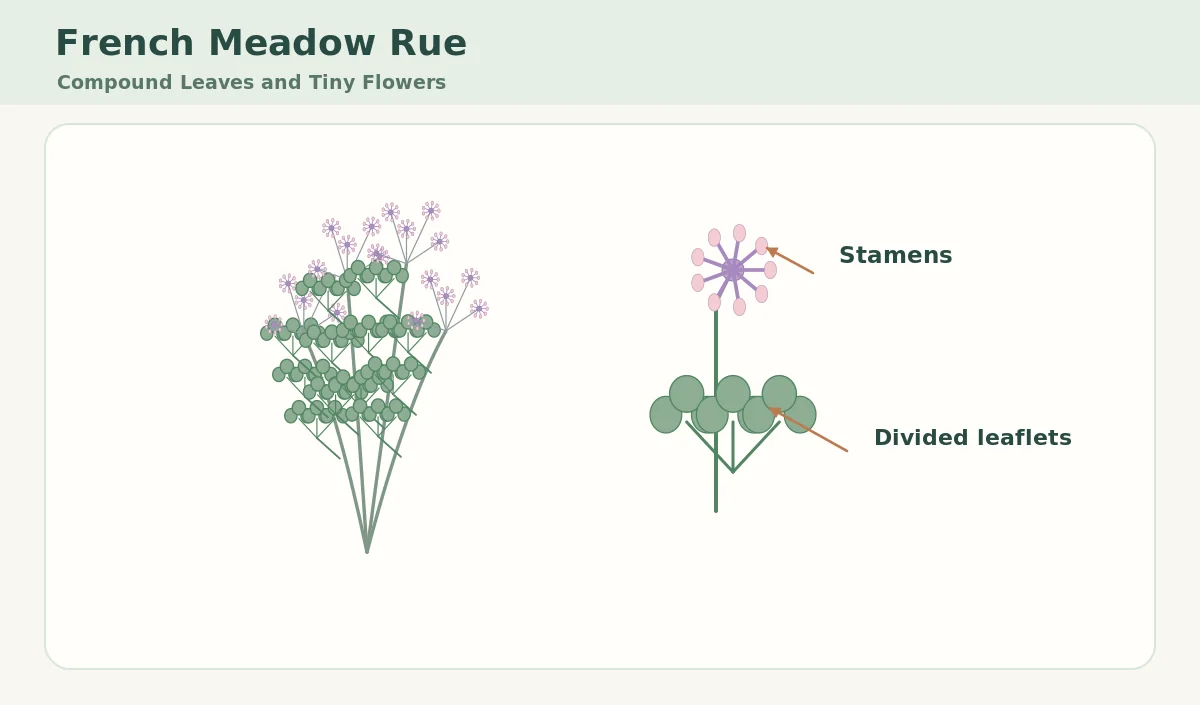
French meadow rue’s flowering display is not a stack of big separate rose-like petals. Numerous small flowers form branched clusters, and the fine colored stamens can dominate the visual effect. A correct diagram shows tiny flowers at the tips of narrow branching pedicels, each belonging to a larger airy inflorescence. The blue-green foliage remains attached to petioles on stems beneath the flowers. The illustration separates the crown, compound leaf and stamen-rich flower cluster. These characters also help avoid confusion with columbine, which has similarly divided leaves but a very different conspicuous flower shape.
Water enough to sustain soft foliage and stems
Keep the root area evenly moist through establishment and dry weather without making it stagnant. Wind can dehydrate tall delicate stems even in a partially shaded site; check the base before assuming disease. A light organic mulch may slow surface drying, but piled material should not press against the crown. If stems lean, a slim stake with soft loose ties can reduce breakage without pinching developing inflorescences. Watch for slug damage on new soft shoots rather than spraying an entire border. For real fungal symptoms, consult local guidance rather than guessing from one discolored leaf. Healthy spring regrowth is the best measure of a successful perennial planting.

Decide whether to leave seed or remove spent heads
RHS suggests removing spent flowers when they fade, but a gardener wanting viable seed must allow selected heads to mature. Choose the goal before cutting: decorative tidiness, limiting volunteer seedlings, or collecting new genetic material. Cut a spent stalk above living lower growth instead of cutting directly through the perennial crown. Handle dry seed heads over a clean paper tray and label them with species and collection date. A clump grown from seed may not match a named cultivar’s flower color or height exactly; vegetative division is more predictable for preserving a particular clump. Document winter performance and protect the crown during subsequent garden work.
How We Research and Illustrate Plant Care
We reviewed the following horticultural sources on October 30, 2026: www.rhs.org.uk; www.rhs.org.uk; www.rhs.org.uk. Their published cultivation and anatomical guidance informed the practical distinctions above; cultivar, climate and garden conditions may change results. The original drawings are explanatory, not measurements to scale.
VegWin provides independent educational gardening information. All three on-page navigation links go to VegWin information, are not affiliate offers, and create no paid relationship. Read the affiliate disclosure. For suspected disease, plant toxicity or identification uncertainty, ask a qualified local Cooperative Extension service.
RHS suggests sowing when seed is ripe or in early spring; follow the species packet and local climate.
T. aquilegiifolium may emerge in mid- to late spring, so avoid digging through a marked crown prematurely.
Showy stamens on numerous small flowers make the airy cluster.
It generally prefers moist but freely draining humus-rich soil with partial shade.
Not reliably; seedlings can vary, while division preserves an established clone more predictably.