
A tray of thin, tall seedlings does not necessarily need fertilizer, and it does not always need to be thrown away. First decide whether the seedlings are merely elongated or whether their stems are collapsing or their roots are failing. Those are different problems. This guide is a triage plan for seedlings that have already emerged, not another guide to choosing a grow-light fixture or starting a whole seed tray. Disclosure: This is independent gardening information, not a paid product placement. Affiliate partnerships for this page are not verified; see the site affiliate disclosure.
Identify Real Stretching Versus Collapsed or Damaged Stems
A leggy seedling typically has an elongated stem between the medium and the first leaves. Several seedlings lean toward the same light source, and their leaves may be relatively small for their height. Iowa State and Illinois Extension identify insufficient light as a common explanation. Stretching is about the form of growing plants. By contrast, a seedling narrowed, darkened or collapsed at the soil line may have damping-off or another root-zone problem and should not be treated as a harmless lighting issue.
Look at the newest growth, not only the most dramatic stem. If the new leaves are green and progressively larger, a stressed plant may still be growing. If stems are breaking, seedlings are falling at the base, or wet mix has an unpleasant smell, isolate the symptoms and review disease and moisture guidance. Do not attempt to prop up a seedling that has collapsed at the soil line and assume the underlying condition is fixed. Recording what changed after emergence is more useful than a label of “weak seedlings.”
Check Light Coverage Before Changing Fertilizer or Water
Light quality is a combination of adequate intensity across the tray and a suitable daily duration. An indoor window may look sunny to a person but deliver weak, one-sided light for much of a winter or spring day. A lamp may work for seedlings at its center and leave edge plants stretching. Rotate a windowsill tray if that is the only source, but overhead supplemental light usually gives more consistent results. Iowa State Extension advises approximately twelve to sixteen hours of adequate light after emergence; use the manufacturer’s safe fixture distance rather than copying one measurement for every lamp. Our guide “Indoor Seed Starting Failures” adds more detail on this.
Check whether leaves are stretching upward or bending sideways toward a stronger light. Then inspect the fixture’s actual coverage, mounting height, dimmer setting and on/off schedule. If light was off for several days after sprouting, record that as a plausible cause. Avoid automatically increasing fertilizer: excessive salts can injure seedlings, and nutrients cannot replace light. A dim light for sixteen hours is still dim; a bright fixture pressed against foliage can scorch plants. Make one measured adjustment and watch the next growth. To go further, our guide “Grow Lights for Seedlings” shows how to set height, day length, and fix leggy growth.

Review Crowding, Air Movement, and Root-Zone Moisture
Seedlings crowded shoulder to shoulder may shade one another even under decent lights. Thin or separate them when suitable for the species and their stage; handle by leaves when transplanting tender seedlings rather than crushing delicate stems. Allow enough space so a light reaches lower leaves without producing a dense, humid canopy. Gentle air exchange may help establish sturdier plants, but a fan blast can quickly dry tiny cells or bend seedlings further. The point is regular air circulation, not bending stems deliberately to harden them.
Keep the medium moist as required for young roots but not continuously saturated. Containers must drain. Overwatering can cause root stress, yellowing and poor growth that coexist with stretching, so check the medium rather than treating every droopy stem with more water. If you used a humidity dome, remove it once seedlings have emerged according to Extension guidance and monitor drying more closely afterward. Temperature also influences growth rate: excessively warm conditions with insufficient light often make stems look worse, but do not impose a universal cold temperature on every crop.
Make a Twenty-Four-Hour Rescue Checklist for the Tray
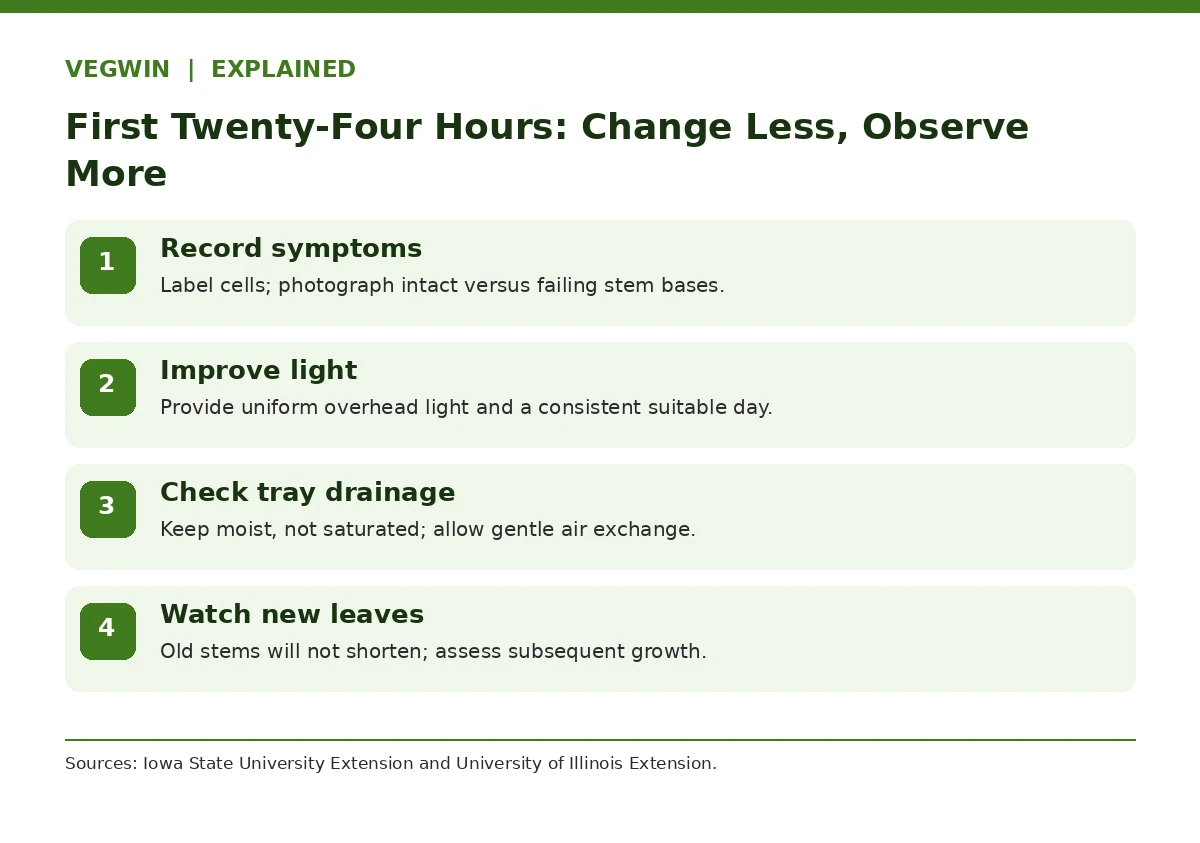
On the first day, photograph and label the tray, identify which cells are longest and check for stems damaged at the base. Correct the light footprint for all cells, set an appropriate light period, and ensure adequate spacing and drainage. Move seedlings gradually if a new high-intensity light might scorch foliage. Support a top-heavy but living seedling temporarily only as needed to avoid physical damage; a stake does not correct the missing light. If roots are healthy, the immediate goal is to let new leaves develop under improved conditions.
Do not repeatedly repot and fertilize during the same short test. Too many changes make it impossible to know what helped and can cause extra stress. Check plant response after a few days. Stems that already elongated generally do not shrink back to normal proportions; improvement appears in stronger later growth. If a batch is still dangerously unstable or is too far from safe transplanting size, compare the remaining time before outdoor planting with the seed packet’s lead time before deciding to resow.
| Observed sign | Most relevant first check | Practical next step |
|---|---|---|
| Tall, leaning, intact stems | Lighting intensity, direction and coverage | Correct light and assess new leaves |
| Seedling narrowed at soil line | Damping-off and saturated medium | Separate affected plants; use Extension disease guidance |
| Yellow leaves but little stretch | Root moisture, media and nutrients | Diagnose before fertilizer |
| Upper leaves scorch after lamp change | Light intensity and fixture distance | Adjust according to lamp guidance |
| Stable but elongated transplant | Crop-specific depth and season left | Evaluate rescue versus resow |
Decide Whether Deeper Potting Is Safe for This Crop
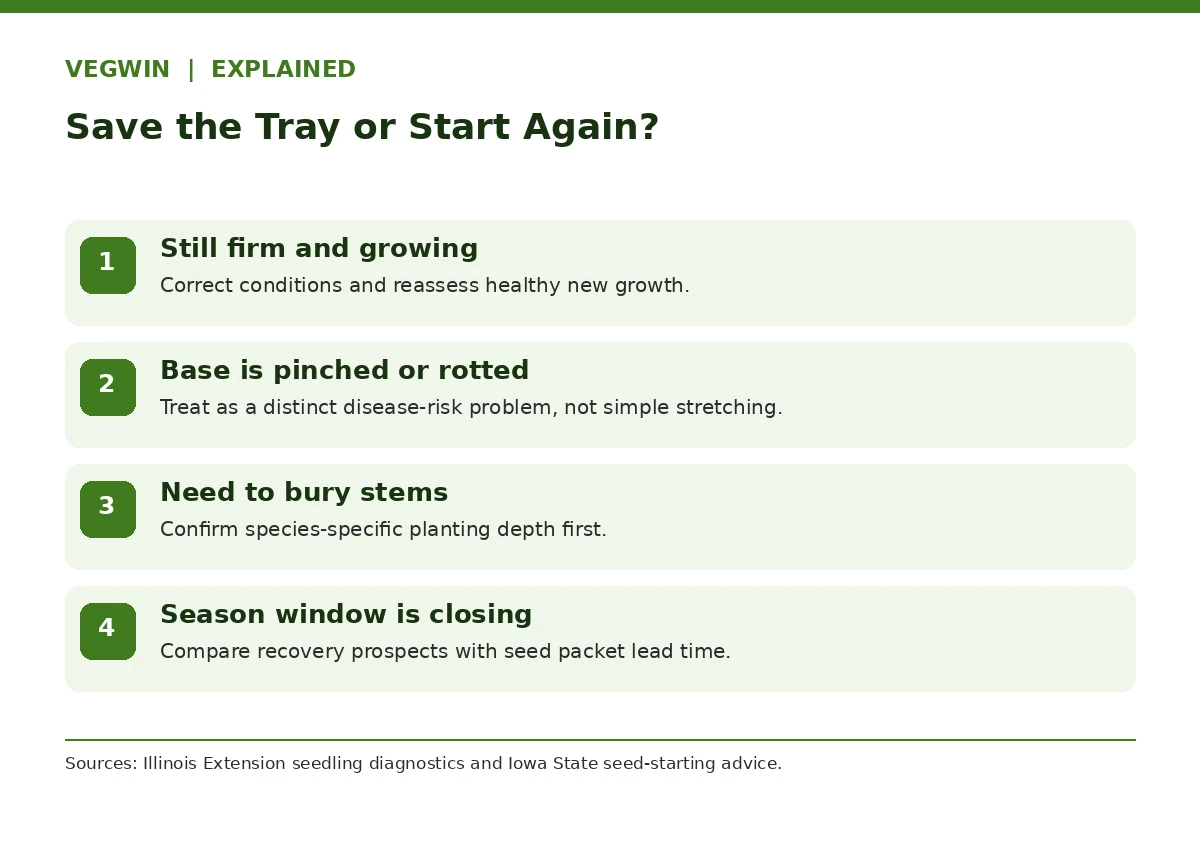
It is tempting to bury every stretched stem up to its leaves, but not all seedlings respond alike. Tomatoes can form adventitious roots on buried portions of stem under suitable conditions, so a tomato-specific Extension method may justify a deeper planting. For other vegetables, planting depth depends on species and risk of stem rot, and the seedling should not automatically be buried to compensate for stretching. Consult crop-specific transplant advice before changing depth, especially for delicate cucurbits.
A seedling with a strong root system and a slightly long stem may still be worth growing, particularly if growing conditions are now stable. A seedling with a pinched, rotting stem base, severely damaged roots, or repeatedly collapsing growth may be a poor investment. The decision also depends on whether a new sowing can catch up within your regional frost and planting window. Starting over too late can waste a season; nursing a failing tray too long can do the same. Our guide “Seed Starting Grow Lights” adds more detail on this.
Reassess New Growth and Keep a Simple Rescue Record
After correcting light and basic care, compare photos of new true leaves, stem support and color after several days rather than expecting already stretched tissue to shorten. Watch for sudden collapse, new discoloration or a tray-wide pattern that points to ongoing root-zone issues. If only cells farthest from the lamp are elongating, improve coverage or redistribute trays. If every cell looks yellow but is not reaching for light, evaluate nutrients and medium using independent Extension guidance rather than calling all yellow foliage etiolation.
Track the date seeds emerged, when the lights were adjusted, lamp type, approximate placement, light duration and which crop is in the tray. These observations turn an anecdotal fix into something reproducible. If you restart, prepare the light and growing medium before sowing so the replacement seedlings do not repeat the same failure. Do not use artificial success claims about how quickly recovery “always” happens; crop, variety, age, environmental conditions and the extent of previous injury matter.
Prepare Only Vigorous Seedlings for Outdoor Transition
Even a recovered seedling should be hardened off gradually before outdoor planting. Direct sun, wind and fluctuating temperatures are very different from the indoor nursery environment. Use the crop’s frost tolerance and the local forecast to select the timing; a warm afternoon is not a safe planting calendar. Water the root ball appropriately before planting and handle it gently. Review the species’ proper depth and spacing rather than assuming that a long, buried stem fixes all earlier stress.
If seedlings remain unstable, diseased or badly root-restricted despite careful conditions, buying healthy transplants or resowing can be a better use of the season. Keep diseased or collapsed seedlings separate from vigorous trays while diagnosing them. A short record of the lighting and watering changes will still be valuable even if you discard the batch: you now know what to change before the next sowing rather than repeating an expensive light or fertilizer purchase. For a step-by-step method, see how to start vegetable seeds indoors.
How We Research This Guide and Review Regional Exceptions
We checked current results for the precise reader question and read primary university Extension horticultural guidance on October 19, 2026. The public VegWin.org article and category pages were inaccessible during our independent check; consequently, we cannot confirm every live or unpublished WordPress URL, category route or ongoing site update. The editor must check competing posts and the live category in WordPress before manual publication. These recommendations reflect source-specific horticultural evidence and do not replace region-specific crop schedules, soil tests or product labels.
Sources checked October 19, 2026: University of Illinois Extension, troubleshooting seedling problems; Iowa State University Extension, starting seeds indoors; Iowa State University Extension, judging light for seedlings. Each source supports the specific horticultural claim listed in the editorial record; the sources do not endorse VegWin. Statements about biological variety, planting readiness or garden pests are conditional on crop and local conditions. No pesticide mixture, fertilizer rate or commercial partnership is assumed. See our affiliate disclosure page for the general site policy.
Previously elongated stem tissue does not become short. Better light can support more compact new growth if the seedling remains healthy.
Often not. Window light may be weak and directional; overhead supplemental lighting is frequently more reliable.
Only when crop-specific guidance supports it. Tomatoes often tolerate deeper planting, but you should not apply that method to every vegetable.
Not when poor light is the primary cause. First evaluate illumination, moisture and root health; excessive feeding may injure young plants.
Discard severely collapsed or diseased seedlings and consider resowing if healthy new growth is unlikely before the safe transplant window.