
A firm, rounded burgundy radicchio in a seed catalog is only one expression of Cichorium intybus. Some garden varieties form tight heads, some grow taller and elongated, and others remain loose-leaved. Harvest timing therefore begins with knowing what shape your cultivar should make. For a true heading type, feel for a well-filled, resilient core under the outer leaves; a loose handful of colored leaves is not the same thing. Waiting indefinitely for every plant to turn dark red can leave you with a flowering stalk or tired leaves instead of a crisp head.
Identify the Radicchio Type Before Testing Firmness
Read the original seed packet or plant label for a picture and a description of the harvest form. Rounded Chioggia-type radicchio usually makes a compact, cabbage-like rosette with white ribs. Elongated Treviso-type plants can form taller, more tapered leaves. Other chicories are intended for loose leaf harvest and may never form a tight globe. These names describe broad forms, not a guarantee that every local cultivar reacts identically to day length or temperature.
Use the leaf arrangement as your first clue. A heading plant develops an overlapping central group of leaves that feels fuller as it grows. An open-leaf plant may stay splayed at the center even while perfectly edible. Do not force the “squeeze the head” test onto a cultivar bred to produce loose leaves. For a mixed planting, put the plant name beside each row before foliage gets too large to distinguish visually.
Feel for a Full Firm Head, Not a Date Alone
Utah State University Extension describes heading greens, including radicchio, as ready when heads are well formed and firm. Place a hand gently against the central portion; mature leaves resist slight pressure without collapsing. The head should look typical for the variety and not contain an obvious hollow center. A date on the packet is a planning estimate, not proof that a given head is ready after heat, drought, or slow establishment.
Examine the outside as well as the center. Healthy protective wrapper leaves may remain green or imperfectly colored; they do not invalidate a sound mature head. The bright interior ribs and leaf blades should be crisp, not slimy, deeply rotted, or badly sunken. UC Davis notes that leaf color can change with maturity or cool weather in certain varieties, so do not judge all radicchio by the intensity of its red pigment.

Watch Temperature and the Risk of Bolting
Radicchio is a cool-season chicory. Its growth and tendency to form heads can vary with cultivar and weather. Sustained heat or other stress may cause bitterness, loose growth, or premature flowering rather than the tidy market head shown on a packet. When a tall central stalk begins to elongate noticeably, the plant is diverting growth toward flowering; older leaves may already be less appealing.
Inspect more often as the head approaches maturity rather than leaving it untouched through rapidly changing weather. If a compact head is already ready and a warm spell approaches, cut it while the quality is good. If an elongated cultivar never makes a ball, revisit the variety description instead of leaving it to become woody. USDA hardiness zone alone cannot tell you when this cool-season annual crop will form a harvestable head.
Cut the Head Low and Leave Protective Leaves
Use a clean sharp knife and support the head with your free hand. Cut near the plant base, retaining enough of the basal stub to keep the leaves together; UC Davis notes a short root stub can help retain leaf attachment. Keep a few sound outer wrapper leaves attached as protection during handling, as Utah State guidance recommends. This is a whole-head harvest: you are not cutting just the top leaf tips and expecting a new compact head immediately.
Work on a dry day if practical and avoid compressing the leaves in a crowded basket. Trim damaged outer leaves only after you have removed the head, while keeping clean usable leaves. Do not place a knife above the head as if pruning a flowering stem; the cut is below the overlapping edible leaf bases. Wash harvest equipment and keep fresh greens away from soil, manure, and untreated irrigation water.

Check for Decay and Insect Damage Between Leaves
Radicchio can hide insects and debris under overlapping leaves. Gently spread a few outer leaves rather than pulling the entire head apart in the bed. Look for holes, insects, slimy patches, or dark wet lesions near the leaf bases. Light cosmetic damage on a wrapper leaf may be trimmed, but widespread decay penetrating the central head is a reason not to salvage it as fresh food.
When symptoms are common across a planting, look at watering, drainage, air circulation, and local diagnostic resources before reaching for a pesticide. This article is about selecting and cutting mature heads, not diagnosing every leaf spot or prescribing chemical products. If you use crop protection at any point, follow the actual product label, preharvest intervals, and local Extension advice.
Cool Freshly Cut Heads Promptly
A freshly cut radicchio head loses quality when left in hot sun. Carry it promptly to shade, remove obvious soil, and refrigerate after cleaning as appropriate for leafy produce. UC Davis emphasizes low-temperature postharvest handling for quality. Home refrigerator temperatures and humidity differ from commercial cold rooms, so do not promise the same shelf life under all household conditions.
Store heads loosely protected from dehydration while avoiding standing water or sealing visibly wet leaves in a bag. Wash before eating, including between outer leaves, following ordinary fresh-produce hygiene. Use slimy or moldy sections as a discard signal rather than trying to hide spoilage under a dressing. Intact wrapper leaves help protect the center while you store it.
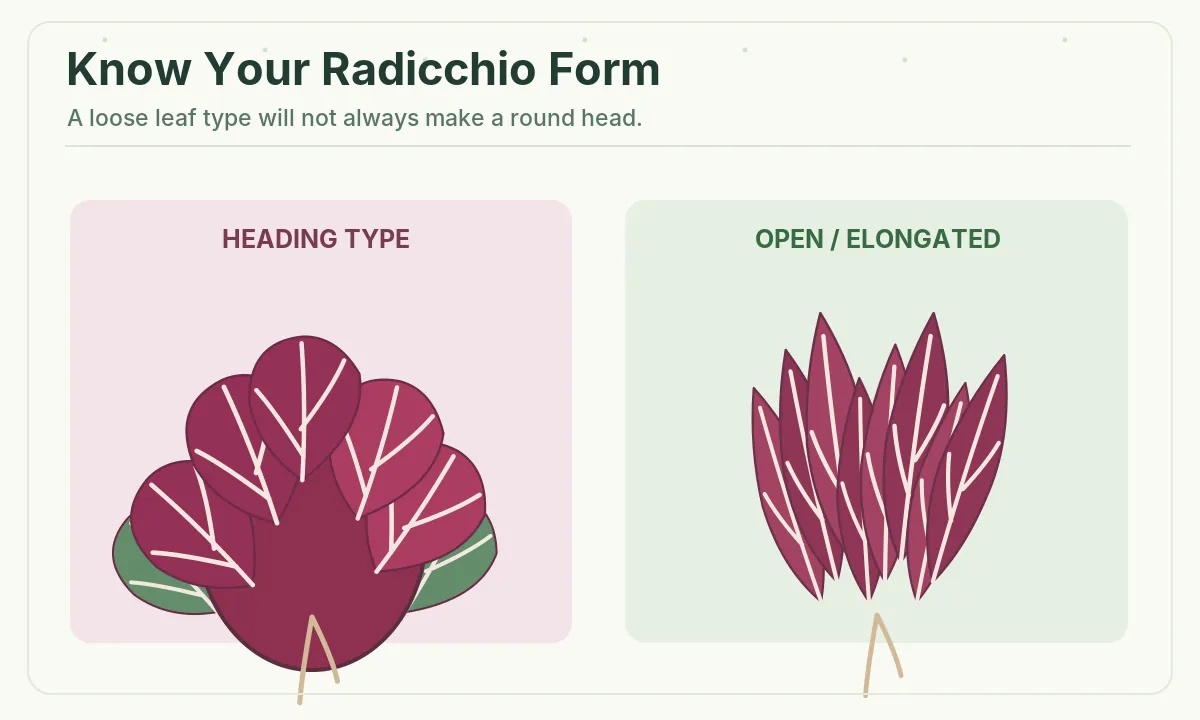
Compare Heading and Loose-Leaf Harvest Choices
A useful garden decision can be made in seconds: identify the cultivar, then look for its intended size, leaf form, and firmness. Rounded heads get harvested whole when compact. Loose-leaf chicories can provide individual leaves according to the cultivar directions, rather than waiting for a hard spherical head that will never appear. This is why two plants with different silhouettes can both be ready on the same day.
If the center is loose on a heading cultivar, give it more time while conditions are favorable, but inspect regularly for stalk elongation or decay. If a head is crisp and full, harvest rather than waiting for an unrealistic deeper purple. Keep notes on the cultivar and harvest conditions so next season you can choose a better fit for your local spring or fall growing window.
Related Guides
- When to Harvest Radicchio: Firm Heads, Loose Types, and Fall Timing
- How to Grow Heading Radicchio With Red Leaves and White Ribs
How We Research This Gardening Guide
For this guide, we cross-checked the crop-specific guidance in the following institutional resources on October 27, 2026: Utah State University Extension (Utah State University Extension describes harvesting heading greens including radicchio when fully formed and firm, keeping protective wrapper leaves.); UC Davis Postharvest Center (UC Davis identifies radicchio maturity by cultivar shape, compact firm head, bright leaf quality, and cutting with a small root stub.). Recommendations are interpreted for gardeners and may need adjustment to local conditions, cultivar differences, and extension advice.
No paid product placement or affiliate recommendation is included in this article. See the VegWin affiliate disclosure. If disease symptoms or food-safety decisions are involved, seek local Extension guidance before making a treatment or food-processing decision.
No. Forms range from compact round heads to elongated or open leaf types; check the variety.
Look for a full-size, well-formed head that feels compact and firm for its cultivar.
No. Color varies by cultivar and weather; firmness and healthy leaf quality matter more.
Cut low at the base with a clean knife, keeping the attached leaves intact and a small basal stub.
Retain sound wrapper leaves to protect the head; remove badly damaged or decaying leaves.