
Edamame is a soybean harvested for its tender green seeds, not a dried bean left on the plant until the pods turn brown. That difference makes timing unusually important. Pods can look long enough while their seeds are still flat, then move quickly from sweet and nutty to starchy as yellowing begins. South Dakota State University Extension and Virginia Cooperative Extension recommend watching pod fill and green color rather than using a calendar date alone. This guide shows how to examine a representative handful of pods, make a clean cut without disturbing the next cluster, and cool the harvest promptly. Soy is a common food allergen, and harvested edamame needs cooking before eating.
Identify the Crop and Its Actual Harvest Stage
An edamame planting looks much like another soybean planting: hairy stems, sets of three leaflets, small flowers, and clusters of short pods attached at nodes. The vegetable is the developing seed within a pod. For food-grade edamame, growers aim for the green full-seed stage, called R6 in soybean growth descriptions. Do not confuse pod length with readiness; an elongated but skinny pod may contain barely formed beans. Conversely, brown dry soybean pods are well beyond the usual fresh-edamame stage. Check the seed packet for the maturity group and variety because the same planting date can lead to different harvest weeks in a cool coastal garden and a hot inland one. Look at several nodes, not only the first pod you notice.
Check Bright Green Color and Seed Swelling
Hold a pod to the light or gently press along its sides. Ready pods are vivid green and feel rounded at the seed positions; the beans have swollen until they nearly touch inside. South Dakota State University Extension uses exactly that near-touching appearance as a practical sign, while Virginia Tech describes pods whose seeds fill most of the cavity. Sample a pod low on the plant and another near the middle, because one early flower can make an outlier. Flat green pods need longer; green pods with well-rounded beans are candidates for today’s harvest. A yellowing pod generally means quality is declining, not that it needs extra sunshine. The plant can still carry both ready and unready pods on the same day.

Understand Why the Harvest Window Is Short
Edamame varieties tend to set many pods over a compact period, making the useful harvest window short compared with repeatedly picked pole beans. Virginia Cooperative Extension describes an optimum span of roughly a week under some production conditions; other sources note it can be only a few days. Temperature, water stress and cultivar matter, so do not treat those estimates as a countdown guaranteed in a home garden. Once pods begin filling, inspect plants every day or two. Record the day a sample pod first became nicely rounded and check a similar sample again later. The goal is to pick while the majority you intend to eat are green and full, before yellowing spreads across the row.
Use a Three-Pod Sample Instead of Guessing
Select three representative pods from different positions and open one if necessary. In an immature pod the beans are small and separated by large empty spaces; leave similar pods to grow. In a ready pod the beans are full but tender and the shell remains bright green; collect it. In an overmature pod the hull may be dull, yellowish or fibrous, and the beans can taste coarse or starchy. This comparison tells you more than an overall plant photograph. If the majority are still flat, postpone whole-plant cutting and inspect again. If most are ready and just a few are small, a bulk harvest may make sense. Avoid taking only the largest exceptional pod as evidence that the entire stand is ready.
| Observation | Useful next step | Common mistake |
|---|---|---|
| Flat pod | Check Bright Green Color and Seed Swelling | Acting before checking the plant |
| Hold the branch | Use a Three-Pod Sample Instead of Guessing | Copying one method without context |
| Wait or compost | Adjust Timing for Weather and Variety | Assuming a single sign proves the diagnosis |
Choose Between Selective and Whole-Plant Harvest
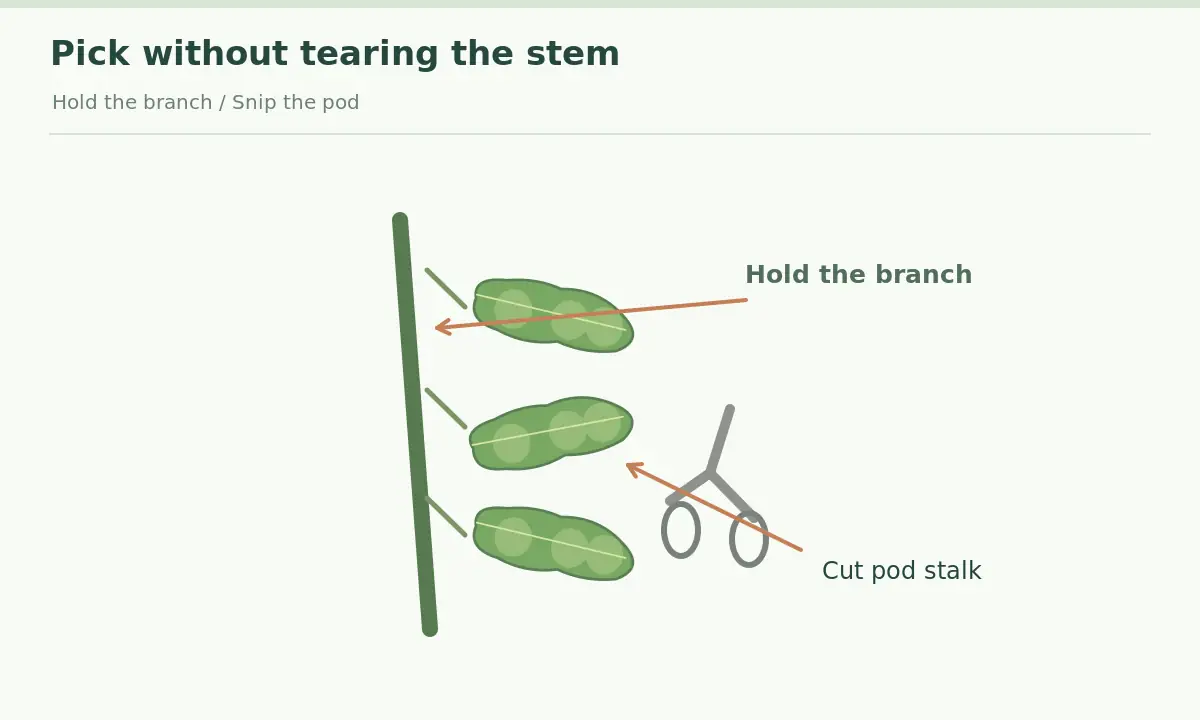
In a small garden, hold the branch steady in one hand and pinch or snip the pod stalk with the other; tugging hard can break the branching stem. Use clean scissors if the pod is stubborn. When many pods reach maturity together, cutting the plant at the soil line can make harvest and sorting easier. South Dakota State University Extension describes both hand-removal and whole-plant methods. Do not assume a soybean will behave like cut-and-come-again salad greens after the main harvest; it is normally grown for one concentrated crop. Do not carry muddy plants into a clean kitchen preparation space. Sort away diseased pods and those with obvious insect damage as you collect.
Keep Harvested Pods Cool and Clean
Fresh pods lose eating quality as they sit in sun, especially after a warm afternoon harvest. Pick in the cooler part of the day when possible and move them quickly to shade, then refrigeration. Collect into a clean container rather than a fertilizer bucket. Discard damaged and moldy pods rather than assuming boiling can correct spoilage. Separate soil-covered stems from ready-to-cook food. Virginia Tech and South Dakota State University both emphasize rapid postharvest handling, because the crop is harvested physiologically immature and continues changing after picking. A small household harvest is easiest to process promptly; when saving it for later, use food-safe refrigeration and cooking rather than leaving a large bucket at room temperature.
Cook the Seeds and Recognize Soy Allergies
The edible part is the bean, not usually the fibrous pod wall. Cook edamame thoroughly before serving; raw or undercooked soybeans can be difficult to digest because legumes contain natural compounds that proper heat treatment reduces. If you cook beans in pods, squeeze the cooked seeds out and discard the hull. Anyone with a diagnosed soy allergy should avoid edamame; garden-grown soy is still soy. Food-safety handling begins before the pot: wash the pods with clean water, use clean utensils and do not let harvested vegetables contact raw meat. Follow a reliable cooking method for the pod size and preparation, and refrigerate leftovers promptly. ‘Fresh from the garden’ is not a substitute for safe food preparation.

Adjust Timing for Weather and Variety
Warm periods can compress the pod-filling and yellowing interval; cool periods can slow it. University of Florida’s edamame growth-stage guidance shows differences among maturity groups and observed stage timing, but those observations are not a universal garden schedule. Do not transplant a research-farm day count into a different latitude as a promise. Water adequately during pod fill if the soil is dry, but avoid waterlogging. Inspect plants after a heat wave rather than waiting for a previously marked calendar date. If a storm is forecast when pods are ready, harvest sound mature pods promptly; waiting through days of wet weather can complicate handling. Gardening decisions work best when pod condition confirms your plan. If you are starting from scratch, read When to Harvest Edamame.
Troubleshoot Sparse Pods or Mixed Ripeness
A plant covered in foliage but lacking filled pods may have experienced heat, drought, poor pollination conditions or another crop-specific setback, and it cannot be repaired by picking early. Check flower and pod history, leaf health and soil moisture before assuming fertilizer is required. Pods near a plant’s lower nodes may be more advanced than recently set upper pods, so selective picking can salvage quality from a mixed stand. Yellow leaves alone are not a complete diagnosis; examine the pods themselves. Fungal spotting, insect injury or malformed seeds require a closer look and possibly local Extension identification. Only use a pesticide if it is registered for edible soybeans in your jurisdiction and its harvest interval permits use.
Plan the Next Planting With Real Observations
Write down variety name, sowing date, flowering date, first filled pod, and the number of days the pods stayed green and full. Those observations become a useful local calendar over successive years. Sow a second small block at a different planting time if your frost-free season permits, rather than hoping the same cut plant supplies beans continuously. Keep seed for next season from a source designated for planting, not an unknown store-bought soybean food lot. When harvest ends, remove unhealthy crop debris according to local disease guidance and rotate where possible with nonlegume vegetables. Your final decision remains simple: harvest the bright green pods with plump beans, and handle them as a perishable food.
How We Research and Verify This Guidance
Sources checked on 2026-10-24. This article compares plant-stage or pest-stage guidance from extension.sdstate.edu — Bright green nearly touching seeds, narrow harvest window and rapid chilling; www.pubs.ext.vt.edu — Pod fill, timing variation and deterioration after yellowing; ask.ifas.ufl.edu — R6 green full-seed stage and differences among maturity groups. We reviewed practical identification, growth and safety details and separated specific recommendations from widely varying local climates. The learning illustrations simplify appearance to make distinctions legible; they are not to botanical scale. The best action still depends on the named species or cultivar, current weather and observed plant condition.
Disclosures, Safety and Regional Differences
This is general gardening education; VegWin does not claim an invented endorsement or affiliate arrangement. See the affiliate disclosure. Where food safety, toxic plant parts or pest controls are involved, follow local Extension guidance and applicable registered product labels. No unverified pesticide formulas, fertilizer dosing, or zone-only planting schedules are recommended.
Pods should be bright green and plump, with the individual beans nearly touching inside; flat pods are not ready.
You can assess sound pods, but peak fresh-edamame tenderness and flavor usually have passed by the time yellowing begins.
Many pods mature close together, but individual plants can have mixed stages; inspect several clusters before cutting the whole plant.
Usually no. Cook the pods or shelled beans, eat the seeds, and discard the tough pod walls.
Cook edamame thoroughly before eating, and avoid it entirely if you have a soy allergy.