
How to Grow Winter Squash and Decide When Each Fruit Is Ready. This hands-on guide tackles the specific question behind how to grow winter squash with Extension-grounded checks and a practical decision sequence. Conditions differ by region, plant variety and site history, so treat the source-linked observations as a starting point for local verification.
The unique value here is this: An end-to-end maturity decision system that separates winter squash growing and pollination from harvest readiness, and specifically flags acorn squash as an exception to blanket curing instructions. All factual plant and safety advice is backed by the named university references below; no commercial partner or pesticide treatment is assumed.
Start with a winter squash type and a real season
Winter squash is a harvest-and-storage category, not a single uniform crop. Butternut, acorn, delicata, kabocha and hubbard types can differ widely in vine vigor, fruit shape, maturation and keeping quality. Read the seed description for the actual variety before assigning it space. A compact plant that makes a few fruits behaves differently from a sprawling vine, even when both packets say winter squash. Our guide to growing pumpkins goes into more detail.
Choose a local growing window long enough for that variety to mature on the vine. Winter hardiness zone maps do not give annual squash sowing dates; soil warmth, local last frost, the seed packet and the first likely autumn freeze are more informative. If your season is short, select a locally recommended earlier-maturing type rather than assuming every fruit will ripen after you move it indoors. If you want the full process, read how to overwinter pepper plants indoors.

Plan vine room and the pollination route
Squash foliage can cover paths and neighboring vegetables as vines extend. Mark a planting area that permits mature vines to develop without swallowing the access route you need for watering, inspection and harvest. Follow the variety-specific spacing on the packet or a relevant regional Extension growing guide. Crowding decreases light interception and can turn a manageable harvest into a tangle of hidden fruit. For the fuller picture, see our guide to growing shiso in containers without letting perilla escape.
Many winter squashes rely on insects transferring pollen between male and female flowers. A vine full of leaves is not evidence that fruit will develop. Minnesota Extension documents the importance of pollinators for squash and the misshapen or absent fruit that can follow inadequate visits. Protect flowering access: avoid sealing plants under insect covers during bloom and do not apply pollinator-harming products to foraging flowers.
Establish roots without making a soggy bed
Place seed or transplants only when outdoor conditions support warm-season growth. Squash roots can be disturbed when moved from a tray, so handle transplants carefully, keeping the root ball together. Prepare a bed that drains reasonably after rainfall and does not need constant foot traffic near the planting mound. If soil is cold or saturated, waiting is generally more productive than forcing a seed into a hostile patch.
Water the root zone rather than repeatedly wetting large leaves. Add organic mulch when soil has warmed and plants are established if you need moisture moderation and fewer weeds. Fertilizer decisions should reflect a soil test and prior amendments, not the belief that larger leaves always mean more fruit. Too much exuberant vegetative growth can obscure flowers; investigate pollination and density before adding extra nutrients.
| Stage | Look for | Action |
|---|---|---|
| 1. Many flowers | Find female blooms | Look behind petals |
| 2. No swelling fruit | Watch pollinator access | Check bloom weather |
| 3. Tiny fruit declines | Check injury + wetness | Avoid instant nutrient fixes |
| 4. Rind | Hard, mature surface | No easy fingernail dent |
| 5. Stem | Firm / corky | Cut rather than twist |
| 6. Whole fruit | No deep injuries | Lift and handle gently |
Check flowers before diagnosing missing fruits
On squash vines, male and female flowers do different jobs. A female bloom has a small fruitlike ovary immediately behind it, while a male bloom has a narrower stalk. Early male flowers commonly precede female flowers. If a new planting shows only male flowers, inspect again over the next series of blooms rather than declaring the crop sterile or applying a foliar product.
If a tiny squash swells and then stops or rots, lack of successful pollination is one possible explanation, but injury, wet conditions and disease are alternatives. Check whether pollinating insects can reach the flowers and whether the vines are severely crowded or heat-stressed. Document fruit development over several days. Hand pollination may help in limited situations, but it does not correct a chronic site or disease problem.

Judge maturity using the whole fruit and stem
Winter squash generally needs to develop full maturity on the vine for good storage. Look for a dull, firm rind that resists a gentle fingernail press, a stem that is becoming hard and corky, and the mature color typical of your named variety. No single color is reliable across all squash. Monitor the calendar and the vine, but use several signs together instead of picking strictly by days after sowing.
When the fruit is ready, cut it using clean pruners or a sharp knife. Avoid tearing it away by lifting or twisting, since stem injury can shorten storage life. Handle each fruit like produce rather than a hard stone: bruises and scratches become decay entry points. Harvest before damaging freezes and sort any soft, punctured or questionable fruit out of the long-term storage group.
Cure by squash type, not by a blanket rule
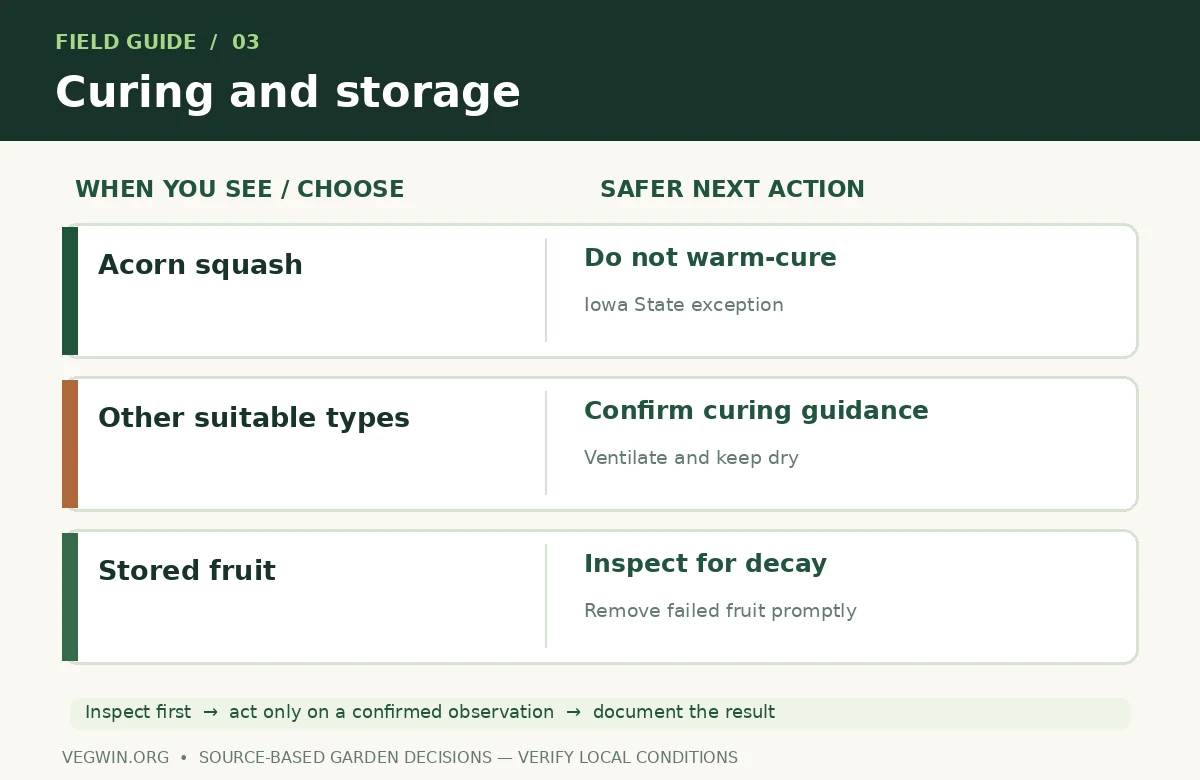
Curing can toughen the rind and help minor surface wounds heal, but not every winter squash is improved by the same process. Iowa State specifically advises against curing acorn types; warm high-humidity curing can reduce their quality and storage life. That exception is easy to miss when general garden advice calls for curing every pumpkin and squash. Confirm the variety before scheduling a warm hold.
For types where curing is recommended, use an appropriate warm and well-ventilated protected environment as described by Extension, avoiding wet weather and fruit sitting in puddles. Keep the fruits separated so air circulates. If available storage conditions do not match the guidance, focus on carefully handling the harvest and using the most vulnerable fruit first instead of improvising extremely hot, enclosed curing conditions. Our guide “Harvest and Cure Sweet Potatoes Without Bruising or Chilling” adds more detail on this.
Inspect the stored crop before rot spreads
Store sound winter squash in a cool, dry, ventilated place that does not freeze and does not have wet surfaces. Extension guidance commonly places long-term squash storage near 50–55°F, but each squash type has its own expected keeping quality. Do not place fruit directly against cold concrete, damp cardboard or another source of condensation. Avoid crushing piles and allow enough room to see each piece. Our walkthrough on how to grow broccoli rabe (Rapini) for tender shoots, not heads sets out each step.
Check stored fruit regularly. A soft patch, leaking juice, new dark decay or a collapsing stem is a reason to remove a squash from the storage group. Do not simply cut off extensive rot and assume the remaining fruit is safe. Use fruits that are bruised or have missing stems earlier if sound, and discard any with spoilage. Keep a note of which variety lasted well in your actual storage area. Our walkthrough on how to grow chayote from a whole fruit on a strong trellis sets out each step.
Related Guides
- When to Harvest Acorn Squash: Check the Rind and Cut the Woody Stem
- When to Harvest Butternut Squash: Check Tan Rind and Cut the Stem
- How to Grow Kabocha Squash From Seed Without Damaging Young Roots
- When to Harvest Kabocha Squash and Handle Its Hard Corky Stem
How We Research and Verify Winter Squash Advice
We used Minnesota Extension’s pollination guide for fruit set, its harvest and storage guide for mature rinds and handling, and Iowa State’s variety-specific guidance to check the acorn exception. Crop labels and local frost records remain essential for timing decisions.
We do not promise a fixed storage life, universal planting date, one curing treatment for all squash, or particular pest-control performance. If you are choosing a cultivar or treating a disease, verify with local Extension and current labeling. This guide contains no confirmed paid product relationship; read the affiliate disclosure. Educational links are used for the three next-step buttons.
No. Iowa State Extension specifically excludes acorn squash from normal warm curing because it can reduce quality and storage life.
Storage quality depends on maturity on the vine; do not plan to finish an immature squash indoors as if it were a ripening tomato.
Check whether female flowers are present, whether pollinators can reach blooms, and whether plants are stressed before assuming a nutrient deficiency.
A firm rind that resists gentle thumbnail pressure is one sign, but pair it with the variety’s expected mature appearance and a hardened stem.
Discard fruit with spreading soft rot, leaking fluid or other obvious spoilage and check neighboring fruit for damage.