
At a glance: Sweet corn is not just a tall vegetable that needs sun. Its edible kernels depend on hundreds of separate pollination events during a brief period when tassels shed pollen and the young ears expose silks. A thriving row of green plants can still produce ears with empty patches. This guide begins with the shape of the planting, tracks what happens at flowering and ends with a direct check of kernel readiness. It is for gardeners growing ears to eat, not for saving genetically isolated seed or producing commercial corn.
Decide Whether Your Garden Can Pollinate a Corn Block
Wind carries pollen from tassels at the top of sweet corn plants to individual silks emerging from the ears. University of Minnesota and Maryland Extension advise planting several short neighboring rows in a compact block, rather than a single long line. A block increases the chance pollen reaches the silks when they are receptive. Before buying seed, sketch the space and the number of rows it can actually support. Corn can occupy more room than the packet photo suggests, and shaded edge rows are not equivalent to a fully sunny planting.
If only a narrow strip beside a fence is available, the honest decision may be to grow a different vegetable instead of promising perfect ears from a solitary row. Avoid treating hand pollination as a guaranteed fix for an otherwise poorly chosen site. The objective is overlapping pollen shed and silk emergence across multiple plants. Note nearby trees, a wall that blocks sun, and prevailing winds. A compact, sunny block with accessible paths gives both pollen movement and room to inspect plants during tasseling.
Choose a Compatible Seed Type Before Any Sowing
Sweet-corn packets may describe standard sugary, sugary-enhanced, synergistic, shrunken or supersweet types. Those descriptions are not just marketing: some genetic combinations need separation from other corn types because foreign pollen can change the eating quality of the current ear. The University of Minnesota guide emphasizes understanding the seed type before planting, and Iowa State explains when distance or different flowering times protect sweetness. Read the packet description carefully before mixing two varieties in one bed.
Growing several varieties with different days to maturity does not automatically isolate them. Cool spells and heat can move pollen shed relative to the calendar. If the planting space is small, one suitable type may be the easiest choice. Cornfields, popcorn and neighboring gardens can also contribute pollen; local recommendations for separation depend on type and geography. Record the exact type and cultivar rather than assuming that any corn pollen will produce the same kernel texture.

Wait for Suitable Soil and Protect Germinating Seed
Corn is a frost-tender warm-season crop, so USDA perennial hardiness zones do not say when to sow it. Check your local frost guidance and measure soil temperature where the seed will sit. Different sweet-corn genetic types vary in their tolerance of cool soil; notably, some shrunken-kernel supersweet seeds need warmer conditions to establish well. University of Minnesota lists type-specific minimums. Use the actual seed-packet guidance and a local Extension calendar instead of copying one national planting date.
Prepare a reasonably even seedbed with drainage and avoid soil that stays saturated after rain. Corn seed planted into cold wet soil may rot or emerge unevenly, which also makes later pollination less synchronized. Check for crusting and emergence before declaring a fertilizer deficiency. Thin carefully if the packet calls for it, but preserve the short-row block arrangement. If gaps appear, replacement sowings may flower too late to help the original block; consider an entirely new block for a later harvest. If you want the full process, read how to grow tomatillos.
Keep Plants Growing Through Tasseling and Silk Emergence
Moisture is especially important when tassels are forming and ears are setting silk. A wet surface over dry soil beneath is not enough evidence of good irrigation. Check a little below the surface in the active root area and water according to soil texture, weather and the condition of the crop. Maryland Extension emphasizes steady water during establishment, flowering and ear development. Corn also needs adequate nutrition, but the right amendment depends on a soil test rather than a universal handful of fertilizer.
Use mulch and shallow weeding where appropriate so competition does not consume available moisture, and avoid damaging shallow roots with deep cultivation. Watch for stalk lodging after high wind, while remembering that a leaning plant is a support issue rather than proof of poor pollen. Keep a short record of drought spells and flowering dates. When an ear has missing kernels later, this record helps you separate a planting-layout problem from stress at silk time.
Read Tassels, Silks and Kernel Gaps as Separate Signals
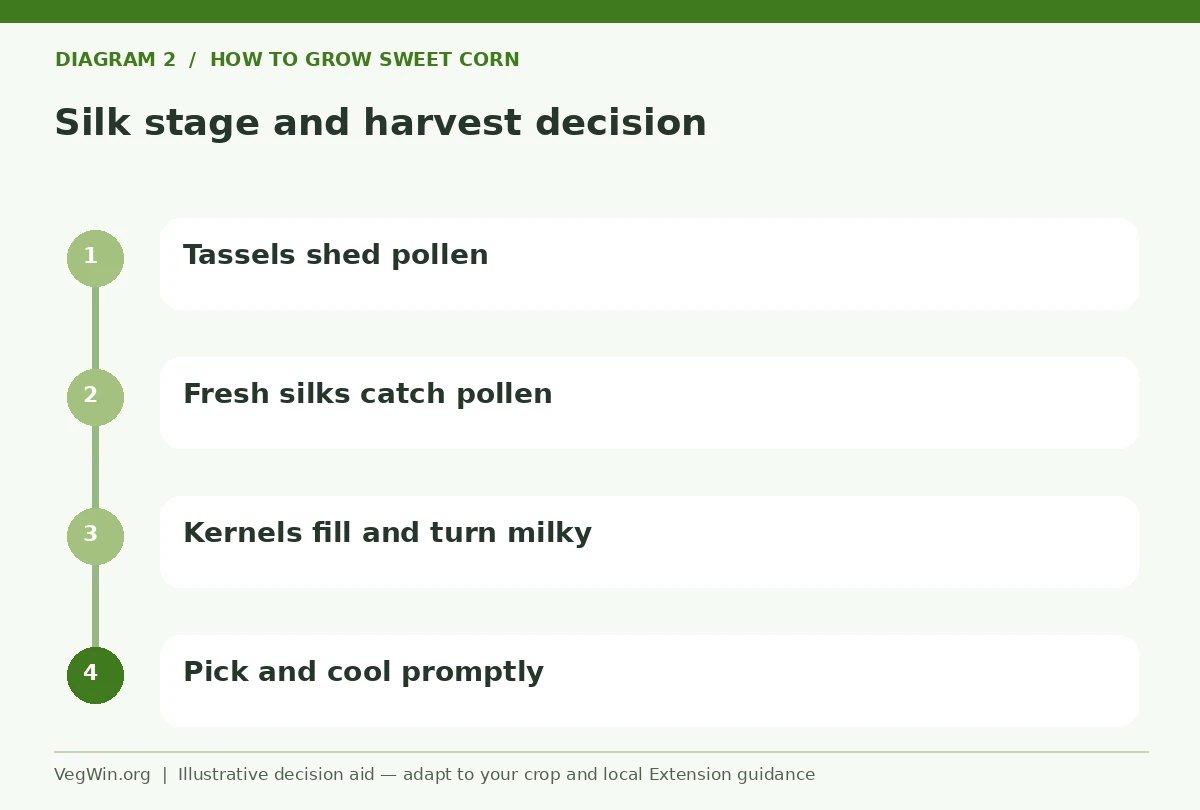
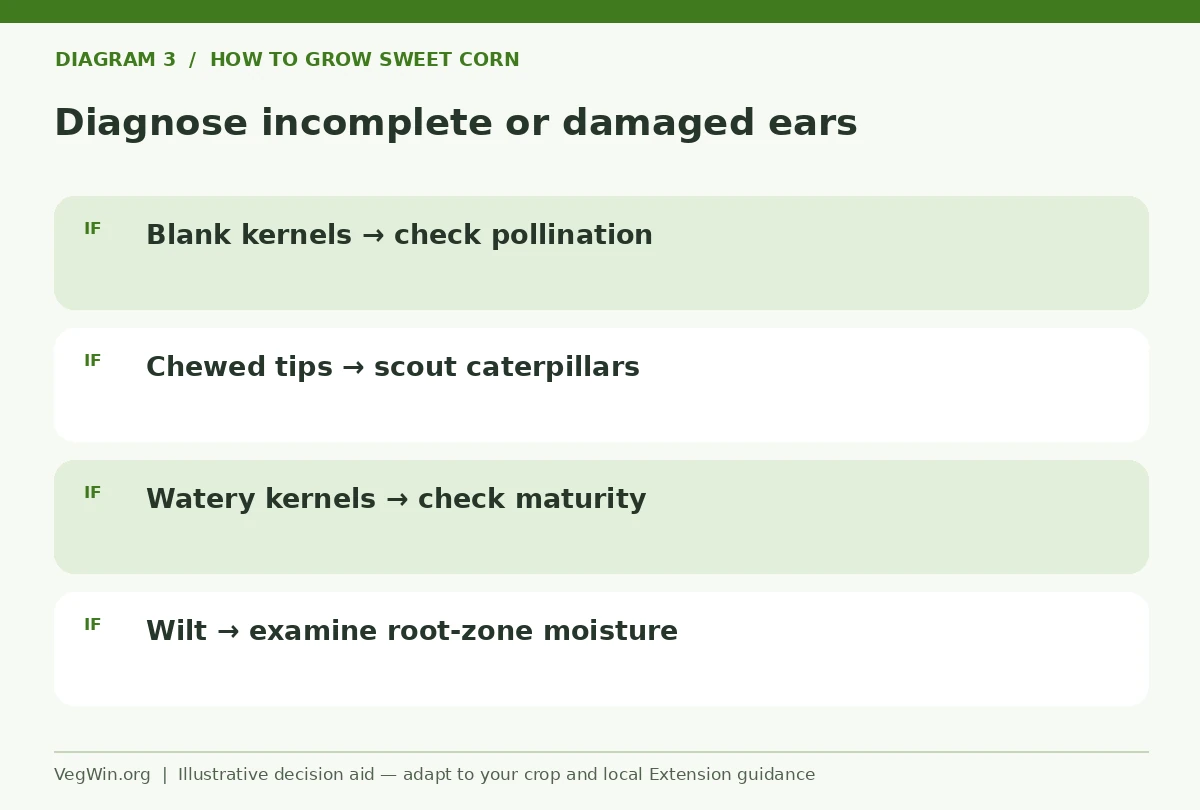
Tassels are the pollen-bearing structures near the top of the plant. Silks are attached to the developing ear; each silk is associated with a prospective kernel. A long delay between active pollen shed and fresh silks can lead to incomplete kernel set. Do not diagnose every partially filled cob as disease or insects without checking the pattern and timing. Empty patches can indicate pollen missed silks, while a chewed area with a caterpillar or droppings calls for a different inspection.
Take a look at several ears across the bed, not one damaged tip. If edge plants repeatedly have gaps and center ears fill better, block geometry deserves attention. If gaps affect plants throughout the block after hot, dry conditions, review irrigation and flowering synchronization. Also, if the ear appears filled but kernels are small and watery, it may simply be immature. These observations form a practical diagnosis; they do not establish a single cause with laboratory certainty.
| What you see | What to check first | Practical next step |
|---|---|---|
| Ears with random empty kernels | Compare pollen and silk dates; inspect block layout | Improve block planting and flowering overlap next season |
| Chewed kernels near ear tip | Look for caterpillar, droppings or feeding trails | Identify pest; consult local Extension IPM guidance |
| Small watery kernels throughout | Check kernel milk stage and maturity | Leave representative ears to mature and retest |
| Plants wilting during flowering | Check root-zone moisture below surface | Restore even irrigation; note stress window |
Scout Insects Without Guessing at Pesticide Treatments
Corn earworms and other caterpillars may feed near the tip of ears. Their presence is a pest-identification question, separate from incomplete pollination. University of Minnesota advises judging management by the history and actual insect activity in the garden. Before deciding anything, inspect damaged ears and compare feeding injury to missing kernels. Check whether husks remain protective and whether damaged ears can be used safely after rejecting spoiled or visibly affected portions.
Follow integrated pest management: monitor, correctly identify the pest, assess the injury and use prevention where suitable. This article does not prescribe an insecticide, mix, dose or home remedy. Any pesticide must be labeled for the crop and target pest, follow its current label and satisfy local rules, including preharvest intervals. Most backyard decisions start with monitoring and sanitation rather than applying treatments to all plants because one ear has a blemish.
Harvest When a Kernel Is Milky Rather Than Clear
Do not rely solely on the stated days to maturity. Sweet corn ripens according to actual weather and cultivar. University of Maryland and Minnesota recommend checking the stage of kernels as silks darken: a pierced, full kernel gives milky liquid when near eating quality; clear liquid suggests immaturity, while overly mature kernels become doughier and less tender. Test an ear rather than stripping several ears on the assumption that one brown silk means all are ready.
Harvest near the time you intend to eat the corn when possible, and cool ears promptly after picking. Note whether the tip is naturally underfilled or shows feeding damage before blaming maturity. For the next planting, record the calendar interval from silk appearance to harvest in your own garden. That local record is more reliable than promising exactly the same number of days every season.
Review Your Block Layout After Harvest
Compare three observations: where the most complete ears developed, whether silk appearance matched pollen shed and which parts of the bed dried fastest. A simple diagram of ear quality by row can show a repeatable edge effect. If the middle did substantially better, improve planting layout next season. If plants grew unevenly, investigate soil moisture, shade and emergence; do not assume extra fertilizer will repair a pollination issue.
Store your notes with the seed type and cultivar name. The next planting decision can then be concrete: keep one genetic type, use a full block, sow after soil is ready, or choose another crop for a garden too narrow to pollinate reliably. Sweet corn is rewarding when these conditions align, but green stalks alone are not an adequate definition of success.
Related Guides
How We Research and Apply Local Evidence
We checked the linked sources on October 20, 2026. Recommendations are limited to the crop facts those sources support; they are not field trials by VegWin or guarantees for every U.S. microclimate. Seed packets, cultivar labels, local weather and Cooperative Extension recommendations take precedence for planting windows, spacing and any pest intervention. USDA perennial hardiness zones alone are not annual vegetable planting calendars. The local WordPress URL inventory was not independently accessible; an editor must compare canonical topics and internal link destinations before publication.
Verified sources (checked October 20, 2026): Corn types, block planting, isolation, crop condition and milky harvest stage; Wind pollination, moisture timing and diagnosing full versus incomplete ears; Sweet corn isolation and pollination geometry. Source descriptions summarize the narrow points used here; they are not claims that a source tested this exact VegWin infographic.
Disclosure: This independent gardening guide contains no paid placements, approved affiliate offers or claimed brand partnerships. Read the general affiliate disclosure.
Frequently Asked Questions
It is possible to grow plants, but pollination and ear filling are less reliable than with several neighboring short rows in a block.
Not necessarily. Some sweet-corn genetic types must be isolated from other types, popcorn or field corn to preserve eating quality.
A mismatch between pollen shed and fresh silks or poorly distributed pollen can leave gaps; check weather and look for actual insect injury too.
No. Combine husk and silk appearance with a kernel test: milk-like juice from a full kernel is a stronger harvest cue.
No. Identify the source of damage and follow local IPM advice; any pesticide use depends on the crop-specific current label.