
A raised bed that remains wet long after a storm can make a gardener feel that the structure has failed. Yet “poor drainage” describes several different problems. Water might be ponding because the surface crusts over, the soil underneath the frame may be compacted, a lining may block the exit path, or the gardener may be watering on top of already saturated soil.
Adding gravel is a tempting quick fix, but the more useful job is to identify where the water stops moving. University of Maryland Extension explains that healthy garden soil holds some moisture for roots while allowing excess water to percolate downward. This guide separates observation from treatment and distinguishes open-bottom beds over soil from containers or beds on paving; these systems do not drain in identical ways.
Check whether water ponds or the entire root zone stays wet
Inspect the bed after an ordinary rainfall, not only during an exceptional downpour. Look for puddles lingering on the soil surface, a shiny packed crust, or consistently wet material several inches below. Use a trowel to check moisture away from a plant’s roots. Surface ponding suggests slow entry into the bed, while saturation throughout the profile may signal a blocked exit or an already saturated soil beneath.
A wilted plant is not proof of drought. Maryland Extension notes that excessive water displaces oxygen from soil pores and roots can wilt because they cannot function properly. Compare moisture at more than one point; an emitter or downspout may create one wet patch while the opposite corner remains dry. Record whether the problem follows heavy rain, daily irrigation or both. That distinction keeps you from chasing a drainage problem with additional watering.
Inspect the bed base and the surface beneath it
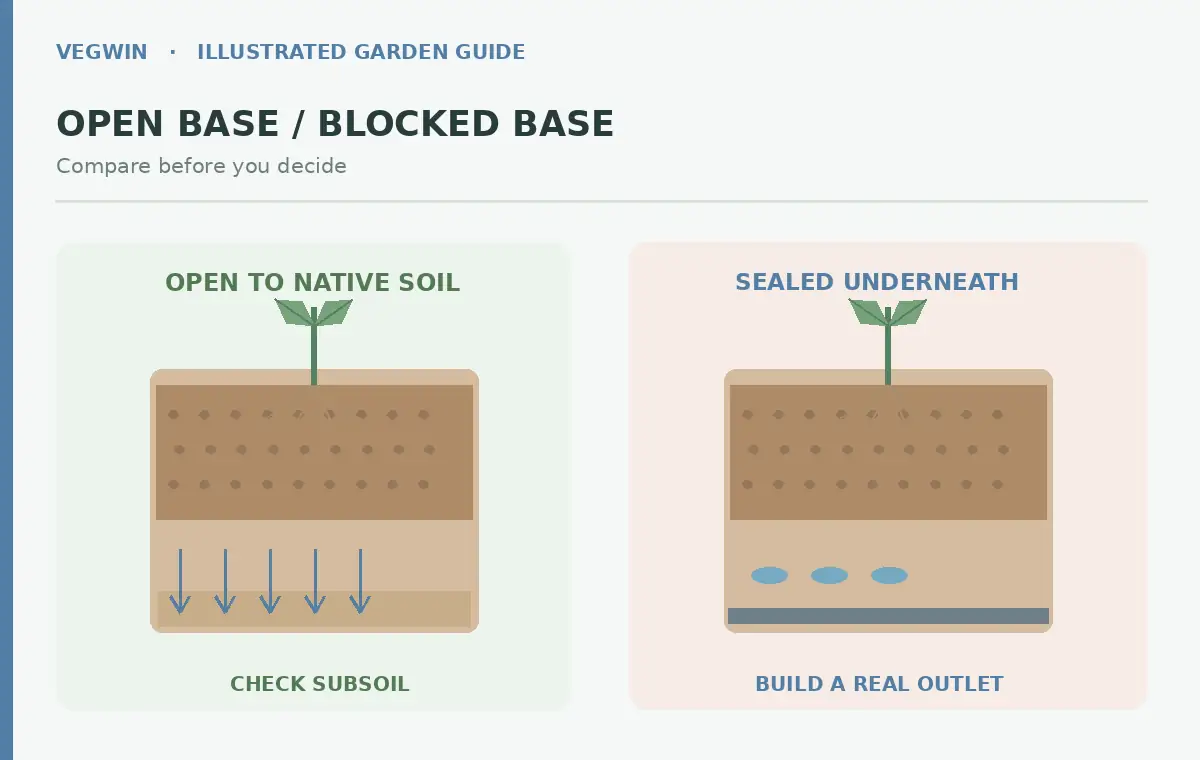
Open-bottom raised beds normally allow roots and water to interact with the underlying ground. Check whether the frame sits on compacted clay, construction rubble, plastic or an impermeable surface. Maryland Extension recommends loosening the soil footprint beneath a new raised bed to help water and roots move downward. If an old bed was assembled over dense packed earth, that transition may be the bottleneck even when the upper fill looks loose.
A bed built on concrete behaves differently. It needs a genuine drainage route out of its base and enough appropriate growing-medium depth for the crops. Water cannot disappear into an impermeable slab. Do not puncture an unknown waterproof building membrane or modify a roof assembly casually; structural load and waterproofing require professional advice. The correct garden fix depends on the actual foundation and where runoff can travel safely.
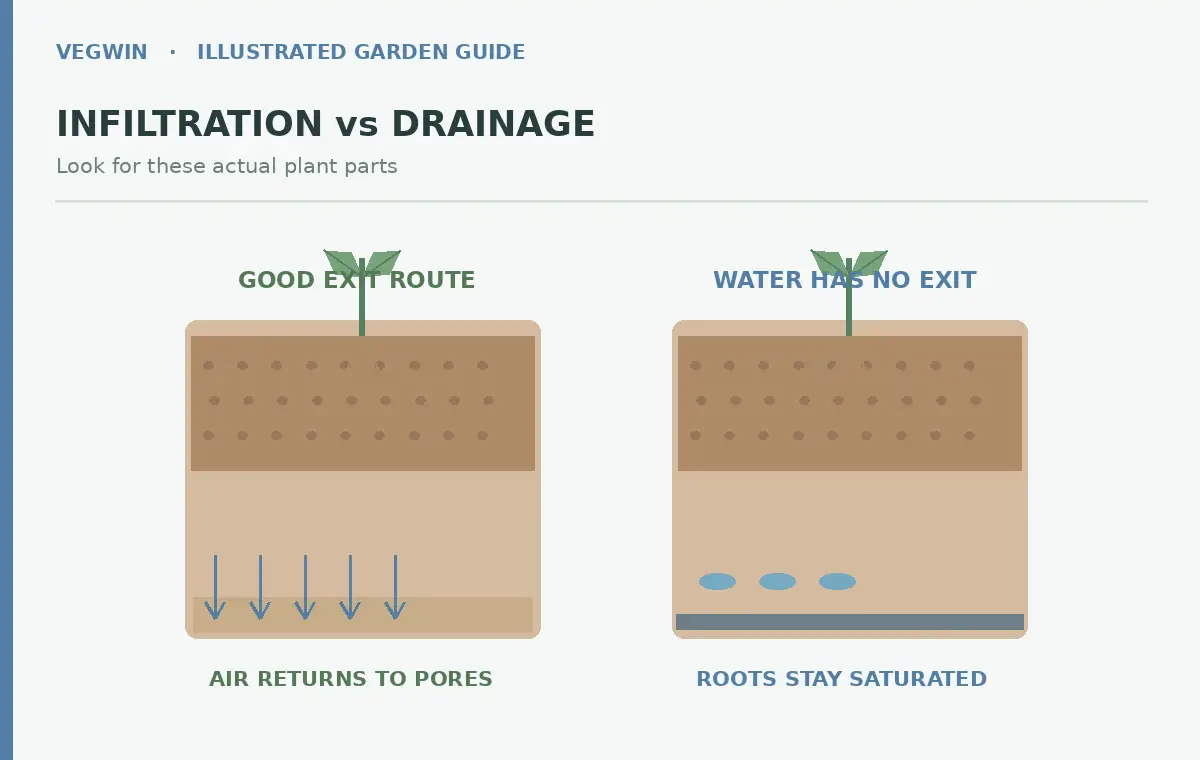
Recognize compaction without digging up every crop
Try pressing a garden fork into a small unplanted section when the soil is workable. If the surface is extremely hard, ask whether people stand on the bed, whether soil was packed down when wet or whether the original fill contained too much dense material. Soil particles need pores of different sizes: some retain available water while others move air and allow excess water to pass. Compaction reduces the latter.
Avoid tilling saturated clay. Working it at the wrong time can smear surfaces and create even denser clods. In a partially planted bed, add accessible walkways around the outside rather than standing inside to reach crops. Where a new bed is being assembled, loosen the original footprint before filling, as Maryland Extension advises. That preventive preparation is often more effective than trying to fix a sealed interface after heavy roots are established.
Do not use a gravel layer as the universal remedy
Putting rocks at the bottom of a flowerpot has long been promoted as a way to improve drainage, but Maryland Extension explicitly cautions that gravel or broken shards do not improve container drainage. Different textures can hold water above their boundary rather than pull it away. An enclosed elevated bed shares some of those container physics, so a neat layer of pebbles is not proof of a better root-zone water balance.
For an open-bottom raised bed over soil, the important question is whether water can percolate out through the entire profile. A gravel strip does not repair a compacted subsoil or a plastic sheet that blocks the route. If the bottom is enclosed, provide a designed outlet and a suitable freely draining planting medium instead of hoping that rocks create an exit. Avoid replacing a known drainage problem with a heavier, costlier one.
Match the soil blend to both air and water needs
Healthy raised-bed soil needs enough pore space for oxygen and enough water-holding capacity to sustain roots between irrigations. Excess fine material can compact, while an extremely coarse blend may dry too rapidly. University of Maryland recommends assessing the starting soil and adding suitable topsoil, compost and sometimes soilless materials according to the site. Buying another bag before diagnosing the original medium may simply recreate the same profile.
Use well-finished compost to improve soil properties where appropriate, not as an endless supply of fertilizer. If you are considering large changes, take a representative soil sample for laboratory nutrient and pH analysis. That test helps with chemical amendments but does not by itself prove drainage is adequate. Physical observation, soil texture and the bed’s exit path must be considered separately. Do not add lime or fertilizer merely because leaves are yellow.
Audit irrigation before rebuilding the structure
Stop or reduce automatic watering temporarily when the bed is already wet and plants are not in immediate danger. Check for leaking drip emitters, uneven irrigation scheduling and sprinklers that overshoot from a lawn. Inspect root-zone moisture several inches down rather than using only the dry-looking surface as a cue. Mulch can make the top surface appear dry even when a lower layer remains saturated. For the next step, our guide to self-watering raised beds explains how to test the reservoir and root zone.
A reliable irrigation schedule changes with temperature, wind, rainfall, crop growth and soil properties. Do not use a fixed daily run time simply because the watering controller offers it. After adjusting, recheck soil over several dry and wet days. A bed that dries normally once excessive irrigation stops needs better moisture management, not necessarily a full soil replacement. This is the least disruptive diagnostic step.
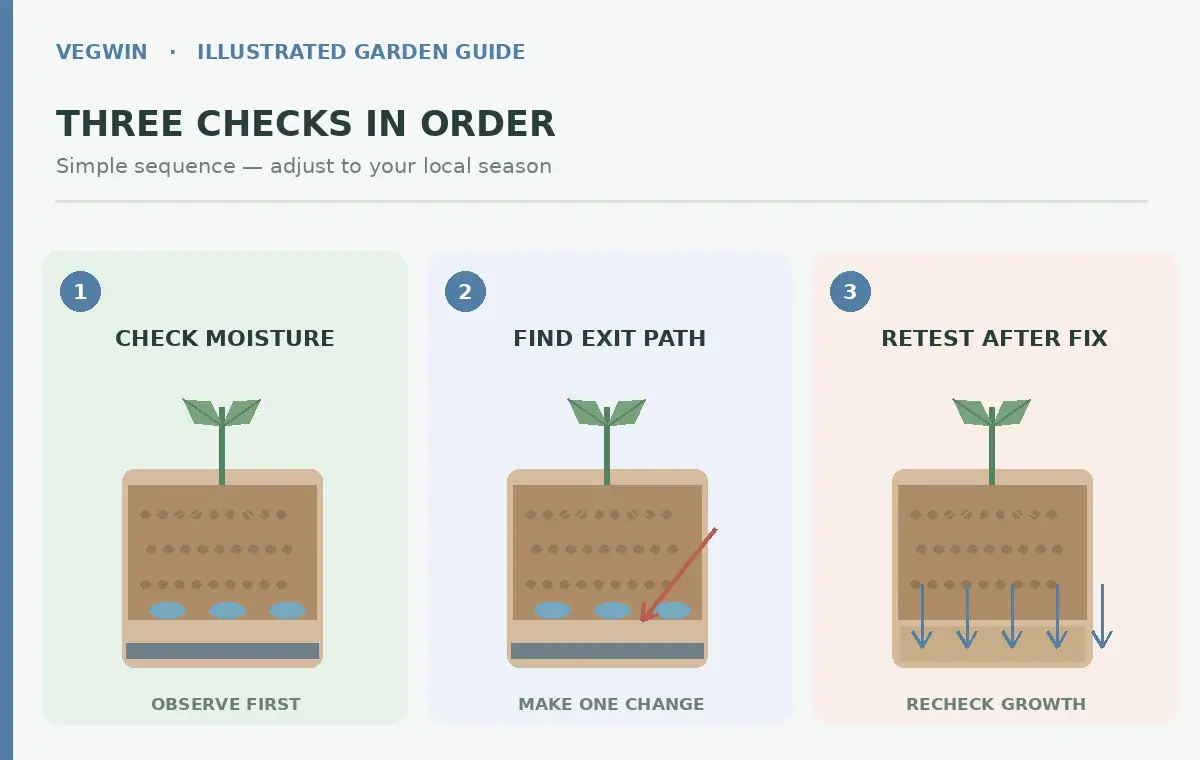
Choose a targeted repair and test afterward
If surface crusting is the problem, reduce compaction and improve the upper soil structure when conditions permit. If a blocked liner causes water accumulation, correct the outlet with attention to the structure and runoff destination. Also, if the open-bottom bed sits over dense subsoil, consider rebuilding the bed to loosen that interface, particularly when crops are out of the ground. If a bed on paving lacks a safe outlet, redesign the container base.
After any repair, watch the next regular rain and the following watering event. Look for better infiltration, fewer persistent puddles and healthy new root growth. Avoid treating a one-time exceptional storm as proof that all soil should be removed. The best fix is the smallest practical change that addresses the point where water is actually being held up, while preserving sufficient plant-available moisture in normal weather.
A Quick Decision Table for Your Next Step
| Observation | What it suggests | Next practical action |
|---|---|---|
| Puddles remain on upper surface | Water may enter too slowly | Check crusting and compaction |
| Fill wet throughout, base sealed | Excess water has no route out | Restore safe engineered outlet |
| Wet area sits beneath one emitter | Irrigation may be excessive or leaking | Audit watering before rebuilding |
| Open-bottom bed over compacted ground | Subsoil interface restricts movement | Loosen footprint during redesign |
Related Guides
How We Research These Garden Recommendations
Research was checked against the named university Extension and botanical horticulture guidance on October 22, 2026. We focused on species differences, observable growth stages, regional limits and interventions that a home gardener can verify. This does not establish a complete full-text audit of every previously published page. The original illustrations are simplified educational diagrams, not measurements or photographs of individual plants.
Sources checked October 22, 2026: Source 1 — Maryland Extension describes how raised beds interact with soil beneath, why loosening the footprint matters and how hard-surface beds differ.; Source 2 — Maryland Extension distinguishes infiltration, downward percolation, compaction and the oxygen problem of saturated roots.; Source 3 — Maryland Extension cautions that gravel and pot shards at the bottom of containers do not improve drainage.. No paid partnership or approved affiliate arrangement is claimed for these informational steps. See the VegWin affiliate disclosure for site policy.
A gravel layer is not a universal drainage fix. Diagnose the soil profile and provide an actual exit route for excess water.
Compacted soil, a blocked base, slow underlying soil, excessive watering and extreme rainfall are different possible causes.
Yes. Saturated pore spaces restrict oxygen reaching roots, which can impair water uptake.
Not by itself. Compost may improve suitable soils, but cannot remove an impermeable base or correct all structural problems.
No. A hard-surface bed needs a functioning outlet and crop-appropriate medium depth; an open-bottom bed connects to the ground below.