
Mature hellebores can form handsome low clumps, but not every plant called a hellebore should be split. Oriental hybrid hellebores are generally the best familiar candidates, whereas several stemmed species are more appropriately raised from seed. Division is also a stressful operation: an arbitrary slice through the center of a crown may leave one piece with leaves but no functioning roots. RHS guidance favors early autumn, with spring just after flowering another option for many clump-forming types. This guide explains how to identify a suitable clump, see the living growing points, retain roots on each section and restore the original planting level without forcing quick flowers.
Identify the Hellebore Before Digging
The name hellebore covers several different species and hybrids. Oriental hybrids, often labeled Helleborus × hybridus, form perennial crowns with leaves and drooping winter-to-spring flowers. RHS describes these as long-lived plants that can be invigorated by division when clumps become large. But RHS specifically notes that H. foetidus, H. argutifolius, H. lividus and H. × sternii are poorly suited to this technique and are better propagated from seed. Do not assume all plants with a similar flower shape have interchangeable division instructions. If the label is missing, identify the habit first or leave the undisturbed plant intact.
Decide Whether Division Is Actually Necessary
A healthy established hellebore can remain attractive and flower reliably for years without disturbance. Consider dividing only when a sufficiently large crown provides several obvious growth points and there is a clear reason to renew or move it. A small recently planted specimen may be more likely to sulk after being uprooted than to benefit from splitting. Do not divide a severely diseased plant merely to increase your stock. If growth is poor, first inspect light, drainage and summer dryness. Hellebores often prefer fertile but freely drained soil with some shade; fixing the site can be better than cutting the root system.
Choose Early Fall or Just After Flowering
RHS favors division in early autumn for most appropriate hellebores, with spring after flowering also possible. This is a growth-based window, not a requirement to work on one universal calendar date. In a warm dry region, fall soil may still be hot; wait for conditions where roots can re-establish without heat stress. In very wet or frozen soil, delay until the ground is workable. Schedule the work when you can water afterward and shade the newly planted sections if needed. Avoid splitting during drought, intense bloom production or immediately before a deep freeze.
Protect Skin Before Handling the Roots
Hellebores contain compounds that can irritate the skin and are harmful if eaten. Wear gloves and avoid rubbing your face while handling leaves, sap, roots and flowers. Keep cut plant material away from children and pets and wash tools and hands after the job. Do not use roots, leaves or flowers in home remedies or tea. If a plant is affected by leaf spot, remove unhealthy debris according to local guidance without dropping it among new divisions. Propagation is not a way to make toxic plant material harmless. The gloves are as important as the garden fork.
Loosen Soil Outside the Whole Root Mass
Mark the perimeter of the clump and begin with a fork well away from the crown. Ease around several sides before lifting; older hellebores can have a surprisingly robust network of fibrous roots. Lifting from only one narrow point often snaps roots and may split the crown unintentionally. Support the root ball from below, shake away enough loose soil to see where shoots meet the crown and inspect for decayed sections. Do not pull on a flowering stalk to remove the root ball. Keep the exposed roots out of direct hot sun while working and prepare replanting holes in advance.

Split Along Natural Shoot Groups
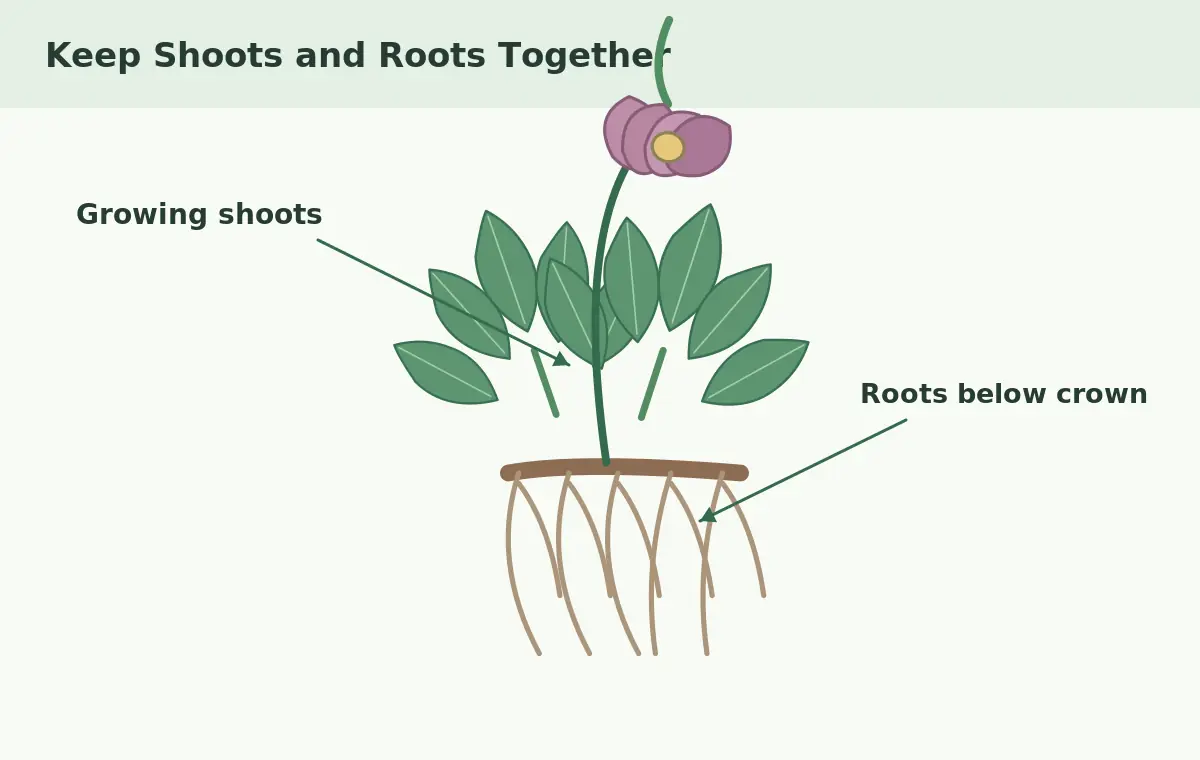
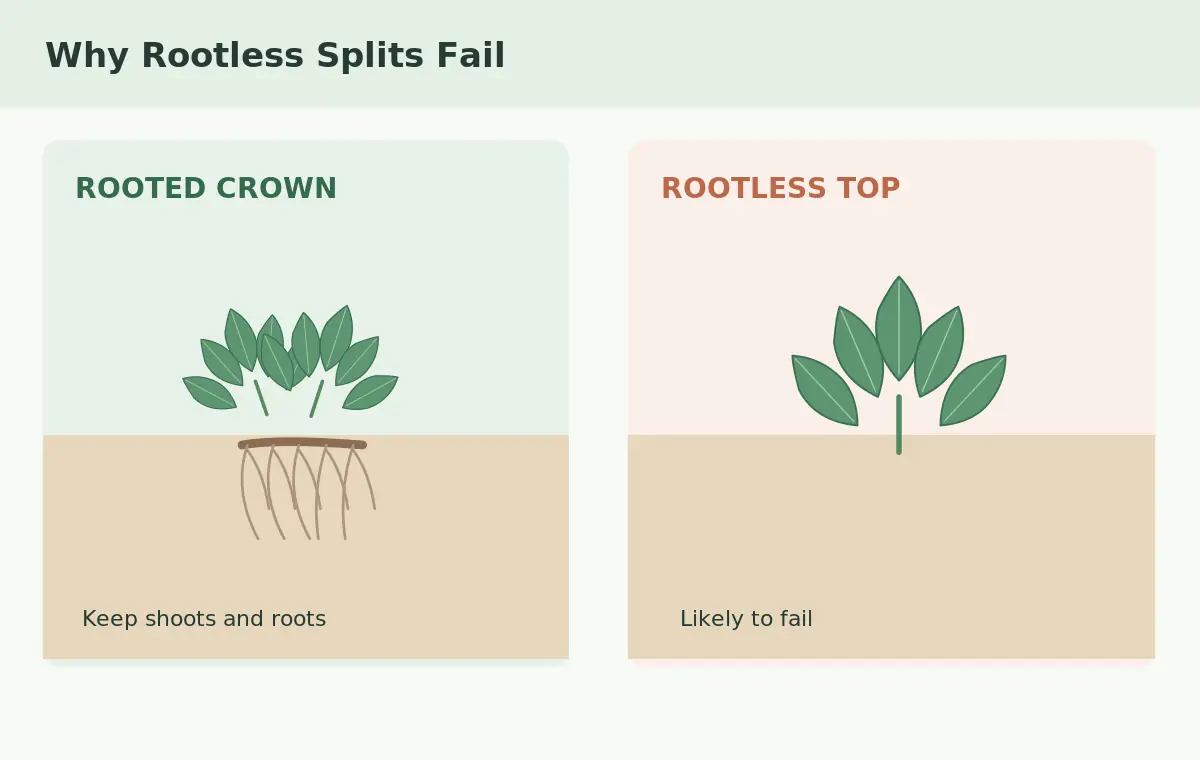
Study the lifted crown for separate clusters of living shoots and attached roots. Use your hands to tease apart loose sections where possible, or a clean sharp knife on denser material. Each intended division must retain at least one viable growing point and a substantial root portion. A bare root scrap with no bud is not a good hellebore division, and a leaf tuft without roots is equally unlikely to establish. Avoid carving the crown into the maximum number of fragments. Two or three robust pieces may establish more reliably than many tiny wounded pieces. Discard obviously dead or rotten tissue.
Replant at the Correct Crown Level
RHS advises setting the first roots at the base of growing shoots around 2.5 cm, or one inch, below the soil surface. This means the growing crown should not be buried deeply under a mound of heavy soil. Set the division into a broad hole where roots can spread naturally rather than curl into a tight knot. Backfill with the garden soil, firm lightly and water to settle contact around the roots. Check the final level after settling. Do not copy the exposed rhizome planting method for bearded irises: hellebores have a different crown and root structure.
Give Divisions Shade and Consistent Moisture
Replanted hellebores need even moisture during their first growing season, but stagnant water can damage roots. Water thoroughly after planting and check the root zone rather than soaking on a rigid calendar. Mulch surrounding soil lightly while keeping material from piling against shoots. Provide partial or dappled shade, particularly where afternoons are hot, and reduce strong wind exposure until foliage is firm. If a few older leaves wilt after dividing, avoid removing all green leaves at once; preserve healthy tissue while roots recover. Watch for signs of continued growth, not immediate large flowers.
Expect Slow Establishment and Variable Bloom
RHS notes that divided hellebores may need a couple of years to flower well again. A modest first season is not necessarily failure if the crown remains healthy and new growth appears. Mark the position of each piece to avoid accidentally digging into it during routine cultivation. Do not use high-nitrogen feeding to force dramatic leafy growth before the root system settles. Check drainage if foliage declines with wet conditions, and keep leaf spot debris tidy where relevant. A well-established plant with a sound crown is a better long-term outcome than immediate showy flowering.
Know When Seeds Are the Better Route
Some upright-stemmed hellebores that resist division commonly make seedlings, and RHS advises seed propagation for them instead. Seed-grown offspring of ornamental hybrids can differ from their parents, so this route is not a reliable method to clone an exact flower color. If a parent plant is rare or unusually small, leaving it untouched while waiting for seedlings may be prudent. Even when a clump-forming species is divisible, root disturbance can be avoided by relocating volunteers. Match propagation method to species, health and purpose rather than applying a universal perennial-division rule.
Authoritative Sources and Further Reading
Recommendations were checked against these resources: www.rhs.org.uk guidance (RHS species distinctions, early autumn or after-flowering division and crown/root depth around 1 inch.). www.rhs.org.uk guidance (RHS lifting and splitting perennials with roots and shoots intact.). www.rhs.org.uk guidance (RHS Helleborus x hybridus horticultural group: division, partial shade and toxicity/skin irritation.).
Related Guides
- When and How to Divide Hellebores Without Damaging Crowns and Roots
- When to Divide Catmint Clumps and Keep Rooted Shoots Alive
- When to Divide Coral Bells and Replant Rooted Heuchera Crowns
- When to Divide Bee Balm and Replant Rooted Rhizome Sections
- How to Divide Bearded Irises and Replant Healthy Rhizomes
How We Research Plant-Care Instructions
We compared the stated plant species and growth stage with the linked Extension, university and RHS sources, distinguished observed facts from practical judgment, and reviewed the botanical structures depicted in this guide. Sources checked October 27, 2026. This intent was screened against 145 available B097–B125 titles; earlier B001–B096 full production files are unavailable, so a complete historical duplication audit is not claimed.
Safety, Climate and Editorial Disclosures
This is educational gardening information, not individualized pesticide, veterinary or medical advice. Recommendations depend on cultivar, local climate, soil and plant condition. No commercial endorsement or paid partnership is implied. Follow legally applicable labels and local guidance whenever products are considered. Read the site’s general affiliate disclosure for related policies.
No. Many Oriental hybrids can be divided, but RHS advises propagating H. foetidus, H. argutifolius, H. lividus and H. × sternii by seed.
Early autumn is often best, with spring just after flowering another option for suitable clumps.
A living shoot or growing bud plus an attached, healthy root system.
RHS recommends about 1 inch of soil over the first roots at the base of the growing shoots, without deeply burying the crown.
They may take a couple of years to become well-established and flower strongly again.