
Sweet cicely, Myrrhis odorata, is a perennial herb with anise-scented divided foliage and delicate white umbels. Its seeds are nothing like tiny lettuce seed: the mature fruits are long, spindle-shaped and ribbed. The bigger surprise is dormancy. The RHS seed-germination guide recommends autumn sowing and a period of cold moist stratification for Myrrhis. The practical job is to keep an identified seed lot cool and moist without drowning it, then recognize the real seedlings in a partly shaded bed. Never harvest an unidentified wild carrot-family plant for food: poisonous lookalikes are a serious concern.
Identify Myrrhis odorata and its distinctive long fruit
Buy seed clearly labeled Myrrhis odorata. Sweet cicely belongs to the carrot family, Apiaceae, with finely divided, two- to three-pinnate leaves, white flower umbels and conspicuously elongated, pointed fruit. The mature dark fruit can be mistaken for a miniature pod or thin grain. It grows attached in a branching umbel where tiny flowers previously appeared, not separately along the leaf rachis.
RHS identifies the plant as a moist-soil perennial for partial shade. Many other members of the carrot family have white umbels, and several wild lookalikes are dangerous. The distinctive fruit and leaf are helpful for learning horticultural anatomy but not proof that a roadside plant is edible. Grow from authenticated nursery stock and do not forage plants or seeds by matching a single diagram.

Choose partial shade and a moist but airy growing site
Sweet cicely suits a dappled-shade location with moderately fertile, moisture-retentive but freely draining soil. This is not the same as a swampy hollow. The RHS plant profile describes its upright growth and possible spread, so leave enough room to view the foliage and flowering stems rather than squeezing it beneath another perennial. Mark the planting area because germination can be slow.
A loose seed-starting compost in a deep enough container can be easier to manage than a busy mixed bed. Either way, give the root zone air and keep the surface from baking dry in unexpected sun. If using containers outdoors through winter, protect them from being washed out by heavy rain while still exposing the seed to the chilling period it requires. Never leave the pot submerged in a tray of water.
Use autumn sowing for natural cold moist stratification
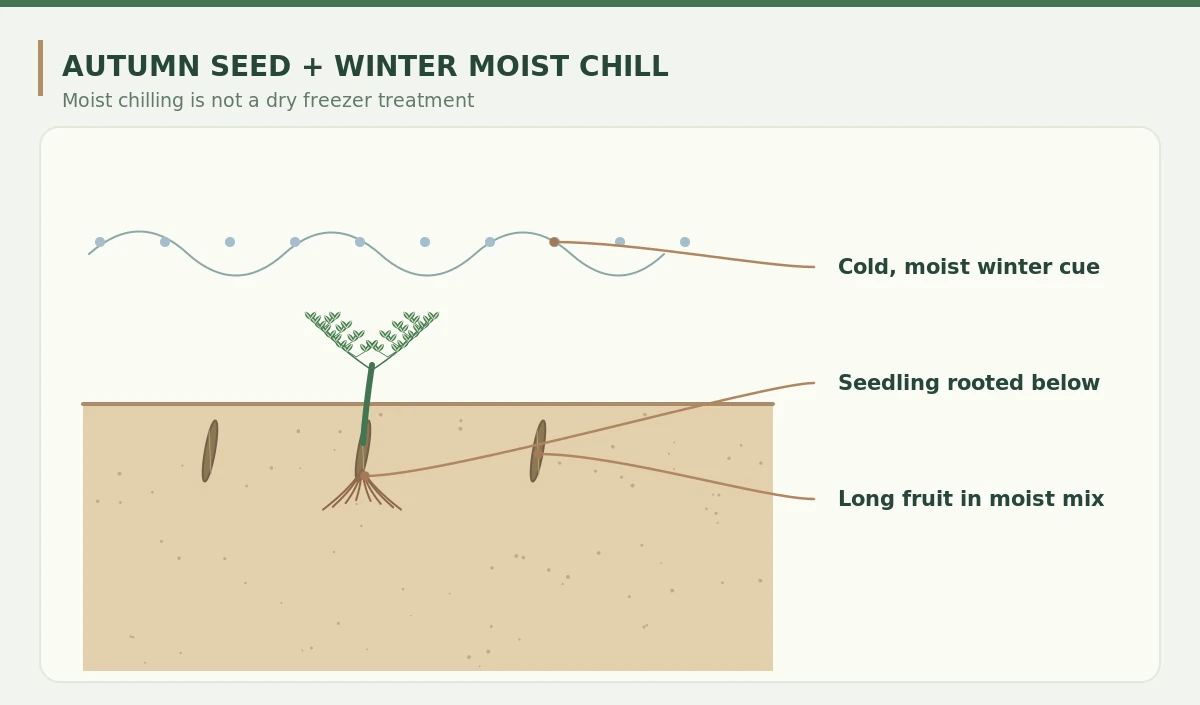
RHS seed-germination guidance specifically lists Myrrhis for autumn sowing and cold moist stratification, with germination potentially taking up to about 90 days under the stated conditions. Outdoor autumn sowing lets appropriate winter weather supply chilling in many climates. Regions without a reliably cold season need a controlled seed-propagation method based on local advice rather than a promise that warm-season sowing will work.
Label the container or bed with the species and sowing date. Cover seed according to a trusted source or packet and keep the medium damp without saturation. A single overnight chill is not a replacement for sustained cold moist conditions. Likewise, dry seed kept in a refrigerator is not automatically stratified: the required cue involves moisture and temperature. Avoid inventing a universal number of weeks for all seed lots.
Prepare a clearly marked sowing tray or seedbed
Use clean equipment and a seed-growing medium that remains open rather than sealing into wet mud. Spread the long fruits with enough space to observe individual seedlings; press them into contact with the medium and cover only as instructed for that lot. Water gently, let excess drain and put a durable plant label where weather cannot dislodge it. Place an outdoor pot where animals will not scratch through the mix.
During winter, check periodically that the medium is still slightly moist; do not keep adding water to already-wet soil. Freezing patterns vary and may affect container plants differently than garden soil. Do not move an autumn-sown tray into a warm greenhouse too early out of impatience. If some seeds sprout at different times, protect the emerging seedlings while allowing the others to finish their dormancy cycle.
Read the true leaves and keep the crown intact
Germinating sweet cicely begins with simpler seedling structures, not a fully developed fernlike leaf. With growth, the foliage develops its characteristic multiple divisions. The leaflets connect to petioles, which arise from a growing crown at the soil surface. A young plant can be confused with a volunteer weed until the true leaf pattern becomes clear, so avoid pulling anything on the assumption that it does not look like the mature photograph.
When transplanting a rooted nursery seedling, keep its root mass together and plant it at approximately the level it previously grew. Avoid burying the leafy crown or leaving roots exposed. Water after planting and observe the plant through a change in weather before harvesting any leaves. The greatest early advantage is a healthy perennial root system, not immediate rapid top growth.
Distinguish the lacy white umbels from developing fruit
Sweet cicely flowers are many small white units arranged in umbrella-like clusters. After pollination, selected flower positions develop long green fruits, then dark ribbed mature fruits. The diagram follows the same branching stem from flowering umbel to elongating fruit. A dry seed lot may consist of the whole fruit structure rather than a naked kernel, which explains its striking pointed appearance.
The presence of white flowers alone does not distinguish this species from all other umbellifers. For a garden-grown, positively identified plant, leave a few umbels if you want seed, but consider removing most flowering stems to support leafy growth; the RHS recommends removing flowering stalks when growing for the foliage. Never invite children to taste unidentified seeds simply because they smell anise-like.
Harvest garden leaves only from confirmed plants
The aromatic leaves are why many gardeners grow sweet cicely, but the identity must be certain and the growing area free from contamination. A cultivated plant carrying a correct nursery label is a better foundation than a wild specimen. Take a modest number of mature, healthy outer leaves only when the perennial is well established and keep central new growth intact.
Use clean cutting tools and wash harvested produce if the plant is being grown for culinary use. Do not claim health benefits, recommend the roots as medicine or substitute this material for prescription treatment. If the plant has set many dark fruits, consider collecting them deliberately or cutting dry umbels before they scatter throughout the bed.

Assess slow emergence before declaring the seed dead
Cold-dormant seeds can emerge unevenly, especially across microclimates and variable containers. The RHS germination schedule is a reference, not a guarantee for every lot. If there is no growth, first check whether the seed actually received its moist chilling period, whether the medium dried out or waterlogged, and whether seeds were lost to animals. Do not dig through the entire tray every few days.
Patience does not mean ignoring contamination: remove obvious moldy surface material and improve drainage and ventilation when necessary. If an old packet fails after a properly managed trial, source fresh correctly labeled seed rather than altering the plant identity. The winning result is an identifiable perennial crown and true compound leaves, not forcing rapid germination with unverified techniques.
How We Research and Check Plant Guidance
For this guide, we checked RHS and university Cooperative Extension material on 2026-10-29: www.rhs.org.uk; www.rhs.org.uk. We compared the plant identity, growth conditions, seasonal constraints and diagram anatomy with the named original sources. The drawings are original explanatory botanical illustrations, not photographs, and different cultivars and local climates can change the exact appearance and timing. We reviewed the supplied WordPress title inventory and the available VegWin batch history for overlapping search intent.
No product in this guide is sponsored and no affiliate purchase is being promoted. Read the VegWin affiliate disclosure for our policy. When a pest or disease is suspected, confirm its identity and use current locally applicable Extension/IPM recommendations before considering any treatment. This growing guide does not provide medical advice or authorize using unidentified plants as food.
RHS specifies autumn sowing and a period of cold, moist stratification for Myrrhis.
Yes. RHS recommends partial shade in moist but well-drained soil.
The seed has dormancy requirements; adequate moist chilling and seed quality affect emergence.
They are long, pointed, ribbed fruits arranged in clusters where white umbels previously flowered.
No. Many carrot-family plants look similar and some are poisonous; use authenticated cultivated stock.