
Disclosure: This independent gardening guide contains no verified paid endorsement or approved affiliate offers. Review the VegWin affiliate disclosure. Local climate, plant variety, soil test and crop-specific Extension guidance may override the general decision framework. The guide focuses on pick the crop you can actually harvest, not a universal gardening recipe.
Define the Fall Harvest You Want Before Choosing Seeds
“Fall vegetables” can mean three separate goals: crops planted in midsummer to harvest before frost, cold-tolerant greens that remain harvestable after light frost, and overwintered plants intended mainly for spring harvest. The list you need depends on which result you want. University of Maryland Extension identifies cool-season vegetables as strong candidates, while noting that late-summer warmth can speed early growth. The first step is to choose a harvest window and the amount of bed space available when summer crops decline, rather than buying one packet of every autumn vegetable. To go further, our guide “Winter Vegetables to Grow” shows how to choose crops for harvest or spring regrowth.
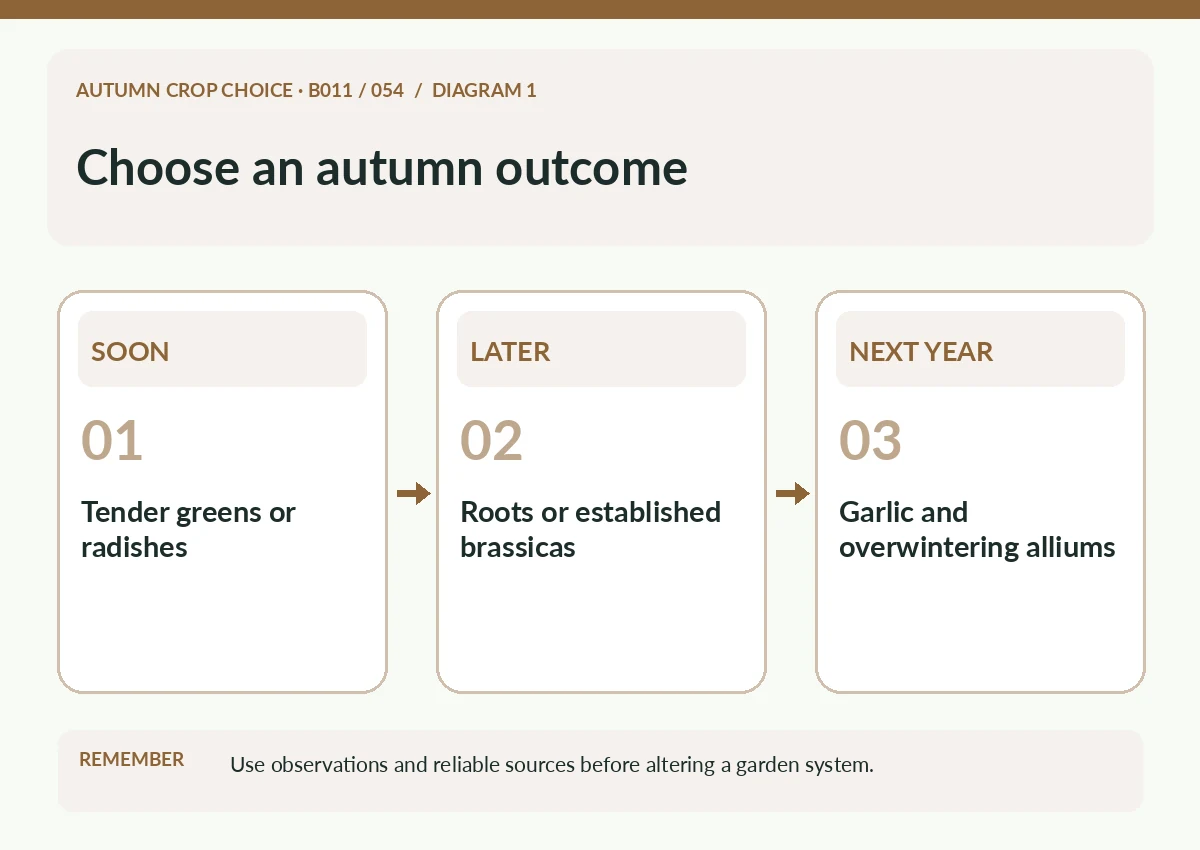
A small garden often benefits most from a few crops you already eat. Radishes and some leafy greens offer quicker options where growing time is short; broccoli, cabbage and many root crops need more planning. Garlic planted in the fall is usually for the following year’s harvest, so it should not be counted as a same-autumn harvest. In milder climates, seasons run differently and some vegetables can be grown over winter. Record whether the purpose is an immediate meal, food storage, overwintering or soil cover. That single choice changes what to sow.
Work Backward From Local Frost Risk and Crop Maturity
Find your local average first-frost window from Extension, weather records and knowledge of your garden. An average is not a guarantee: frost may come sooner or later, and different neighborhoods have different risk. Read the seed packet’s days-to-maturity statement, noting whether it starts with sowing or transplanting. Compare that number with the growing time remaining, then allow for slower growth as days shorten. A plant may survive cold yet produce little new growth when light becomes limiting. Plan a margin instead of setting a harvest on the first possible date. To go further, our guide “Winter Vegetable Gardening” shows how to plan harvests around light and cold.
Do not use USDA plant hardiness zones as autumn vegetable calendars. Those zones describe average winter minimum temperature patterns, not the arrival of a first frost or the soil conditions that seeds experience. Transplants may provide a head start for slower-maturing brassicas, but buying a large transplant cannot guarantee maturity before cold weather. Conversely, direct-sown fast greens can work well where the seedbed is cool enough and watered consistently. Let crop-specific Extension recommendations overrule internet-wide claims like “always plant kale in August.” For more detail, our guide “Direct Sowing Seeds Outdoors” looks at a crop-by-crop success checklist.
Compare Quick Greens, Roots and Brassicas Honestly
Leaf lettuce, arugula, mustard greens, spinach and Asian greens can make sense for late sowings, but they do not all share the same preferred germination temperature or harvest stage. High midsummer soil temperatures can inhibit some cool-weather crops. A crop selected for tender small leaves may be harvestable sooner than the same crop grown to a large head. Spinach can be useful when weather cools, though a late sowing may establish slowly. Maryland Extension lists hardy leafy crops and Iowa State gives locally framed planting advice; combine those rather than treating any list as universal.
Carrots, beets, radishes and turnips differ in how long they need and how they respond to cold. A radish crop may fit a short interval that cannot mature a storage carrot. Roots must develop before freezing soil; surviving foliage alone is not a usable harvest. Kale, collards, cabbage and broccoli can tolerate some cold, but larger brassicas may need earlier starts or transplants to form their edible part in time. Check the cultivar on the packet, not only the crop’s species name. A wide range of varieties can behave differently.
| Harvest goal | Candidate crops | Main constraint |
|---|---|---|
| Quick tender greens | Arugula, leaf lettuce, mustard greens | Heat at germination; slowing light |
| Root harvest | Radish, turnip, beet, carrot | Full root development before freeze |
| Established hardy greens | Kale, collards, selected spinach | Variety, sowing date and cold exposure |
| Larger brassicas | Broccoli, cabbage, cauliflower | Long lead time; transplant availability |
| Following-year harvest | Garlic and certain alliums | Not an immediate fall crop |
Plan for Heat at Planting and Cold Near Harvest
The contradiction of fall gardening is that you often start cool-season vegetables in summer heat. Seedlings can fail when topsoil dries between watering, or when soil is hot enough to inhibit their germination. Shade cloth used judiciously, careful moisture monitoring and site selection can improve establishment in some climates; follow region-specific Extension rather than sealing seeds under an impermeable cover. Start slow-growing transplants where suitable and harden them to outdoor conditions. Irrigate to the root zone, avoid washing seeds out and remove weeds that compete for limited moisture.
Later in the season, choose protection based on the plant and forecast. Lightweight row covers on supported hoops may buffer exposure, but they are not a license to ignore severe freezes or collapsed covers. Crops and cultivars vary in frost tolerance, and cold winds can damage leaves even when a nearby temperature sensor looks acceptable. Iowa State and Maryland Extension distinguish cold-tolerant candidates from tender crops. Inspect after cold events and use only healthy harvestable tissue. Any claimed minimum survival temperature should come from local Extension and the cultivar’s demonstrated behavior.

Match Crop Choice to Available Space and Labor
A long-season summer crop can continue using the space you hoped to plant for fall. Inventory when beans, cucumbers or tomatoes will actually finish, and identify a bed you can clear without sacrificing valuable harvests. Fast leafy crops can fit smaller successive patches, whereas a head-forming brassica needs the final spacing described on its label. Do not crowd plants because the season is ending: short daylight makes poor airflow and competition more costly. If a suitable bed will not be empty soon enough, a fall cover crop or protected container greens may be more rational than late vegetable sowing.
Keep a simple card with columns for crop, variety, intended harvest stage, packet maturity, projected sowing date and local frost risk. The card is a planning tool, not an exact weather forecast. A gardener wanting salad greens may accept smaller early cuts; a gardener wanting storage roots needs enough time for full development. A variety chosen because it claims rapid maturity should still be validated in your climate. This is where local trials and past garden notes pay off more than a universal national planting chart.
Use a Late-Season Go-or-No-Go Decision
As summer wanes, reassess rather than defending the original calendar. If the crop has fewer realistic growing days than its packet requires and you lack cold protection, do not keep reseeding the same failed crop simply to fill the space. Choose a faster leafy harvest, a suitable transplant, or a soil-protecting cover crop instead. If plants are growing well, harvest selectively and observe local freeze alerts. Temporary protection can extend picking, but growth slows under shortening days and the return on extra equipment varies by location.
Before the next season, compare your planned dates with actual frost and harvest dates. Record heat-related sowing failures separately from cold-related crop loss. When an experiment succeeds, record cultivar and harvest stage, because “lettuce survived” is not precise enough to reproduce the result. This article is a crop-selection filter, not a promise of uniform planting dates across US regions. Use the linked Extension guides for local transplant methods, fall crop windows and frost protection, and adjust the shortlist to the climate you actually garden in. For the fuller picture, see our guide “Plan a Fall Vegetable Garden Using Frost Dates and Crop Growth Time”.

How We Research and Check These Decisions
We checked the linked sources on 2026-10-19. The unique reader job is: A crop-choice matrix built around harvest objective, frost tolerance and whether packet maturity begins at seed or transplant, helping gardeners rule out too-late fall sowings. We avoided unsourced fixed planting dates, crop-independent amendment rates and claims that a consumer product guarantees yield. This page is a decision-focused autumn crop shortlist. Original illustrations are decision diagrams, not photographs of trials.
Sources checked 2026-10-19: University of Maryland Extension — Fall Vegetable Gardening; Iowa State University Extension — Fall Planting of Vegetables; University of Minnesota Extension — Planting Vegetables in Midsummer for Fall Harvest; Virginia Tech Extension — Fall Vegetable Gardening. These university documents support particular claims in the source records and are not VegWin sponsors. Extension guidance varies by climate and may change; use local recommendations for exact growing dates, product labels, regulatory requirements and soil-testing methods. Review our disclosure before interpreting any outbound reference as a commercial relationship.
Fast leafy greens and radishes are often candidates, but check the actual cultivar, remaining light and local frost window.
Possibly, but hot soil can inhibit germination. Use your region’s Extension timing and soil-temperature advice.
Some kale varieties tolerate frost, yet growth slows with shorter days and cold; tolerance does not guarantee a full late harvest.
It is often planted in autumn, but is generally harvested the following growing season rather than immediately in fall.
No. Use regional first-frost estimates, days to maturity, cold tolerance, local weather and transplant-versus-seed timing.