
A red-flowering currant is easiest to shape right after its show of dangling pink or red flowers ends. It is an ornamental shrub, Ribes sanguineum, and its pruning schedule should not be borrowed uncritically from a fruiting blackcurrant. Cutting a flowering currant hard in winter or late summer may remove the wood carrying next spring’s buds. The key is to distinguish the shoots that flowered this year from the younger replacement growth that will display next year.
Not every flowering currant needs annual pruning. An airy, balanced shrub can be left alone except for damaged wood. If stems are tangled, a few well-placed thinning cuts after bloom can restore its outline without making a bare framework. This article uses the RHS early-flowering shrub guidance and University of California Master Gardener advice to decide how much to remove—not a fixed height or arbitrary haircut.
Confirm that the shrub is ornamental Ribes
The name currant covers several very different garden jobs. Red-flowering currant bears showy spring flower clusters and is often planted for wildlife and ornament. Edible redcurrant and blackcurrant bushes are managed for their fruiting wood and can require other pruning patterns. Identify the plant by its hanging spring racemes, leaves and label where possible before making cuts. If you are unsure whether the plant was grown for berries, do not remove a whole set of older canes on the assumption it must follow this ornamental schedule. Species and purpose matter more than the common name.
Use the end of flowering as your calendar
RHS guidance explains that flowering Ribes generally develops its blossoms on the previous season’s growth. As a result, the least disruptive shaping window begins when the flower display has finished. In some coastal gardens this occurs early; in colder interiors it can happen much later. Let the actual bloom, not a national monthly calendar, determine timing. Dead and dangerously broken wood can be removed when necessary, but routine heavy cuts while flower buds are swelling sacrifice the current display. Late-season clipping similarly risks cutting the young shoots that were going to carry next year’s flowers.
Decide whether a cut is actually useful
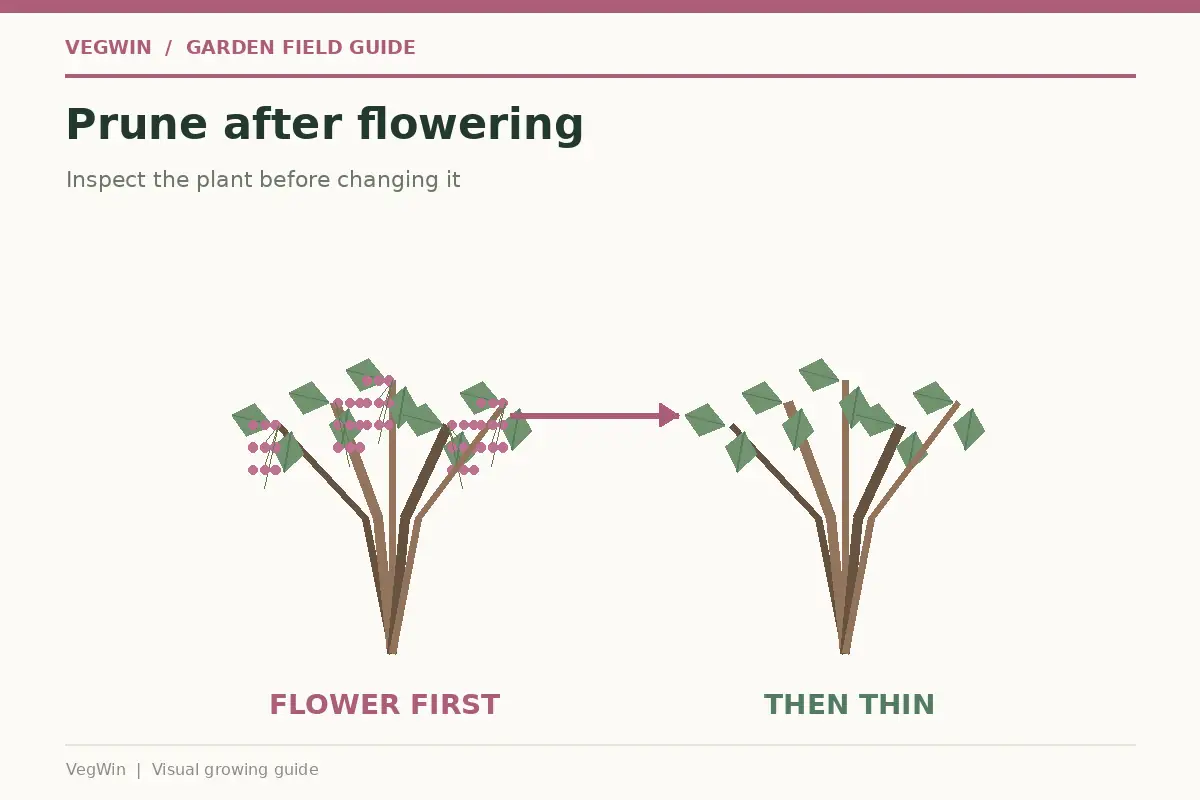
Stand back before opening your pruners. Does the shrub block a path, rub against a structure, or contain crowded crossing branches? Are older stems bare and less floriferous while younger shoots grow through them? Those are specific reasons to thin. A naturally irregular outline is not a defect that needs shearing. When the shrub is healthy and has space, skip the work; every wound is a cost. If renewal is warranted, identify one or two aging branches to remove or shorten at appropriate branch junctions instead of reducing the entire shrub to a uniform rounded shape.
Trace old flowering stems to young replacements
Follow a flowering stem down toward the base or to a strong younger shoot arising below. In many cases the correct cut removes an old finished piece while preserving that vigorous replacement. The RHS early-flowering shrub guide suggests thinning a modest share of aging stems; it does not call for a complete yearly cutback. Examine where remaining shoots point, because an outward-growing young shoot can open a tight center. Avoid leaving long stubs that can die back, and avoid a flush cut into the branch collar where the stem attaches to a larger limb.
| Situation | Action |
|---|---|
| Healthy loose spring bloom | No routine shaping needed |
| Crossing or broken branch | Remove the problem branch at a sound junction |
| Overcrowded old stems | Thin a limited portion just after flowers finish |
| Summer shearing proposed | Avoid cutting next spring’s developing flower-bearing growth |
Thin a little rather than shearing everything
Start by removing dead, broken or obviously diseased pieces with clean equipment. Next deal with rubbing wood and a limited selection of congested or unproductive older stems. UC Master Gardeners warn that severe removal of many stems at once can harm Ribes. Retain useful newer shoots growing in sound directions so the shrub can rebuild a flower-bearing framework. If the plant is very overgrown, spread improvement over several seasons rather than demanding a dramatic transformation in one afternoon. A loose flowering habit serves the plant and its early-season visitors better than an annual buzz-cut.

Handle outward growth at the right junction
If the shrub has simply become too wide, trace the offending branch back to a younger side shoot that points in a better direction. A reduction cut there is usually less conspicuous than chopping all tips to the same level. Check that the retained side shoot is substantial enough to take over growth. Avoid cutting through clusters of new shoots just because they project beyond an imaginary hedge line. Use bypass pruners for small stems and a suitable saw for thicker branches; clean tools when working around suspected disease.
Protect early flowers and their visitors
Flowering currant is an early resource for birds and pollinating insects in many western landscapes. Oregon State Extension includes red-flowering currant in its guidance on nectar-bearing shrubs. Pruning after flowering leaves the display intact and allows you to observe which stems were most productive. When handling fresh stems, check for wildlife activity before removing branches. A shrub planted as a loose habitat border may need less intervention than one next to a narrow walkway. Reduce obstruction where necessary while preserving enough open flowers and leafy replacement stems.
Avoid confusing pruning with plant health treatment
Yellow leaves, powdery growth, sudden branch death or poor bloom are not solved automatically by hard pruning. Check whether the shrub has adequate light, drainage and seasonal moisture, and look closely for pests or specific disease symptoms. Sanitize tools after suspect material and dispose of visibly diseased wood appropriately. Do not spray an unidentified problem just because the plant belongs to Ribes. Before any pesticide use, follow a reliable regional IPM resource and the current product label. Often a light structural thinning and better growing conditions are the most useful nonchemical steps.

Review the framework at next flowering
Photograph the plant after pruning and again during the following spring. The comparison reveals whether retained shoots flowered and whether the center became less tangled. Look for strong young stems replacing removed old wood. If the shrub flowers and fits its site, stop cutting. If a few old limbs continue to shade all young growth, remove another limited portion after the next flower show. The goal is not a mathematically even shrub; it is a stable cycle of replacement wood and accessible spring flowers.
How We Research and Check Recommendations
This guide was researched on October 23, 2026 using the institutional horticultural references below. We separated species-specific guidance from broader garden practice, checked limits on regional timing, and avoided treating a search phrase as a universal instruction. Dates and site conditions in your garden may differ from the examples. The drawings simplify plant structure to explain decisions; inspect the living plant before making a cut, sowing or transplanting.
Sources reviewed: www.rhs.org.uk — Ribes bloom on previous-season growth and are usually p; www.rhs.org.uk — Early-flowering shrub renewal pruning and limits on old; www.ucanr.edu — Avoid severe pruning preserve replacement shoots thin s; extension.oregonstate.edu — Red-flowering currant flowers and benefits to pollinato. Each reference was checked on October 23, 2026. For more information on site relationships, read the affiliate disclosure. There are no paid product recommendations or approved affiliate offers in this article.
You can remove urgent damage, but general winter shaping risks taking off branches already carrying spring flower buds.
No. Ribes sanguineum is grown chiefly for ornamental flowers; edible blackcurrant pruning guidance targets fruiting wood.
No. Selective thinning is typically better than cutting back the entire framework.
Spread renewal over multiple seasons and retain younger replacement stems; severe all-at-once cuts can damage the plant.
Pruning after flowering protects the seasonal display; leaving healthy shoots and suitable habitat helps maintain the shrub’s landscape value.