
Coreopsis is a genus containing different annuals and perennials. A seed packet labeled only “tickseed” can tempt gardeners to follow instructions intended for a different species. This guide is specifically about lanceleaf coreopsis, Coreopsis lanceolata, a yellow-flowered perennial widely used in pollinator and meadow-style plantings.
University of Florida IFAS publishes a direct-seeding calendar for Florida-grown lanceleaf coreopsis, while NC State Extension describes its site preferences and tendency to self-seed. Those facts are useful, but an October-to-January Florida sowing window cannot simply be pasted onto every northern garden. Identify the seed and match timing to your region.
Read the botanical name before opening the packet
Lanceleaf coreopsis is Coreopsis lanceolata. It forms a basal clump of narrow leaves and sends up stems carrying yellow daisy-like flowers. It is not identical to Coreopsis tinctoria, an annual tickseed sometimes included in wildflower mixes. Penn State Extension explicitly lists both taxa in its discussion of seed mixtures. Differences in life cycle affect bloom timing and how the planting persists.

Check whether the seed originated from a regionally adapted native population or a named garden selection. For habitat plantings, local ecotype may matter more than a dramatic catalog photograph. Do not assume every coreopsis is native to the exact county where it is sold. NC State notes that lanceleaf coreopsis is established in North Carolina but likely naturalized there rather than locally native.
Choose a sunny site that drains rather than stays soggy
NC State Extension describes full sun and good drainage as strong choices for lanceleaf coreopsis, which tolerates relatively lean, sandy or rocky soils. Rich, heavily fertilized soil can encourage sprawling growth. Do not prepare the bed as though planting a heavy-feeding vegetable. Remove perennial weeds first; their established roots can overwhelm tiny coreopsis seedlings.
Examine the area after rain. If water remains pooled for a long time, consider a better site or address the drainage problem before sowing. A seedbed needs contact between seed and soil, but it also needs pore space and oxygen. If your garden has persistent shade, select a plant actually suited to those light conditions rather than expecting coreopsis to flower equally well everywhere.
Treat Florida fall sowing as regional evidence
UF/IFAS recommends direct sowing lanceleaf coreopsis in Florida from October through January. In that climate, the cool season supports establishment. Elsewhere, the decision changes with winter severity, soil conditions and regional native-plant guidance. The quoted Florida dates are not a universal command for growers in Minnesota, Colorado or the Pacific Northwest.
Ask local Cooperative Extension, native plant societies and reputable regional suppliers about spring or fall sowing where you live. Decide whether winter precipitation will help germination or wash seed away. If using an indoor-start method, consult seed-lot instructions rather than inventing one required cold-treatment duration. A well-chosen season matters more than copying a calendar from a distant region.
Keep seeds close to the soil surface
UF/IFAS specifies a firm seedbed and very shallow planting for lanceleaf coreopsis, no deeper than one-eighth inch in its Florida guidance. Rake the top lightly, break large clods, and press seed into close contact with soil. Thick mulch, a crusted clay lid or a deep furrow can prevent small seedlings from finding daylight. Avoid broadcasting seed into dense turf and expecting it to compete successfully.

If you mix fine seed with a little dry sand for more even distribution, label the mixture and scatter it carefully rather than dumping it in patches. Gently water as needed so the seed stays in place. Do not cover the bed with opaque plastic that overheats and smothers emerging shoots. Once seedlings appear, keep people, pets and equipment from trampling the young rosettes.
| What you see | Appropriate next step |
|---|---|
| Seed packet says Coreopsis lanceolata | Use lanceleaf-specific site and seedbed guidance. |
| Florida site; fall/winter sowing possible | Use UF/IFAS regional calendar and rainfall checks. |
| Cold-winter region | Confirm season with local Extension; do not copy Florida dates. |
| Tiny seed in firm bed | Place shallowly and protect from soil crusting. |
| Garden border with no room for volunteers | Deadhead before mature seed disperses. |
Water by the condition of the seedbed, not by the clock
During germination, a seedbed that dries out completely can interrupt emergence, yet constant saturation can cause failure. UF/IFAS notes supplemental watering may be needed during abnormally dry Florida winters. That illustrates the principle: water in response to local moisture, weather and the condition of the upper soil layer, not because a timer says every morning.
Use a gentle spray so small seeds are not pushed into low spots. Check after heavy rain for rills, compacted soil or a crust. Do not fertilize a weak seedling bed before diagnosing whether the light, temperature or moisture is suitable. Compost can improve badly structured soil, but large inputs of nitrogen are unlikely to produce sturdy compact lanceleaf coreopsis in naturally lean settings. For a step-by-step method, see how to sow coreopsis seeds.
Separate seedlings from weeds before thinning
New coreopsis seedlings can be easy to confuse with self-sown weeds. Mark the sowing area and take photos as true leaves appear. Compare seedlings with a reliable botanical reference before pulling anything that looks unfamiliar. Thin crowded seedlings gradually rather than scraping the entire patch with a hoe. Give remaining plants enough room for air and the basal leaf clump.
When seedlings are healthy, shift from frequent surface moisture to deeper, less frequent watering appropriate to the soil and weather. An established perennial generally tolerates drier conditions better than newly germinated seedlings. If plants make large leafy clumps but few flowers, assess sunlight and nitrogen inputs before buying bloom boosters. For a step-by-step method, see how to direct-sow California poppy seeds without disturbing taproots.
Decide whether self-seeding is desirable in your garden
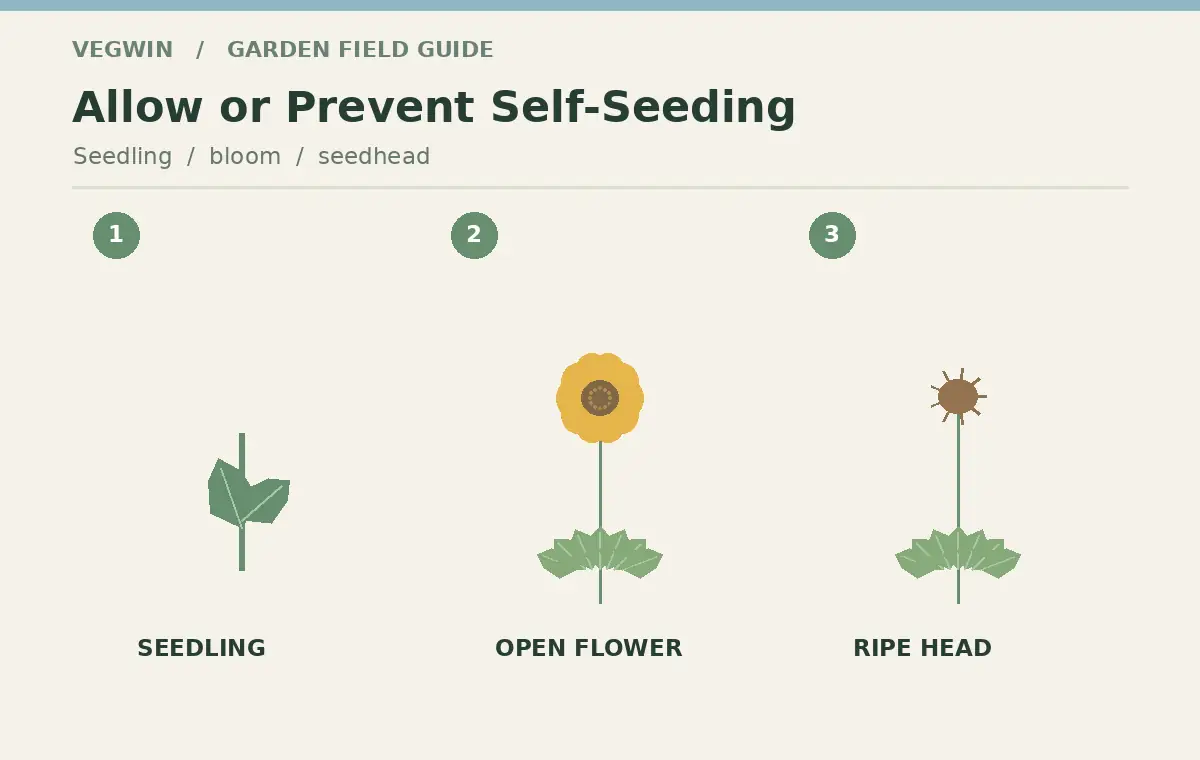
Lanceleaf coreopsis readily sets seed, and NC State Extension describes it as potentially an aggressive self-seeder. That is an advantage in a naturalized meadow patch but a problem in a tightly edged ornamental border. Decide early whether you want new seedlings to fill gaps. If not, remove spent heads before ripe seed disperses. Do not assume every escaped seedling will stay within a decorative boundary.
If you want to save seed, collect heads shortly after they mature, because UF/IFAS notes the seedheads shatter readily. Dry collected seed before storage and label the species, harvest year and garden source. For a habitat planting, follow local guidance about appropriate native seed provenance and nearby sensitive sites. A flower being low maintenance does not make every self-sown plant desirable everywhere.
Check first-season success without expecting instant meadow color
Perennials grown from seed often invest in roots and leaves before delivering an impressive flower display. Judge establishment by healthy rosettes, survival through suitable weather and increasing vigor, not only by flower count in the first few months. Watch for weed competition, winter wet and repeated disturbance. Resist overseeding repeatedly when the original seedlings are simply small.
Keep a record of sowing method, rainfall, thinning and bloom dates. A small trial patch can show whether a seed lot and site are compatible before you plant an entire slope. For ongoing management, divide mature clumps only if needed, following species-specific local advice. Coreopsis is most effective when matched to its soil, sun and maintenance setting rather than treated as a universal wildflower mix. For the basics, see our guide: When to Sow California Poppy Seeds and Why Direct Sowing Helps.
Related Guides
How We Research These Garden Decisions
This guide compares species-specific published horticultural advice with practical home-garden decisions, not an untested social-media shortcut. The sources below were reviewed on October 23, 2026. The advice changes with plant type, growth stage, local weather and the source region. Use your nearest Cooperative Extension where a regional calendar or tree safety assessment is needed. Sources can be revised, and this editorial review is not a substitute for inspecting your own plants.
Sources reviewed: ask.ifas.ufl.edu (UF/IFAS explains direct sowing Coreopsis lanceolata in Florida fall/winter, a shallow seedbed and self-seeding.); plants.ces.ncsu.edu (NC State Extension confirms lanceleaf coreopsis habitat, sunshine, soil drainage and self-seeding behavior.); extension.psu.edu (Penn State distinguishes Coreopsis lanceolata and Coreopsis tinctoria in mixed wildflower seed contexts.).
Editorial and affiliate disclosure: This is informational horticultural content, not a sponsored or paid product review. No affiliate relationship or paid recommendation is claimed. Read the VegWin affiliate disclosure before following any commercial links added after separate review.
No. Identify the species; annual and perennial coreopsis can differ in their establishment needs.
It tolerates lean, well-drained soil and can sprawl with excessive fertility.
UF/IFAS recommends no more than one-eighth inch in its Florida direct-sowing guidance.
No. Follow region-specific guidance for your local winter and spring conditions.
It may self-seed readily; remove spent heads when unwanted volunteers are a concern.