
When daffodil flowers collapse, the leaves can still be doing the most important work of the season. Their green tissue uses sunlight to replenish energy reserves inside the underground bulbs. If the leaves are cut or bundled away immediately because they look untidy, next spring’s flower display may be weaker. The useful question is not ‘How many days have passed?’ but ‘Has this plant finished using these leaves?’. A calendar estimate is secondary to the actual color and condition of the foliage.
Iowa State Extension advises keeping daffodil leaves until they have browned and died naturally. The same university explains that removing a spent flower is optional for daffodils and that braiding the green leaves reduces their ability to collect light. A garden can look neat without sacrificing leaves: use neighboring plants for a visual screen, mark the location of bulbs, and wait for the plant’s own dormancy signals. Here is a decision sequence for beds, drifts and containers. If you are starting from scratch, read When to Divide Overcrowded Daffodil Bulbs After Their Leaves Turn Yellow.
Tell spent blossoms apart from working green leaves
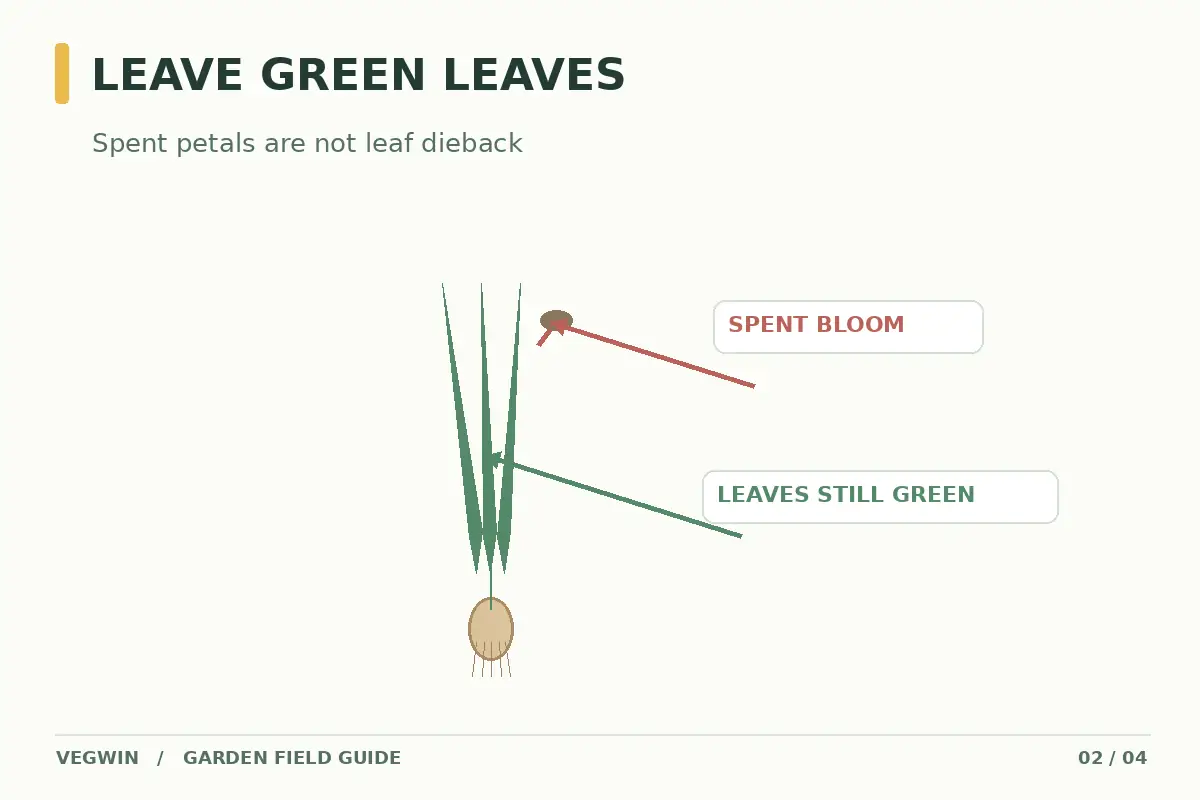
Look for the individual faded blossom at the end of its stalk and distinguish it from the strap-shaped green leaves emerging near the soil. These are different parts with different jobs. A gardener may remove an unattractive spent flower for appearance, but that does not mean the whole stem cluster or leaf bundle should be clipped. If pollination and seed production are of interest, you may deliberately leave some spent heads. Iowa State notes that, unlike tulips, deadheading daffodils is not generally essential to maintaining bulb vigor.
Green leaves remain valuable after the final petal falls, even if they flop to the ground or begin to lose their glossy appearance. A leaf with some yellowing along one edge may still have working green tissue. Resist the urge to measure everything with scissors at the same level. Follow a few marked plants through the season: they reveal how long your bulbs keep foliage in your garden, which can differ from a reference photograph taken in another climate.
Use leaf color instead of a rigid cutting date
University Extension sources give general post-bloom periods, but their precise numbers vary with bulb type, sunlight and weather. Four, six or eight weeks can be useful reminders to inspect, not an absolute instruction to cut. Look instead for foliage that has become fully yellow-brown, dry and clearly nonfunctional. Where the leaves remain green for longer, allow them to stay. Removing green growth just because it is a few weeks past flowering reverses the process that helps the bulb renew itself.
In a cool, mild spring, foliage may persist considerably longer than a gardener expects. In hot or dry sites, yellowing can happen faster, but yellowing caused by severe stress is not a promise that the plant is healthy. If many plants lose foliage prematurely, inspect drainage, soil moisture and possible disease rather than congratulating yourself on an early cleanup date. The goal is not simply a brown leaf. It is a bulb that has had a reasonable season for photosynthesis and recovery.
Avoid tying braiding and folding live foliage
Braiding daffodil leaves is a familiar garden habit that makes a clump look smaller while leaving the blades technically attached. It is still undesirable. Folding and tying reduce the surface exposed to light, and dense wet bunches can be slow to dry. Iowa State specifically recommends leaving the leaves untied and unbraided. The foliage does not need to stand upright in order to work. It merely needs light and a chance to die back naturally.
A low neighboring perennial can disguise the disorder, but it should not cast so much shade that it shuts down photosynthesis. Plant companion foliage around, rather than through, an established dense bulb clump, especially while the bulb locations are hard to see. In turf, mark the edge of a naturalized drift and delay mowing until the bulb leaves have finished. A temporary small marker prevents accidental early trimming by someone who did not see the spring flowers.
Handle watering and fertilizer without overcorrecting
During active post-bloom growth, plants need enough moisture to keep functioning, but bulbs do not benefit from chronically soggy soil. A spring rain may be all an established planting receives; container bulbs can dry sooner and need closer attention. Use soil condition as the guide instead of daily automatic watering. Later, when growth has fully died down, many spring bulbs prefer relatively drier dormancy conditions. Avoid planting them in a spot that stays saturated by summer irrigation. For the basics, see our guide: When to Repot Amaryllis and Help the Bulb Bloom Again.
More fertilizer is not the answer to every weak daffodil clump. Iowa State’s all-about-daffodils guide notes that ordinary daffodils generally need little supplemental fertilization unless a soil test suggests a shortage. Dumping nitrogen around leaves near a routinely fertilized lawn can create a misleading abundance of leaf growth without correcting a flowering problem. If bloom has declined, first inspect sunlight, overcrowding, previous leaf cutting and drainage. Address the identified cause instead of assuming one product can replace stored energy.

Remove dead leaves without injuring bulbs
Once the foliage has died and turned dry brown, cleanup becomes a cosmetic choice rather than a race. Gently remove loose dead leaves that separate easily, or trim only fully dead material with clean tools. Do not tug hard enough to lift bulbs or tear their crowns. If a clump is still green at its base, leave it longer. Mark the position so you do not drive a tool into bulbs hidden below dry litter later in summer. Not every clump reaches the same stage on the same day. For the basics, see our guide: When to Cut Back Bleeding Heart Foliage Without Disturbing Dormant Roots.
Keep leaves showing unusual spotting, distortion or rotting separate from material you intend to compost until the cause is understood. A plant that has failed because of a drainage problem needs that problem corrected before another planting is attempted. Discard obviously mushy bulbs rather than replanting them among healthy stock. Always identify problems before considering a pesticide, and use current local Extension and label directions if treatment is genuinely necessary.
Decide whether crowded bulbs need division
If a clump produces lots of healthy leaves but fewer flowers than it used to, crowding may be one possibility. Shade from growing shrubs, deep planting, excessive fertility and premature leaf removal are others. Examine the conditions over a full season before digging. An established drift that still flowers generously does not need division merely because several bulbs are close together. Avoid disturbing bulbs while leaves are actively feeding them.
For a clump that really needs relocation, wait until foliage has yellowed and died enough that the bulbs have finished their growth. Lift carefully with a fork beyond the visible clump, separate healthy bulbs and either replant under suitable local guidance or store appropriately for autumn planting. Keep varieties labeled if you want to preserve color and bloom time. The timing of dividing and replanting is a separate task from the routine removal of dead foliage.

Make a seasonal after-bloom care checklist
At the end of flowering, decide only whether to remove spent heads for looks; do not automatically shorten the leaves. Over the next several weeks, allow natural light and sensible moisture while the foliage stays green. If the bed looks disorderly, use a nearby plant or an unobtrusive marker rather than a leaf knot. When growth becomes fully brown and dead, clean up gently and record which areas flowered poorly. This simple sequence prevents one common mistake from being repeated every spring.
Photograph a clump just after flowering and again when the leaves have died back. The date of the second photograph is a local record, not a universal recommendation for another garden. Next year, compare flower counts and consider whether changes in sunlight, turf mowing or water affected performance. The most reliable aftercare often involves doing less to the leaves, while paying more attention to what the underground bulbs need from the season. If you are starting from scratch, read When to Cut Back Bleeding Heart After Bloom Without Harming Next Spring.
A quick garden decision table
| Condition now | Action | Why |
|---|---|---|
| Petals faded, leaves green | Optional flower cleanup only | Leaf still feeds bulb |
| Leaves green but flopping | Leave loose, do not tie | Maximize light exposure |
| Leaves fully brown and dead | Tidy gently if desired | Photosynthesis is finished |
| Good leaves but few flowers | Investigate shade and crowding | Cutting is not the only cause |
How We Research and Verify This Guide
This is a topic and title review, not a complete side-by-side audit of all previously published full articles. The supporting illustrations are simplified conceptual drawings rather than photographs or measured botanical plates. Climate-sensitive timing should be reconciled with regional Extension and the exact plant identity. No paid affiliate program is confirmed for this article; see the affiliate disclosure.
Source notes (checked October 22, 2026): yardandgarden.extension.iastate.edu: Iowa State advises waiting for completely brown and dead foliage, with timing affected by site and season. yardandgarden.extension.iastate.edu: Iowa State distinguishes optional daffodil deadheading from retaining foliage and discourages tying or braiding leaves. hgic.clemson.edu: Clemson explains why post-bloom bulb leaves should be retained and how to camouflage the fading foliage.
No. Leave working green leaves until they turn fully brown and die back naturally.
No. Tying and braiding leaves reduce their light exposure and do not help bulb recovery.
Not usually. Removing individual spent heads is primarily an aesthetic decision for daffodils.
Leave them until natural dieback; weeks after flowering are a rough guide, not a strict cutting deadline.
Investigate premature leaf removal, shade, overcrowding, growing conditions and fertility before taking action.