
Red hot poker (Kniphofia) grows long, strap-like basal leaves and upright spikes of tubular flowers that often shift from red or orange buds to yellow lower blooms. Planting in spring with a correctly positioned crown and drainage is a more useful rule than buying solely by its flower color.
Check which Kniphofia you are buying
The name red hot poker covers several Kniphofia species and many garden hybrids, not one fixed-size plant. NC State distinguishes the genus from K. uvaria and notes a broad range of heights and colors. Choose according to the mature spread, flowering season and local winter conditions rather than relying on a photo of a two-toned spike. A healthy plant forms a basal tuft of long, narrow or strap-like leaves and tall leafless flower scapes ending in a dense raceme of many separate tubular flowers. This is not a bulb topped by one giant solid orange cone; each flower has its own attachment to the flowering axis.
Choose spring once wet cold soil has passed
RHS recommends planting kniphofias in spring, when soil is warming and the worst winter wet and cold have passed. This gives roots time to establish before a subsequent winter. Use your local soil and weather pattern, not a universal date for all USDA zones. A potted plant can usually be set out once the garden site is workable and excessively wet periods are ending. Avoid transplanting immediately before prolonged waterlogging or hard freezing. Spring timing is particularly important where soil stays saturated through cold months. Fall planting in a mild well-drained region may sometimes work, but is not the default advice given by RHS.
Choose sun and soil that releases excess water
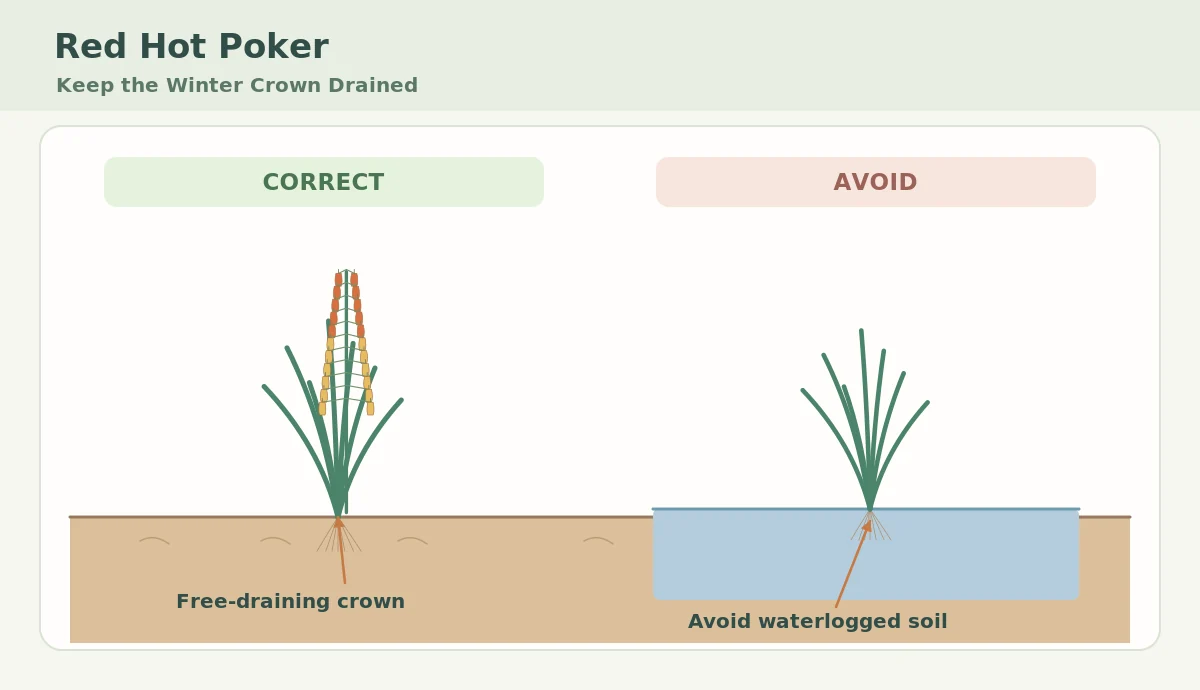
Kniphofias are best in a sunny, free-draining position. RHS warns that permanent wetness, especially in winter, can kill them; NC State also notes root rot in poor drainage. Loosen an appropriate planting area and improve the structure according to local soil guidance, but do not create a water-holding bowl in heavy clay. A raised mound or suitable container is often more reliable than a deep wet hole. Full sun promotes flowering, though particular cultivars may tolerate some light shade. Deep shade is not a good substitute for moisture control. Allow space for arching strap leaves that will emerge around the plant’s center.

Identify the crown, rhizome and living shoot
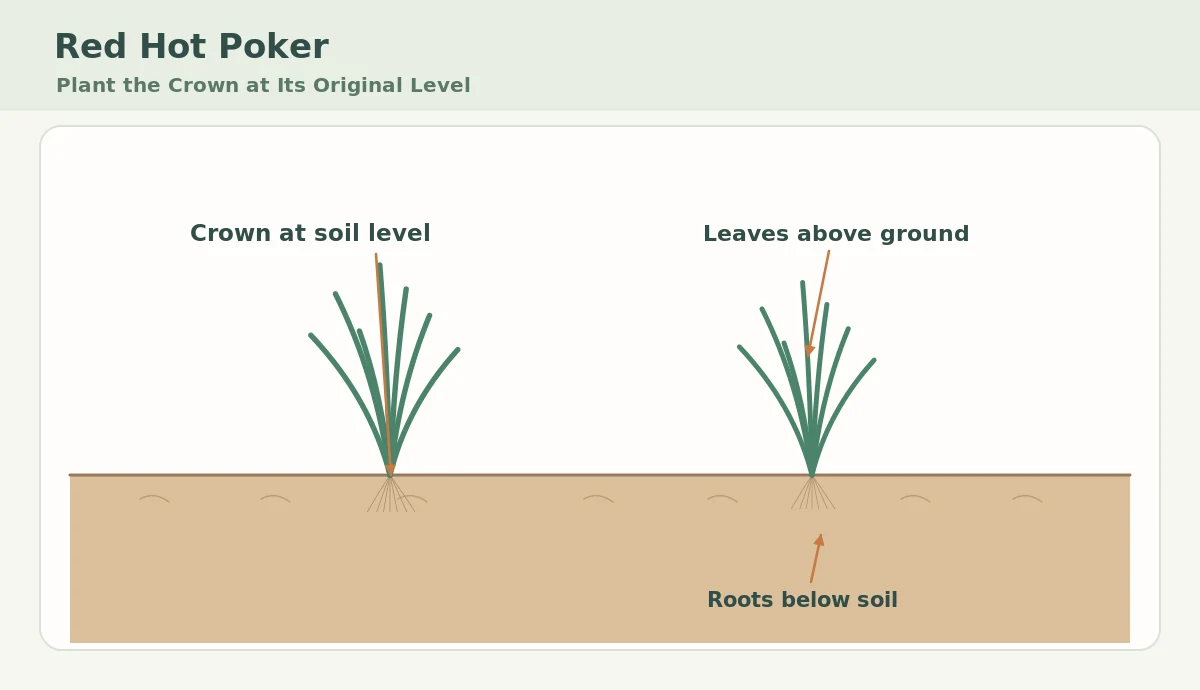
The crown is the basal growth region where leaves arise and roots or rhizomatous structures continue below. The tall flowering scape grows up from that same rooted clump; it is not the root. RHS advises placing a pot-grown kniphofia at the same depth as it was growing, or orienting a dormant planting piece with its emerging top shoot just proud of the soil. Follow the package instructions for the specific bare-root material. In the drawing, roots extend below the soil line, while attached foliage and the top shoot remain above. Labeling a leaf base as an underground root would be anatomically wrong and could encourage harmful burial.
Plant the root ball without creating a wet funnel
Water a dry nursery root ball enough to hydrate it, then remove the pot carefully. Open a planting hole wide enough for the existing root system without aggressively separating every strand. Set the crown at the original nursery level, replace loose soil around the roots, and water gently so the soil settles. A depression that channels irrigation straight into the crown is unnecessary. Keep mulch a little back from the immediate shoot base. If planting a bare rhizomatous division, check that new growth points face up and are not crushed, and follow RHS depth guidance for the material. Do not leave exposed roots suspended in air.
Water through establishment, then avoid constant saturation
During the first growing season, roots need periodic thorough watering when conditions become dry. Established plants are more tolerant of some drought, although flowering and growth still depend on available moisture. RHS emphasizes that waterlogged roots are dangerous. Check the soil below the surface rather than watering on a fixed daily schedule. Container-grown kniphofias dry more quickly than those in the ground and require more attention, but the saucer should not remain filled with water. Pale leaves or a soft crown are reasons to inspect drainage before adding fertilizer. The goal is moist, aerated soil, not a permanently muddy root zone.
Recognize the true structure of the flower spike
A kniphofia spike is a dense array of tubular, often drooping flowers. On many red hot pokers, upper buds are red or orange and lower opened flowers become yellow or cream, producing a graduated torch appearance. NC State describes flowering from the bottom upward. Each individual tubular flower attaches to the upright scape through a small flower stalk or base. The sword-shaped leaves remain in a lower basal clump and do not grow from the top of the flower cone. This anatomy matters when trimming: the spent flowering scape may be removed while healthy basal foliage is left to continue supplying the crown.
Cut spent scapes without shearing green foliage
After a flower spike has genuinely faded, remove its scape near the base without cutting through emerging leaf fans or new buds. Use clean sharp secateurs and keep the blades on the actual flower stalk. NC State recommends removing spent flowering spikes to encourage a tidy plant, while RHS advises removing dead leaves in spring. Do not cut every green strap-like leaf to soil level while the plant is actively feeding its underground tissues. For a deciduous form, more foliage may naturally die back; for an evergreen cultivar, retain sound leaves through winter where possible. Exact pruning needs vary by cultivar and climate.
Protect the crown from prolonged winter wet
A Kniphofia that tolerates winter cold in a published hardiness range may still rot in persistently wet soil. RHS recommends protection from winter wet; some gardeners tie remaining leaves loosely over the crown or use suitable dry material to deflect excessive rain. A mulch should not trap sodden debris right on the growing point. Clear out collapsing or decaying leaves when appropriate and keep drainage routes open. Do not seal the crown in non-breathable plastic. If the site repeatedly ponds in winter, consider moving the plant at a safe season to a raised draining position rather than repeating unsuccessful protective covers every year.
Check new growth before dividing or moving
Kniphofias are clump-forming perennials and some spread by rhizomes or offsets. RHS describes division in spring and notes that seed-grown plants may take years to flower and may not match named cultivars. Do not divide a struggling, newly planted clump simply to make it look more productive. Wait for healthy active growth and only separate rooted pieces when needed, retaining growth points and sufficient attached roots. Check for emerging basal shoots in spring before declaring a winter-dormant clump dead. A successful first season means an anchored, well-drained crown and a healthy leaf fan, even if spectacular torch spikes come later.
How We Research and Illustrate These Garden Steps
For this guide we reviewed horticultural guidance from www.rhs.org.uk; plants.ces.ncsu.edu; plants.ces.ncsu.edu on October 30, 2026. Sources distinguish species identification, practical timing, transplanting, and care. Conditions and cultivar differences mean that a local Cooperative Extension service and the actual seed packet remain important for site-specific decisions. Botanical drawings illustrate connected plant anatomy but are not measured planting-depth templates.
VegWin provides independent educational garden information. The navigation links in this article lead to VegWin content, not paid recommendations, and no affiliate relationship is claimed. Read our affiliate disclosure. For uncertain plant identity, poisoning exposure, or serious disease, seek appropriate professional or Cooperative Extension help.
RHS recommends spring as soil warms and winter wet and cold have eased.
No. Pot-grown plants go at their previous level; new shoots on dormant planting pieces should remain correctly oriented.
Prolonged wet soil around the crown and roots can cause rot, even in otherwise suitable climates.
On many cultivars individual tubular flowers change as they open, often producing red-orange upper buds and yellower lower flowers.
Yes, typically in spring, but keep rooted offsets with sound growth points and avoid needless disturbance.