
A hardening-off plan is easy to write for seven perfect spring days, but real weather rarely cooperates. A sunny afternoon may be followed by a windy evening, a chilly shower, or an unexpected hot spell. The useful question is not simply how many days a seedling has spent outside. It is whether today’s conditions provide a safe next exposure for that crop. This guide provides a repeatable decision log for gardeners who move trays between a protected space and an outdoor location. It complements, rather than replaces, a full explanation of acclimation or a diagnosis of already injured seedlings.
Start With Crop Condition Instead of a Fixed Day Number
Before moving a tray, read the plant and the next forecast together. A sturdy, well-rooted brassica transplant and a tender young pepper seedling do not handle the same conditions identically. Check whether the root ball holds together, whether recent new leaves are healthy, and whether the media is damp but aerated. Seedlings already wilting indoors should be stabilized before testing sun and wind. Record the crop and variety rather than treating all trays as one batch. Our guide to hardening off seedlings goes into more detail.
University of Maryland Extension describes hardening as a gradual acclimation that can take roughly five to fourteen days depending on crop and conditions. That span is context, not permission to progress one stage every calendar day. If your weather shifts sharply, consider an unchanged sheltered session successful maintenance rather than a failure to follow a schedule. Do not use deliberate wilting or severe cold as a shortcut to toughness.
Make a Go, Hold, or Bring-In Decision Before Each Session
Write the planned outdoor location, shade level, expected wind and forecast overnight conditions on one card. GO means a mild period in a sheltered place with a way to retrieve the plants. HOLD means repeat the last tolerated exposure because sunshine, temperature or wind is more challenging today. BRING IN means significant cold risk, strong gusts, heavy rain or an unattended location creates a poor test. The crop, not a universal temperature threshold, determines what is unsafe.
It helps to distinguish predicted conditions from what the tray experiences. A concrete patio may reflect heat onto leaves while a sheltered porch remains cooler. Wind can dry shallow cells even when ground beds stay damp. Observe the tray halfway through an unfamiliar exposure and do not leave it outside merely to complete a planned number of hours. Record changes in leaf posture and substrate moisture alongside the next-day forecast.

Change Just One Exposure Variable at a Time
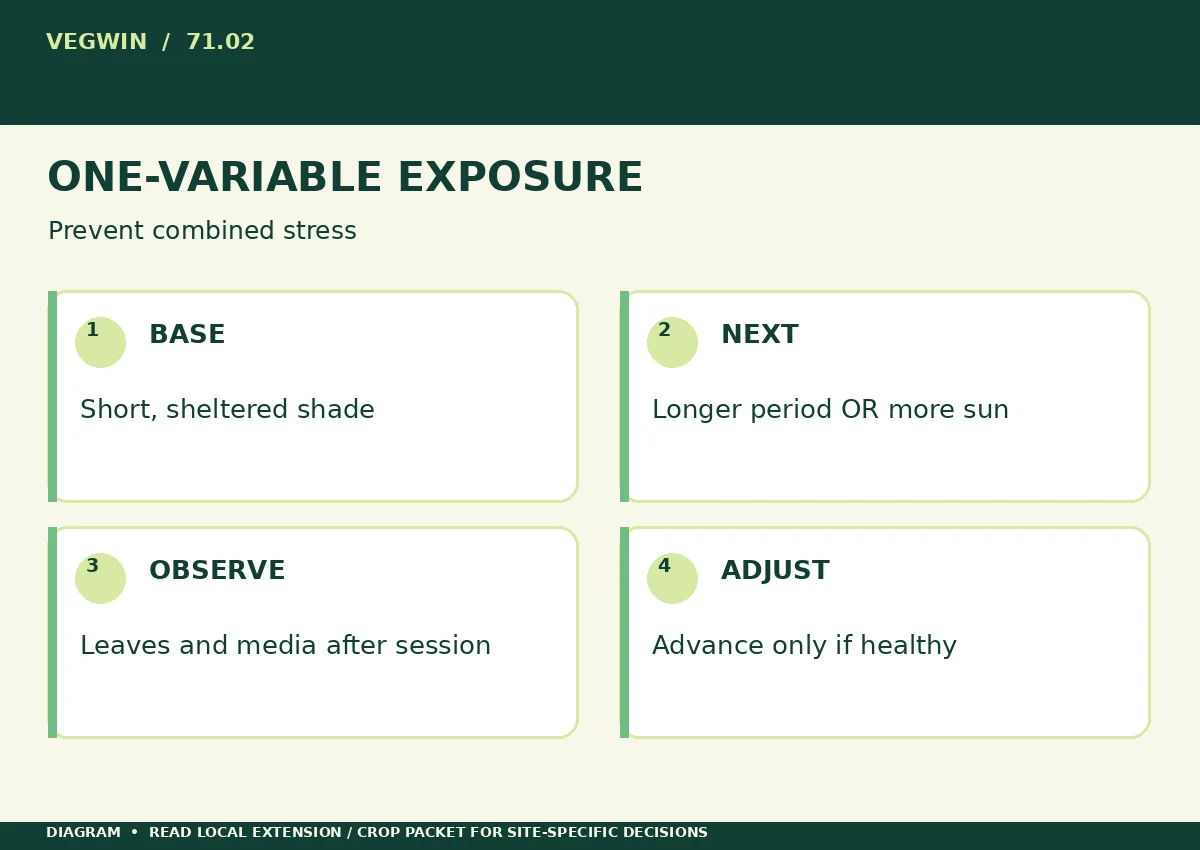
Start with outdoor shade and protection from direct wind. University of Minnesota Extension recommends a short, sheltered outing before increasing sunshine and time. When the foliage stays normal after the session, lengthen exposure or increase light slightly, but avoid increasing both abruptly on a much warmer day. Direct midday sun, drying wind and low nighttime temperatures combine stresses, which makes the cause of wilting harder to interpret.
If you have a cold frame, it is a tool for controlled transitions, not an automatic exemption from monitoring. Closed frames can become hot in sunshine; venting and daily checks matter. On a balcony, air movement can be stronger than at ground level, so the most sheltered position may be more appropriate than the brightest one. A useful log records exactly what the plants actually experienced rather than only whether they were outdoors.
| Situation | Practical choice | Important check |
|---|---|---|
| Gentle, sheltered weather | GO: repeat or slightly expand exposure | Check leaves after session |
| Hot sun or drying gusts | HOLD: use shade and protection | Review media and leaf response |
| Cold night or risky forecast | BRING IN: protect crop | Confirm species tolerance |
| Visible lasting leaf damage | RETREAT and diagnose | Do not increase stress tomorrow |
Use Plant Response to Decide the Next Day
At the end of each session, compare leaves before and after. Leaves should remain reasonably firm and continue growing normally. A brief change in leaf angle may reflect light direction, but persistent limp stems, bleached patches, or brittle margins are reasons to reduce exposure and investigate moisture and weather. Do not reflexively fertilize or spray foliage to repair a bad hardening session. Look for healthy new growth rather than expecting damaged tissue to turn green again.
Separate leaf injury from media problems. If the entire root ball dried rapidly, restore even moisture and improve wind shelter; if it was soaked, avoid creating another waterlogged episode. A tray suffering major collapse should be assessed for root disease or other causes instead of automatically blaming sun. The diagnosis-focused article in the existing VegWin queue addresses these symptoms in more detail; this page is solely a decision tool for what to do next.
Plan Around the Next Transplant Opportunity
Hardening is preparation for a suitable transplant window, not a guarantee that any calendar date is safe. Before scheduling the final session, confirm local frost risk, soil condition and crop tolerance using nearby Extension advice. A seedling acclimated to daylight does not become frost-proof. If outdoor planting must be delayed, hold plants in adequate light and appropriate containers rather than forcing roots to remain crowded in tiny cells for an indefinite period. Our guide to hardening off plants covers a safe step-by-step outdoor transition.
When a safe planting day appears, choose a calmer period and maintain the root ball carefully. If hardening stops for several indoor days, judge the next exposure conservatively instead of assuming the plant retained full tolerance. Note any protected holding area you can use during interruptions. The objective is uninterrupted establishment after transplanting, not a perfect-looking calendar record.
Keep a Three-Line Daily Hardening Log
A useful field log has only three entries: CONDITIONS (shade, wind, daytime and overnight risk); RESPONSE (firm leaves, slight stress, or clear damage); and NEXT ACTION (advance, repeat, retreat, or transplant). Compare the same tray at the same point each day if possible. The log helps distinguish a genuinely tolerant transplant from one that survived a single lucky mild afternoon.
Keep the entries practical, not falsely precise. There is no research-backed universal formula that converts one cloudy hour into a number of sunny minutes for every vegetable species. Use the log to test whether today’s conditions were reasonable and whether the next forecast is better or worse. If repeated severe weather blocks safe acclimation, delay transplanting and keep plants healthy under appropriate protected conditions.

Know When a Separate Guide Is Not Needed
If you only need a standard sequence of shade, increased light, and final transplant readiness, use the earlier hardening-off tutorial. If leaves are already white, brown or collapsed, begin with the prior symptom-based recovery guide. This weather-interruption card is useful only where daily decisions are the reader’s main problem.
For readers, the central habit is simple: forecast first, check the crop, choose a sheltered session, observe the response, and adjust tomorrow. Treat exceptionally harsh days as a reason to protect the plants instead of a test of determination. Protecting seedlings before transplanting is more valuable than following a rigid countdown.
Related Guides
- How to Start Vegetable Seeds Indoors: Timing, Trays, and Transplant Care
- How to Harden Off and Transplant Pepper Seedlings at the Right Depth
How We Research and Check These Recommendations
This article was reviewed against public university Extension materials on 2026-10-20: University of Maryland Extension University of Minnesota Extension. We compared crop-specific recommendations, the circumstances behind them, and where different regions may advise different practices. Verify local weather, soil tests, cultivar packet details, and updated Extension guidance before making irreversible decisions. An automated preflight checks formatting, not biological accuracy or website intent overlap.
Disclosure: This is an educational article, not a paid product recommendation. See our affiliate disclosure. The destination page and existing WordPress URLs require live verification before manual publication; the informational source links were separately checked.
No. Crop tolerance, nursery growth, container size and actual conditions differ. Group trays with similar tolerances and assess them separately.
Yes, a mild sheltered outing may be useful acclimation, but it does not replace gradual adaptation to direct sun.
Only when local overnight conditions are suitable for that crop and the plants have responded well. One week is not an automatic safety threshold.
Not necessarily. Reassess plant condition and resume at an exposure the seedlings can tolerate; reduce intensity if they were indoors for several days.
Scorched patches often remain damaged. Protect surviving growth and check for healthy new leaves before deciding whether the plant is usable.