
Sesame (Sesamum indicum) is a heat-loving annual grown for seeds inside upright capsules, not a perennial whose performance can be predicted from a USDA hardiness-zone number alone. The decisive questions are whether your soil becomes reliably warm, how long your frost-free season lasts, and whether pods have time to mature and dry. Sesame also has an unusual harvest challenge: older capsules low on the plant may ripen while flowers are still opening above. Understanding the sequence prevents most false promises about growing sesame in a cool garden.
Use frost-free growing time instead of a zone label
USDA hardiness zones summarize average extreme winter lows and are most useful for judging perennial cold survival. Sesame grows as a summer annual, so a zone number by itself cannot tell you whether pods will mature. A warm coastal site and a cool mountain site may share a zone but have very different summers. Estimate time between your usual last and first frosts, then compare it with the cultivar’s maturity guidance. Remember that a predicted number of days is not a guarantee under cloudy, wet or unseasonably cool weather.
Wait for thoroughly warm soil before direct seeding
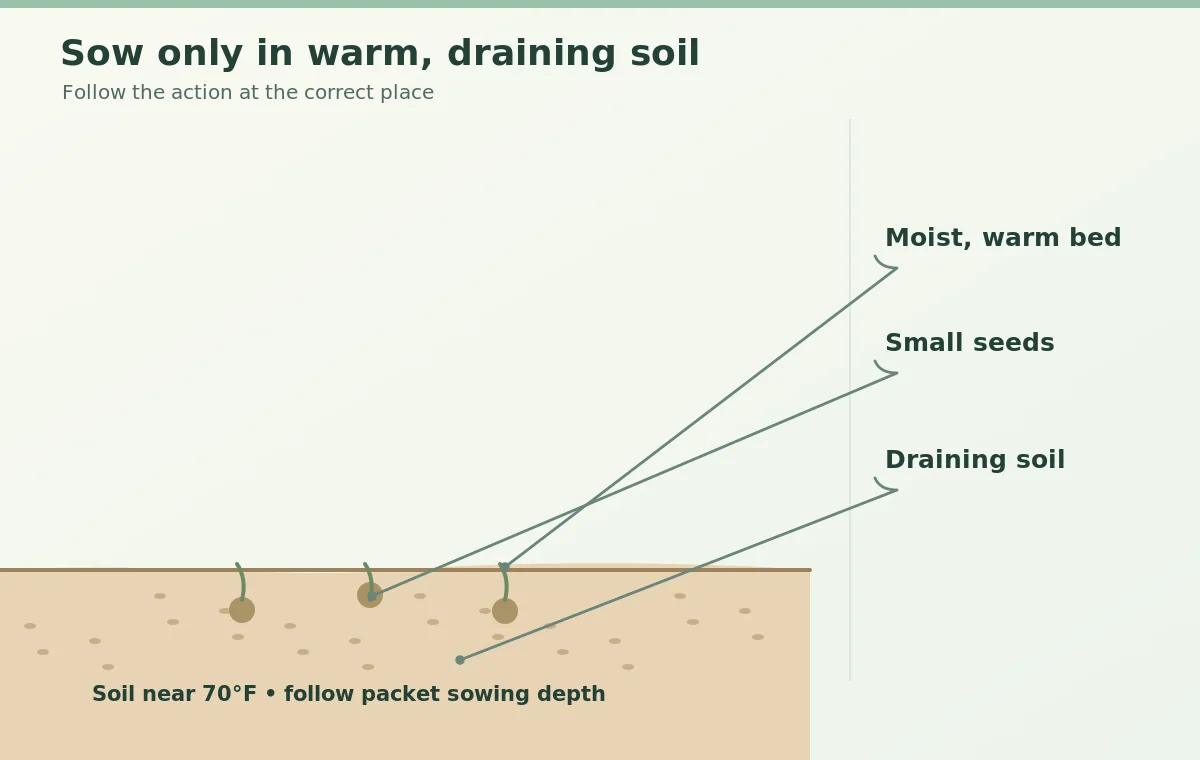
The USDA NRCS sesame plant guide identifies soil around 70°F as a useful threshold for establishment. Seeds sown into cold wet ground can fail or produce weak seedlings. Choose a sunny site that warms early and drains well; avoid a pocket that floods after rain. When the soil is warm, sow in fine, settled seedbed soil following the packet’s depth recommendations. Sesame seed is small, so a heavy crust or clods can stop emergence. Check the actual bed temperature instead of selecting a planting date solely from a calendar or USDA zone map.
Identify a seedling before giving it space
Sesame is an upright broadleaf plant rather than a grass. Leaf shape changes as the plant matures: the USDA guide describes lower leaves that may be lobed and upper leaves that are often narrower and lance-shaped. Thin emerging rows carefully once you can distinguish seedlings from volunteer weeds. Keep a clear band around the stem while plants establish, because young sesame grows comparatively slowly before its rapid warm-season phase. Never pull a neighboring plant so violently that its roots disturb the one you want to keep.
Pick drainage over a heavily enriched bed
The crop tolerates summer heat and some dry periods once established, but standing water around its roots is hazardous. A well-drained sandy loam is more useful than a rich, saturated planting hole. If the bed floods repeatedly, change the site rather than assuming extra compost will solve oxygen deprivation. Make fertilizer decisions from a soil test and the previous crop; excessive feeding is not a shortcut to earlier mature seed. Early irrigation supports emergence, whereas later watering should respond to actual root-zone conditions.
See where sesame flowers really form
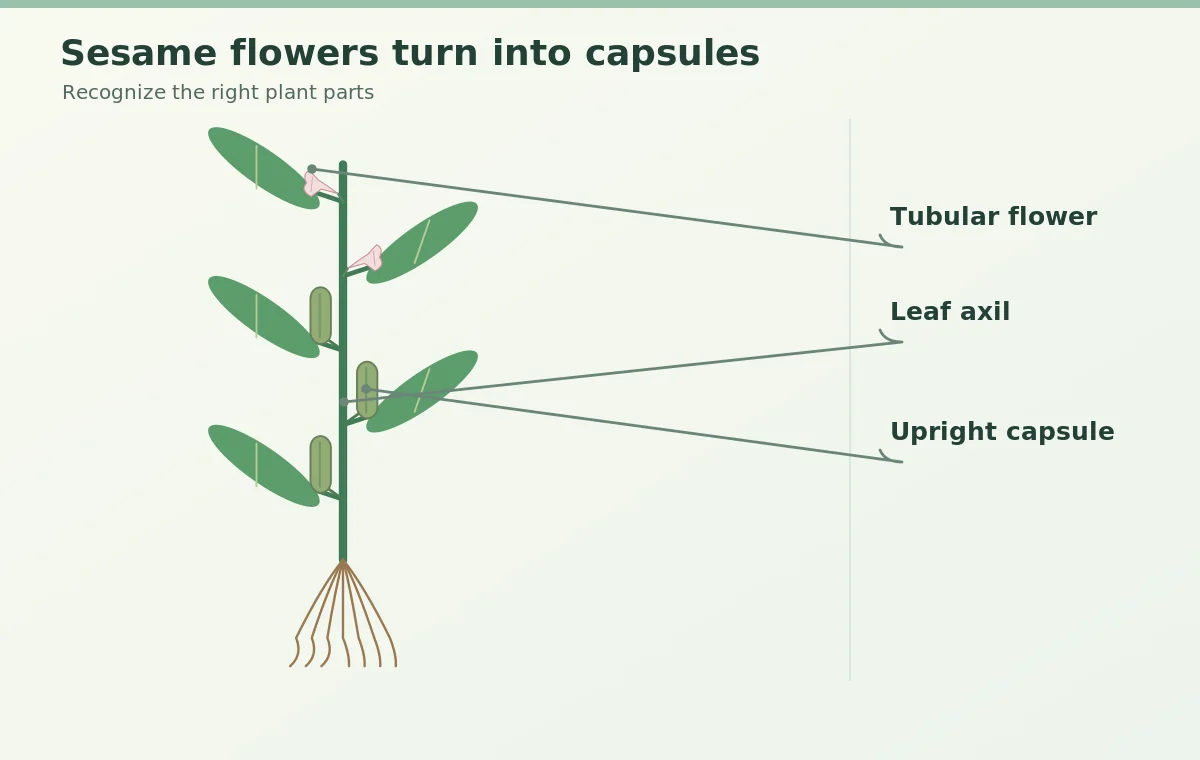
Flowers grow at leaf axils—the places where leaf stalks meet the upright stem. They are generally tubular and pale white to pink depending on selection, opening sequentially from lower to upper positions. A flower is not the same object as a green capsule. Once fertilized, the bloom gives way to a narrow upright seed capsule at that same node. On a diagram, the capsule must attach to the stem; a floating oval is not an accurate sesame fruit. Observing the flower-to-pod change gives a better maturity guide than plant height alone.
Expect uneven maturation on one plant
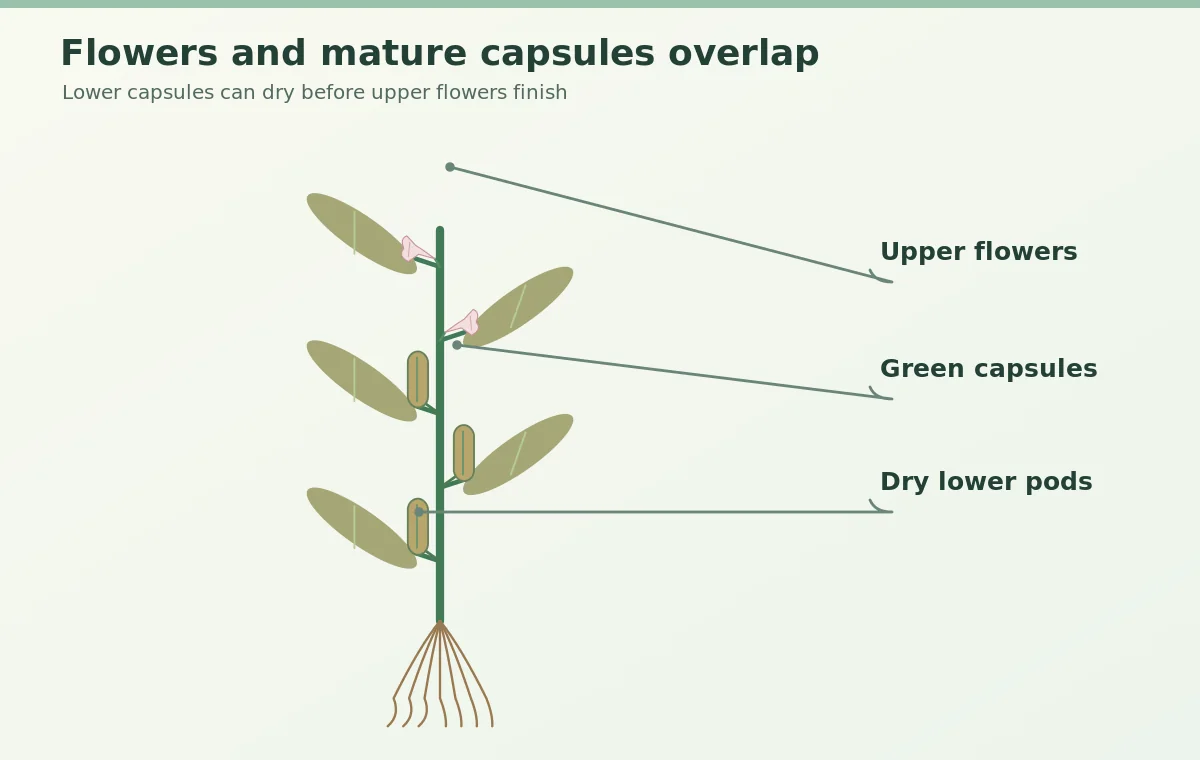
Sesame is commonly indeterminate, so flowering, ripening and drying overlap. The USDA guide explains that lower capsules may hold mature seed while the upper canopy remains green or is still blooming. Inspect the lower nodes often as the season advances. Cutting the plant at the first colored capsule wastes potential later seed; waiting until every pod has shattered can lose much of the earlier seed. The right compromise depends on whether your variety holds seed inside its capsules or readily splits when dry.
Recognize the divided capsule and loose seed
A sesame pod is a narrow divided capsule rather than a bean pod or a cucumber-shaped fruit. As it ripens, internal compartments hold small, flattened seeds that may be white, tan, brown or black depending on cultivar. In traditional shattering types, a fully dry capsule can open and scatter seed with little disturbance. Place a paper sheet under a test pod and gently flex it to see whether seeds are dropping. Avoid claiming that any capsule remaining green is mature merely because lower leaves have yellowed.
Plan small-scale harvest before seed loss
Monitor pod color and dryness as the growing season approaches its end. For a small planting, cutting stems and drying them over a clean catch surface may preserve falling seed better than shaking upright plants directly into soil. Keep harvested stems in an airy protected place and ensure the seed becomes fully dry before sealed storage. Avoid storing damp stems in a closed plastic bag. A shatter-resistant commercial selection and a traditional open-capsule selection require different timing, so the variety name belongs in the garden notes.
Check frost forecasts before delaying harvest
Cold nights slow growth; frost can terminate the plant before all capsules are ripe. If the first frost is approaching, prioritize already mature seed over waiting for late green pods that may never finish. Record the date of first bloom and the date of the first dry capsule so you can judge whether the same selection suits the location next year. Use a nearby agricultural weather record rather than borrowing the growing-season length of a city with a different elevation or coastal influence.
Keep food-grade seed handling practical
Harvested seed requires good drying and clean storage to avoid mold, contamination and rancidity. Discard batches with visible mold, unusual odors or evidence of pests. Sesame is also a major food allergen, so keep harvested seed clearly labeled and separated from foods for anyone with sesame allergy. Do not market homegrown seed as certified food-grade or disease-free without appropriate testing. For home use, clean equipment and sensible storage are more important than promises about unusual health benefits.
Diagnose setbacks with three climate observations
When plants are short or flower late, compare soil warmth at sowing, the amount of direct sun and prolonged periods of waterlogged roots. Leaf spots in humid weather deserve close inspection, not an automatic assumption that every lesion is a specific fungus. If good flowering occurs but seed fails to mature, the local frost-free season may be the limiting factor even when summers feel hot. Adjust sowing location, cultivar and timing for a future trial rather than treating a winter-zone map as a seed-harvest guarantee.
How We Research and Check These Recommendations
We checked species identification, cultural requirements and cautions against plant profiles and research-backed guides, prioritizing horticultural universities and public botanical agencies. Recommendations here describe observed growth characteristics and practical decisions, not guaranteed results for every garden. Local weather, purchased variety and site drainage can change the right choice. For further reading see the first plant reference and the second detailed guide. This page contains no paid affiliate recommendation; read the VegWin affiliate disclosure for our site policy.
It is grown as an annual for seeds; zone numbers are not a dependable predictor of summer seed maturity.
The USDA plant guide identifies about 70°F soil as a useful minimum for establishment.
Sesame flowers develop at leaf axils along the stem, usually progressing upward as the plant grows.
Sesame commonly flowers and ripens sequentially, so mature lower capsules overlap with immature upper ones.
No. Many varieties shatter when dry; timing depends on the seed-holding characteristics of the selection.