
Lacinato kale, also sold as Tuscan kale, cavolo nero or dinosaur kale, looks distinctly different from the tight frills of many curly kales. Its leaves are long, dark, narrow and strongly puckered, with a central midrib running through the blade. Gardeners can raise it from ordinary brassica seed and harvest leaves for a long period if the plant has room and the top growing point stays healthy. This guide separates the seedling phase from mature leaf anatomy, explains when to thin or transplant, and shows where to remove a leaf without beheading the plant.
Check the cultivar before sowing
Look for packets naming lacinato, Nero di Toscana, Tuscan or cavolo nero. These labels usually refer to the long, blue-green, blister-textured kale form rather than a round cabbage head. RHS lists Nero di Toscana among narrow puckered-leaf choices. Because kale types differ in final size, a spacing rule for small salad leaves is not necessarily sufficient for a full mature lacinato plant. Some cultivars have green rather than nearly black foliage, and seedlings cannot immediately show their eventual pronounced surface texture. Keep the label until the crop matures so you can assess whether its characteristic leaves appear.
Provide a sunny site with sound drainage
Choose a bed with light, reasonably fertile, well-drained soil and space for the full-sized leaves to spread. RHS advises adding garden compost or decomposed organic matter and keeping the bed weeded. Partial shade can be tolerated, particularly in bright climates, but severe shade leads to weak elongated plants. Avoid waterlogged patches and do not depend on constant heavy feeding to compensate for badly compacted ground. If other brassicas were recently damaged by clubroot, consider crop rotation and regional disease advice. A large container may hold a plant, but it needs enough rooting volume and closer water monitoring than garden soil.

Sow seed at the depth actually shown
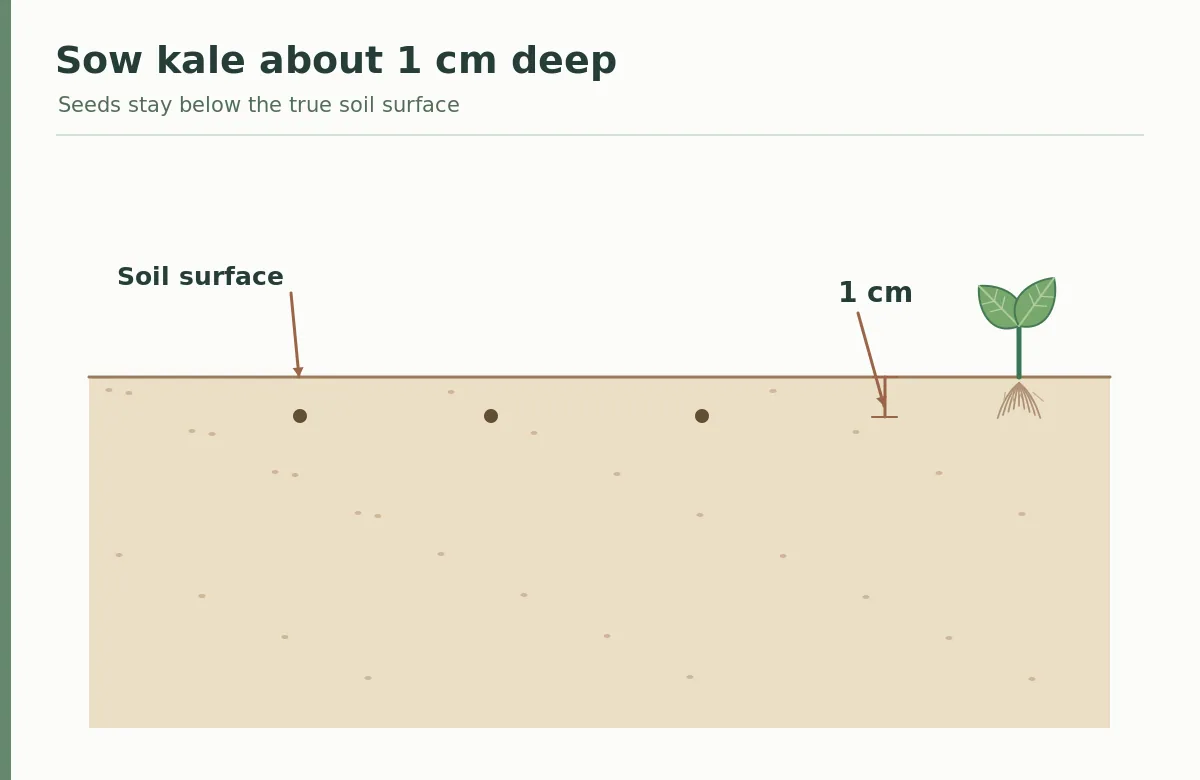
For kale, the RHS sowing guide specifies approximately 1 cm of covering soil in modules or a prepared outdoor drill. That depth is measured from the true soil surface to the seed, not the top of a mulch layer. Water a dry drill lightly before sowing, cover seed with fine soil, and avoid a hard crust at the surface. For modules, sow a small number of seeds per cell and retain the strongest seedling. Direct-sown seedlings can be thinned carefully, but leave room for the future leaf fan. The cross-section in the illustration keeps the seed underground and the first green leaves above ground.
Select indoor or direct sowing by season
Kale is suited to the cooler parts of the growing year, but planting windows differ considerably by region. An early indoor module sowing can protect small seedlings from exposure and slug damage; outdoor sowing saves transplant work. Follow regional frost and soil conditions rather than interpreting the USDA hardiness zone as a calendar. RHS describes sowing in spring and early summer for temperate UK conditions, while some gardeners sow again for fall harvests. Avoid planting tender seedlings into waterlogged or severely chilled ground. When starting indoors, provide strong light to prevent thin, pale stems before plants reach the garden.
Distinguish the first leaves from mature foliage
Seedlings begin with two simple cotyledons, followed by small true leaves that gradually show the kale type. Do not expect a tiny emerging leaf to display the deep pebbled wrinkles of a mature lacinato blade. As growth proceeds, the adult leaves become narrower and deeply textured, with relatively smooth outer margins rather than the dramatic fringes of curly kale. The leaf detail image emphasizes this surface and the continuous central midrib, rather than presenting a randomly zigzagged leaf. If all your plants develop big rounded cabbage leaves, check the packet and any volunteer brassicas in the bed.
Thin and transplant without damaging the crown
For mature kale plants, RHS lists generous spacing which varies by cultivar; roughly 30–60 cm is a useful range to compare with the seed packet. Transplant young modules carefully with the root ball intact, firming the soil around the plant. Set the seedling deep enough to support its stem as RHS explains, while keeping the actively growing center and lowest leaves visible above the finished soil. Water in, then watch for wilt during warm wind. Crowding increases competition for light and humidity around the leaves. A tightly sown strip can work for short-lived baby greens but should not be treated as a bed of full-sized kale.
Harvest older leaves and preserve the tip
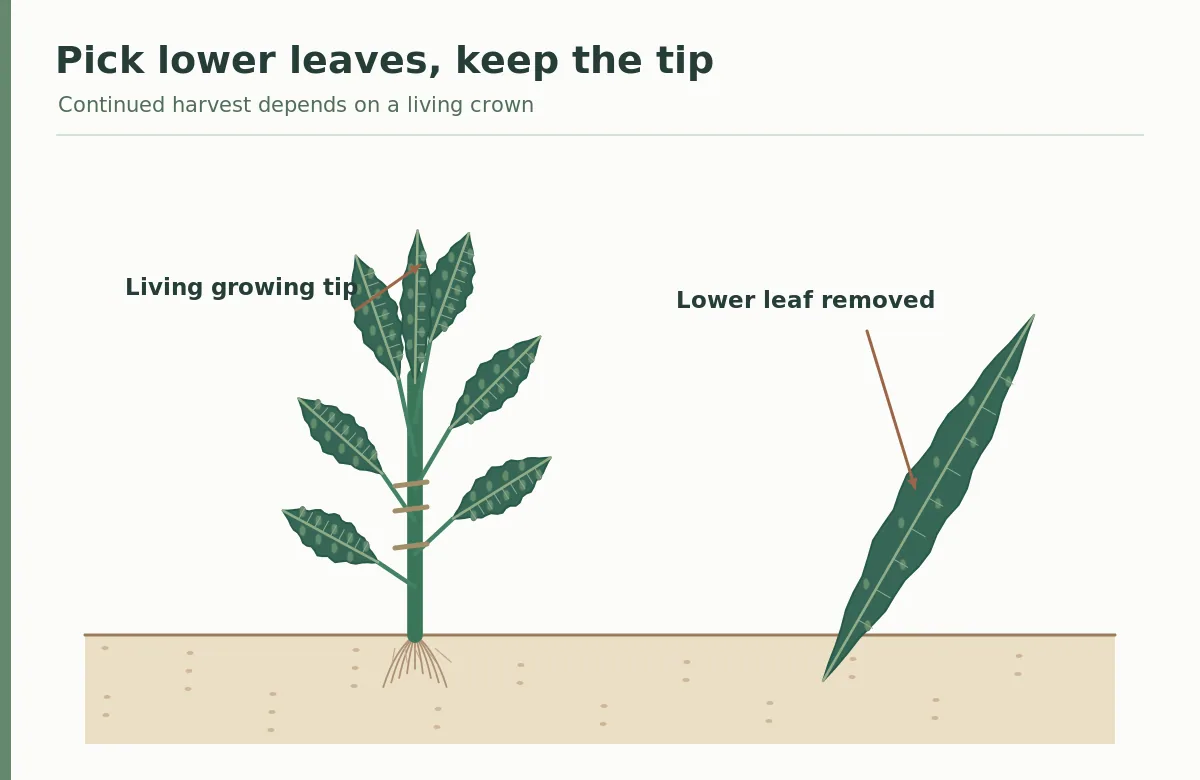
A lacinato plant makes new leaves near its top, while older leaves form below. Begin picking tender lower leaves once the plant is established and large enough to spare them. Grasp each petiole near the stem and make a clean removal without scraping the main stem or cutting the tight crown of younger leaves. RHS recommends taking a few lower leaves at a time from mature kale. The practical illustration shows the retained central tip, a real petiole attachment and harvested lower-leaf scars. Removing every leaf at once weakens the crop and is not equivalent to a normal cut-and-come-again picking.
Manage insect pressure by inspecting leaf surfaces
Kale belongs to the brassica family, so caterpillars, aphids and flea beetles may attack. Inspect undersides and midribs regularly, especially when leaves overlap. A few holes are not proof of a serious outbreak. Fine protective mesh installed before insects arrive can help when it suits local conditions; keep mesh raised so leaves can grow and do not trap pests underneath. Use appropriate local Extension IPM references before choosing any pesticide, and observe legal crop labels if a treatment is necessary. Yellowing lower leaves may reflect age or inconsistent water, not automatically an infection requiring fungicide.
Use weather to judge leaf quality
Cool weather often improves the eating quality of kale, while high heat or drought may toughen leaves and slow growth. Maintain even soil moisture during establishment and long dry spells without turning the root zone soggy. Container plants dry faster and may need more attention. In cold regions some established kale can remain productive through frosts, but do not assume every container, variety and exposed site is equally hardy. If a plant bolts in its second year, the flowering stalk changes the crop: tender leaves may still be usable, but repeated lower-leaf harvest becomes less predictable. Plan fresh sowings rather than expecting one biennial plant forever.
Record growth rather than chasing a fixed yield
Photograph the same plant at transplanting, first harvest and later autumn. Note the number of lower leaves taken, whether the growing tip remains healthy and whether leaves became narrower and more textured. Uneven plants in a row may indicate local shade or soil variation, not bad seed. Compare light, moisture and spacing before adding fertilizer. If you want very young baby leaves instead of mature lacinato fronds, sow a separate denser strip and harvest it on a different schedule. That distinction makes both planting plans clearer and avoids the common mistake of crowding a crop intended to develop a tall central stalk.
Related Guides
- Growing Kale: Harvest Outer Leaves and Prevent Brassica Problems
- How to Grow Flowering Kale for Colorful Cool-Weather Rosettes
- How to Harvest Dinosaur Kale Without Removing Its Growing Tip
How We Research and Verify Plant Details
This VegWin article was prepared using current guidance and botanical descriptions from www.rhs.org.uk, www.rhs.org.uk, extension.illinois.edu. Each named source was consulted on October 28, 2026 for the specific claims recorded in the article metadata. Differences between cultivars, planting seasons and local conditions are distinguished from the plant anatomy depicted in the diagrams. Where a diagnosis or precise schedule depends on region, ask a local Cooperative Extension service rather than assuming a universal answer.
This is independent gardening education, not a sponsored endorsement or a promise of results. See the VegWin affiliate disclosure for site policy. The illustrations emphasize correct locations of seeds, leaves, roots, growing tips and fruiting structures, but proportions vary among cultivars and seasons.
Both are kale, but lacinato has long narrow, puckered leaves with relatively smooth margins.
RHS recommends about 1 cm of fine covering for kale seed in prepared soil or modules.
Keep the central growing point intact if you want repeated harvests of lower leaves.
The characteristic pebbled texture becomes clearer as true leaves expand and mature.
It is principally a cool-season crop; use local frost and weather conditions to choose sowing dates.