
Herbaceous peonies can live for decades without division. When a mature clump truly needs moving, the hardest part is knowing which piece can survive and bloom: a cut root by itself is not the same as a crown section with viable eyes. This guide follows the plant through fall lifting, inspection, division, shallow planting and aftercare. The depth recommendations apply to ordinary herbaceous peonies, not grafted tree peonies.
Confirm You Have an Herbaceous Peony Before Digging
Common herbaceous garden peonies die back aboveground each winter and return from renewal buds on a persistent crown. Tree peonies retain woody stems and use different planting guidance, especially when grafted. Intersectional Itoh peonies also have distinctive crown structures; consult instructions for the actual plant before copying a procedure designed for herbaceous kinds. Examine the label and seasonal growth habit. Healthy herbaceous peonies generally do not need division every few years like some short-lived perennials; dig only when the clump is crowded, misplaced, shaded or being propagated. Avoid the common mistake of dividing a flourishing peony merely because it has reached an arbitrary age.
Schedule Lifting for Fall Dormancy in Your Climate
Iowa State Extension identifies September as a good time to divide peonies in Iowa, allowing the roots to establish before winter. In other temperate regions, choose the local fall period after active growth slows and when soil remains workable; do not use September as a universal date for every hemisphere and elevation. Avoid lifting a plant in peak flowering season when growth and water demand are high. Allow healthy leaves to recharge the roots through the growing season; removing foliage too early can diminish stored energy. Work before the soil is frozen and water the planting site beforehand if it has become excessively dry.
Find the Pink Eyes and the Thick Storage Roots
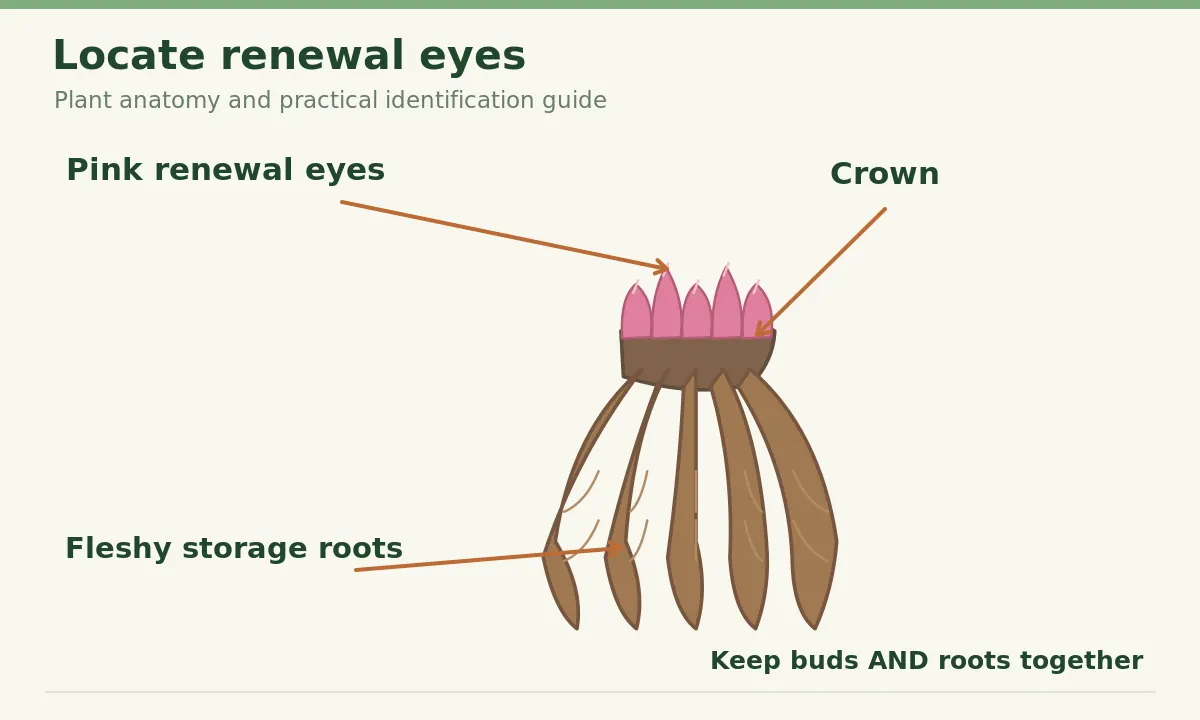
A peony crown is the knobby junction where last season’s stems, new shoots and thick storage roots meet. The eyes are short pink, reddish or pale buds projecting from the upper crown; next spring’s shoots grow from those buds. Below it, fleshy tan or brown roots store resources and anchor the plant. A thick detached storage root with no crown or eyes should not be treated as a reliably viable division. Some eyes can hide between old stem bases, so gently clean the crown before deciding where to cut. The illustration points to an actual bud tip attached to crown tissue, not to the end of a dangling root.
Dig Far Enough Out to Protect Fleshy Roots
Cut back old herbaceous stems when the plant has finished its season and begin loosening soil at a generous distance from the clump. Slide a garden fork into the soil outside the root mass, easing it up from several sides instead of levering through the center with a sharp spade. Peony roots may extend wider and deeper than the visible tuft of leaves. Lift slowly, supporting the heavy crown and roots rather than carrying the plant by brittle stems. Some roots may be lost during moving, but avoid avoidable breaks. Set the clump in shade and gently shake or rinse just enough soil away to see the junctions clearly.
Plan Division Lines Around Groups of Three to Five Eyes
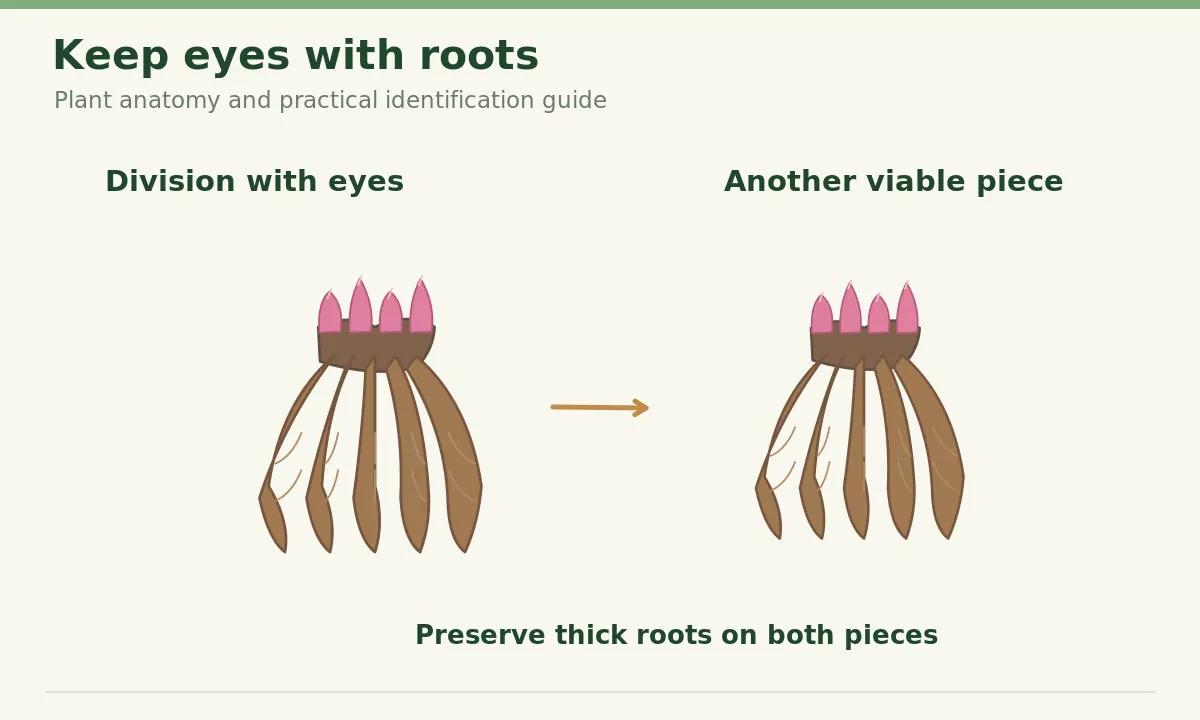
Iowa State and Penn State Extension recommend divisions with approximately three to five healthy eyes and a substantial root system. Look for natural spaces between groups of buds and attached storage roots. Each proposed portion must contain both a bud-bearing crown section and enough sound roots; a line that leaves all roots on one piece or separates eyes from their base is not acceptable. A large clump does not have to be cut into identical-looking pieces. Prioritize quality over quantity, especially when an old crown is irregular. Very small divisions can survive but often need extra seasons before giving a strong display.
Cut the Crown With a Clean Sharp Tool
Choose a knife or sturdy tool able to make a controlled cut through firm crown tissue. Disinfect equipment between suspect plants and avoid working with torn or rotten material. Align the blade with the spaces you identified so each piece keeps viable eyes and fleshy roots. Cut carefully; do not tear the root mass apart by tugging on stems. Once separated, inspect each division again, confirming pink eyes are still attached and sound roots remain connected. Remove visibly soft or decayed material conservatively. Use caution because a wet peony crown can be slippery and the blade may suddenly pass through tissue more easily than expected.
Prepare a Drained Site With Room for Mature Plants
Peonies prefer a sunny position and well-drained soil; chronic waterlogging promotes root damage and poor growth. Choose a location where a mature clump will have adequate space instead of squeezing fresh divisions between vigorous shrubs. Iowa State commonly recommends spacing herbaceous peonies about three to four feet apart, but allow for mature cultivar width. Prepare a broad hole that lets roots spread without doubling them sharply. Follow a local soil test for fertility adjustments rather than filling the hole with a concentrated fertilizer layer. Ensure loose backfill can settle evenly, and note the anticipated finished soil level before placing any division.
Set Eyes Just One to Two Inches Beneath Soil
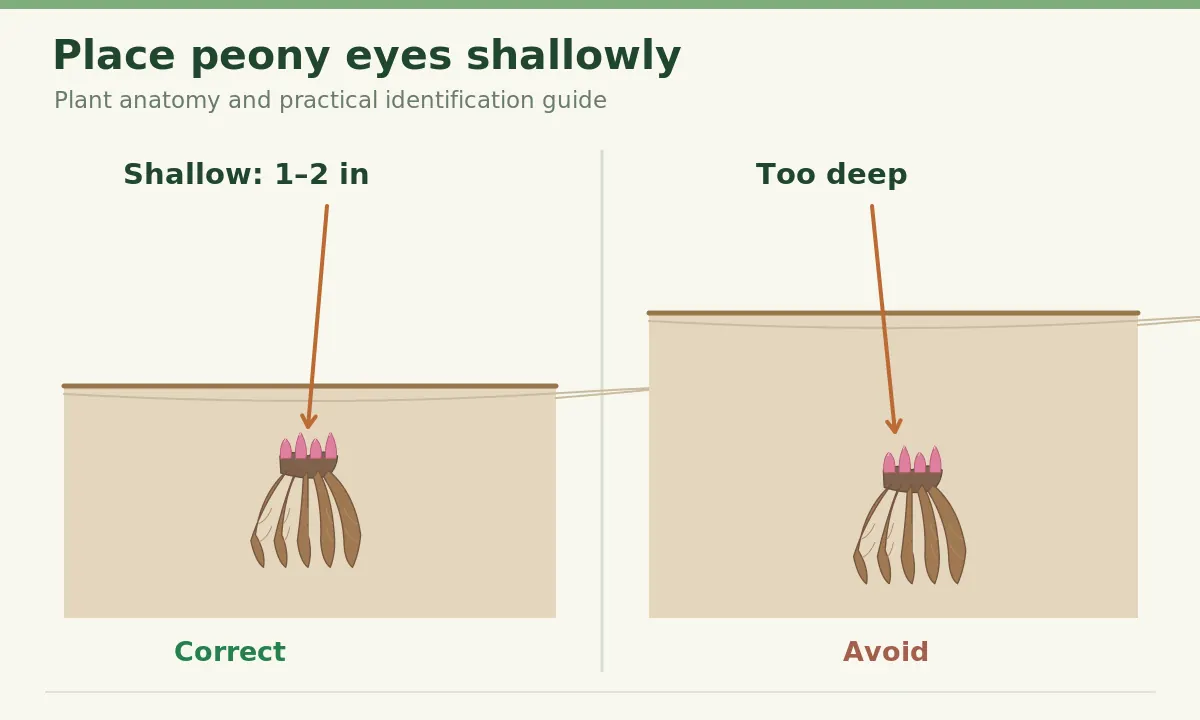
For standard herbaceous peonies, Iowa State instructs planting with eyes roughly one to two inches below finished soil level. Place the pink buds pointing up, hold the root mass naturally downward and backfill carefully so the depth remains shallow after watering and settling. Planting the crown much deeper is a common reason for poor flowering. Do not treat the deepest old root tip as the planting-depth reference; measure from the top of the renewal eyes to the soil surface. This shallow advice does not apply to the graft union of a tree peony, which needs a different depth. Mark eye position before covering the division.
Water Firmly Then Use Mulch Without Smothering Eyes
Backfill around roots to remove major air pockets, firm gently and water thoroughly after planting. Keep the soil moderately moist during establishment where rainfall is lacking, but avoid permanently saturated ground. In climates with repeated freezes and thaws, Iowa State recommends protective late-fall mulch to reduce heaving; pull excess mulch away as spring growth resumes so the eye depth does not become effectively much greater. Do not form a thick wet compost mound directly on the crown. Label the position because dormant peony divisions are easy to lose sight of under winter debris. Protect the bed from repeated digging while the crown is settling.
Expect a Recovery Period Rather Than Instant Bloom
Recently divided peonies may produce fewer flowers in their first year or two while roots rebuild. Iowa State notes that sections with fewer than three eyes can take particularly long to form a good flower display. This is not an invitation to fertilize aggressively or excavate the crown after every quiet spring. Verify first that the buds were planted at the proper depth, the site drains and the young plant has adequate sun. Keep light records of division size, planting date and eye depth. If shoots emerge normally but flowers are sparse in the first year, allow time; if nothing emerges, review drainage and crown condition before intervening.
Inspect Every Division Before Backfilling
Hold each section and check four things: at least several genuine eyes are on the crown, attached fleshy roots are intact, all cut surfaces are sound, and the future eyes will sit only shallowly below finished grade. Then check that roots are not bent sharply upward and that the chosen site drains. Complete the planting, water it and mark it. Avoid equating a large thick root with a complete peony division; roots store energy, but the growing shoot must originate from the crown eyes. The anatomy-first check is the most useful way to prevent a disappointing transplant.
Related Guides
- How to Divide Herbaceous Peonies in Fall and Set the Eyes Shallowly
- When to Move Peonies: Protect the Root Clump and Set Buds at the Right Depth
- When to Cut Back Peonies: Keep Summer Leaves and Know the Plant Type
- How to Plant Bare-Root Herbaceous Peonies With Their Eyes Near the Surface
- When and How to Divide Siberian Irises Without Losing Healthy Fans
How We Research and Verify Plant Advice
Sources checked on 2026-10-26: yardandgarden.extension.iastate.edu; yardandgarden.extension.iastate.edu; extension.psu.edu. We reviewed each institution’s plant identification, correct growth stage and relevant cultural recommendations before adapting them into an independently written step-by-step guide. Where sources are region-specific, their calendar details are not applied universally. Pictures use simplified teaching shapes and should be compared with living specimens; they are not a substitute for laboratory disease diagnosis or local climate guidance. The relevant advice is paraphrased rather than reproduced.
Safety and Independent Editorial Disclosure
This independently prepared educational article does not claim sponsorship or affiliate approval. Our category reading links are informational, not product endorsements. See the VegWin affiliate disclosure. Clean sharp tools before cutting plants, protect hands from thorns and blades, and keep cut plant material away from children and pets where appropriate. Use only locally registered plant treatments labeled for the actual crop, and observe the product label. Do not rely on unsupervised home remedies or unverified harvest-safety promises.
During local fall dormancy while soil is workable; Iowa State often recommends September for its climate.
Aim for approximately three to five healthy renewal eyes together with a substantial portion of roots.
A loose storage root without bud-bearing crown tissue is not a reliable flowering division.
For normal herbaceous peonies, position eyes about 1–2 inches below the finished soil surface.
No. Tree peonies, particularly grafted specimens, have different planting-depth requirements.