
Ground cherries hide dozens of tiny seeds inside a sweet yellow fruit wrapped in a papery lantern. Saving seed requires a different method from shaking dry pods: the fruit must be fully ripe, the juicy pulp must be separated, and the cleaned seed must be thoroughly dried. Use naturally dropped, mature Physalis fruit and a small bowl of water, not hard green fruit or a sealed container of wet seeds.
Tell Ripe Ground Cherries From Tomatillos
Common garden ground cherries include Physalis pruinosa and related species. Their small berries develop inside inflated, veined, papery calyces. A fully ripe ground cherry usually turns yellow or gold, the husk becomes dry and tan, and the fruit often drops naturally. The University of Minnesota notes that ground cherries differ from tomatillos, which are typically gathered firmer and often still green. Do not use tomatillo harvest rules as a substitute for ground cherry seed maturity.
Remove and inspect a husk before processing. The ripe berry should have the mature color for its variety and no signs of mold or rot. A green, bitter, or unripe fruit does not become reliable seed stock merely because you place it in a paper bag. Keep different varieties separate during gathering. Our detail illustration identifies the papery calyx outside the flesh and the tiny seeds embedded inside the fruit, not attached to the outer husk.

Collect Healthy Dropped Fruit Promptly
Ground cherry fruit often falls as it reaches full maturity. Search beneath healthy plants and clean mulch frequently; fallen fruit can be lost to rain, insects, or decay. Choose sound ripe fruit from plants free of obvious disease. Seed Savers Exchange describes ripe husks as dry and papery and the berries as yellow. Discard specimens with leaking pulp, fuzzy mold, holes or foul odor rather than trying to salvage questionable seed.
Keep the collected fruit in a shallow breathable container until processing. A deep, sealed pile encourages moisture accumulation and spoilage. If you are selecting seed for a particular family line, choose several representative healthy plants rather than only the first berry available. Record the variety name and the date; nearby varieties may cross with insect help despite ground cherries being capable of self-pollination. For genetic purity, use credible isolation guidance.
Open the Husk and Release the Seeds
Peel away the dry husks; do not grind them into the seed mixture. Cut or mash ripe berries into a clean bowl with a little water. The small pale seeds are embedded in soft, juicy flesh, so rubbing open a dry calyx alone will not release them. For a home gardener, hand mashing a few fruits is more controlled than using a high-powered blender on delicate seed. Clean utensils and containers before starting.
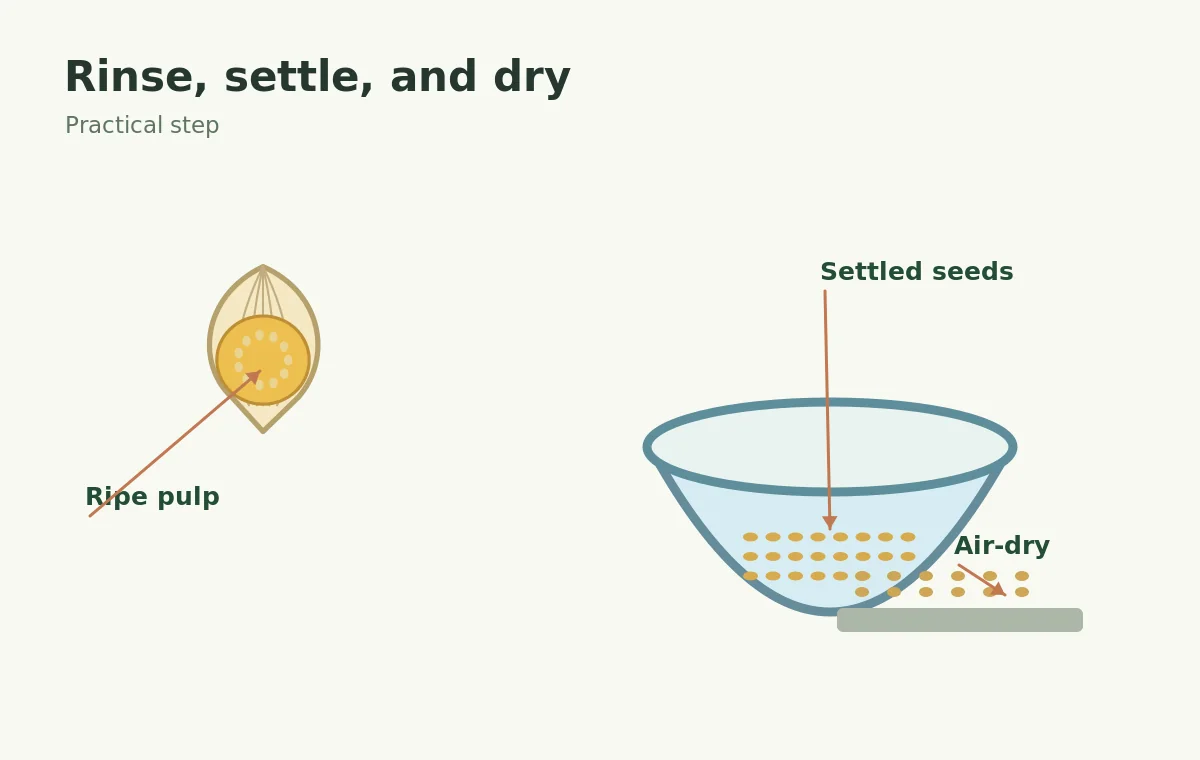
Mash gently enough to separate the fruit pulp from most of the seeds. Add clean water and stir. Some skins and lighter fragments float, while sound seeds often settle toward the bottom. Seed Savers Exchange advises repeated settling and decanting for ground cherries. Do not assume every single floating object is automatically nonviable; examine the mixture and save the dense cleaned fraction rather than relying on one hurried pour.
Decant the Pulp and Rinse Fine Seeds
Allow the mixture to settle, then carefully pour off the suspended pulp and cloudy water without discarding the seed layer at the bottom. Add fresh water, swirl, allow to settle, and repeat until most fruit residue is gone. A fine-mesh strainer is necessary: ground cherry seed is much smaller than a bean or squash seed and can pass through a coarse kitchen colander. The diagram shows the settled seeds under a lighter pulp layer.
Once the water is clear enough, pour the saved seeds into fine mesh and rinse gently. Avoid leaving them soaking for days or assuming that fermentation is required simply because tomatoes are sometimes processed that way. The ground cherry workflow in Seed Savers Exchange guidance uses water cleaning and drying. If you process many samples, label each bowl and drying sheet to prevent accidental variety mixing.
Dry on an Airy Surface Before Storage
Spread rinsed seed in a thin layer on a clean coffee filter, fine screen, or similarly breathable surface in a shaded, well-ventilated place. Separate clumps so moisture can escape. Do not seal damp seeds in an airtight jar or place them in a humid corner: moisture can lead to mold or premature germination. Drying time depends on local humidity and airflow, so judge the seed by its condition rather than one universal number of hours.
Check that seeds are dry and free of sticky pulp before packing. Paper filters can be handy for handling tiny seed, although lightly stuck seeds may need careful separation. Transfer dried seeds to a labeled paper envelope, then into a cool, dry storage environment suitable for your conditions. Record the year and species; closely related Physalis plants and different varieties can look similar once the seeds are cleaned.

Avoid Unripe Fruit and Mixed Samples
A common seed-saving error is harvesting fruit while still green because the husk has begun to dry. Another is saving fruit that has rotted on wet mulch. Neither is a good foundation for reliable planting stock. Favor fully mature, healthy berries and process promptly. If one sample is visibly diseased, keep it out of a mixed batch rather than spreading potential contaminants through water shared with healthy fruit.
Do not let pets or children eat unidentified Physalis plant parts; unripe fruit and foliage should not be treated like ripe edible ground cherries. Handle seed-saving fruit as garden material and follow food safety practices when using ripe produce for meals. The papery calyx is a diagnostic structure, not an edible ingredient. Drying and labeling are just as important as seed separation for reproducible results next season.
Test Saved Seeds and Manage Volunteers
The following season, test a small portion of the stored seed before relying on an entire saved batch. Use clean, suitable sowing media and compare germination with a fresh labeled packet if results seem poor. Remember that ground cherries can self-sow; volunteers may appear after ripe fruits are left under plants. Remove unwanted fallen fruit if you prefer not to have surprise seedlings in nearby beds.
Save notes about ripe fruit color, collection dates, weather, and the number of parent plants. A seed lot from one fruit may germinate but capture less of a variety’s genetic diversity than a broader collection. Seed Savers Exchange recommends larger parent populations for preserving a variety across generations. Our final comparison shows ripe yellow fruit and mature seeds versus green fruit and wet, unprocessed pulp.
Related Guides
- How to Grow Ground Cherries and Know When the Husks Are Ripe
- When to Harvest Ground Cherries: Dry Husks and Fallen Ripe Fruit
- How to Grow Ground Cherries From Seed and Recognize Their Husks
How We Research and Verify Plant Details
Sources reviewed October 28, 2026: seedsavers.org — Seed Savers Exchange documents ripe fallen yellow ground cherries, small wet-fruit seed extraction, settling, rinsing and drying. extension.umn.edu — University of Minnesota Extension describes ripe ground cherry fruit dropping inside dry papery husks and contrasts it with firm tomatillos. seedsavers.org — Seed Savers Exchange explains wet seed processing, careful drying and cool dry storage for seed longevity. Our illustrations simplify plant structures for practical decisions rather than claiming exact scale or universal climate dates. Refer to your local Cooperative Extension for local growing conditions and cultivar-specific guidance.
This independently written educational guide contains no paid product placement. Read the VegWin affiliate disclosure. Where pests or disease are involved, identify the issue first and follow local integrated pest management guidance and registered product labels.
Use fully ripe fruit, usually yellow with a dry husk and often naturally fallen.
No. Remove the husk and separate the many tiny seeds from the fleshy fruit.
No. The described Seed Savers Exchange method uses mashing, water settling, rinsing and drying.
Pulp and lighter material may float; let the dense seed layer settle and decant carefully.
Label fully dry seed and keep it cool, dark and dry in suitable packaging.