
Identify common hyssop by its narrow opposite leaves and blue flower spikes, then set up a draining pot and prune it at the right stage. These illustrations explain visible botanical structures and practical decisions rather than offering a universal calendar. Match the steps to your cultivar and local weather.
Confirm the Hyssop Species Before You Pot It
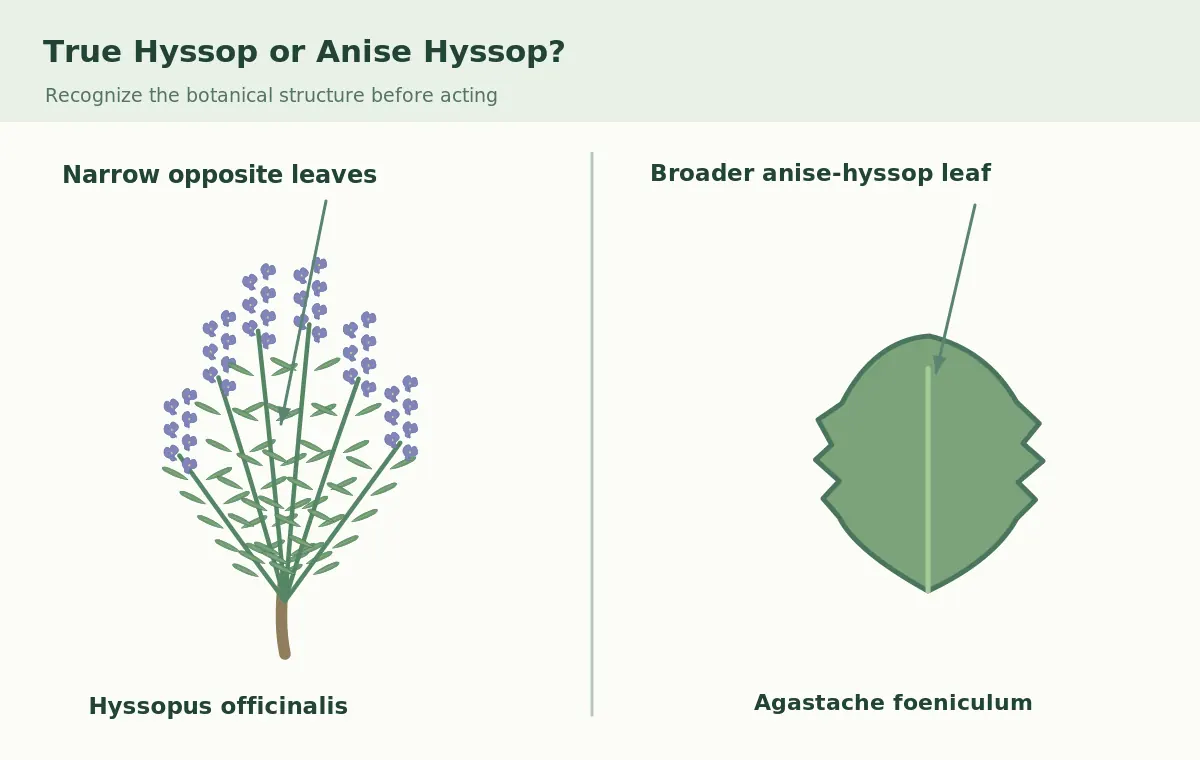
Common hyssop, Hyssopus officinalis, is a compact mint-family perennial with upright somewhat woody stems, short narrow leaves in opposite pairs, and spikes of small two-lipped blue or violet flowers. The opposite leaf pairs are an important clue: two leaves attach across from each other at one node. A leafy plant merely called hyssop may instead be anise hyssop, Agastache foeniculum, whose broader, more strongly toothed leaves and taller flower spikes differ significantly. Check the botanical name before following a pruning diagram.
NC State lists common hyssop as a short-lived subshrub and notes that plants can naturalize. This means it does not behave like a single soft basil stem that renews entirely from the base each week. Keep some healthy green growth when shaping its crown; very old bare wood may not sprout reliably after a hard cut. The cover illustrates the narrow-leaf form with blue spike flowers, while the detail drawing makes the contrast with the broader-leaved anise hyssop explicit.
Choose a Container That Releases Extra Water
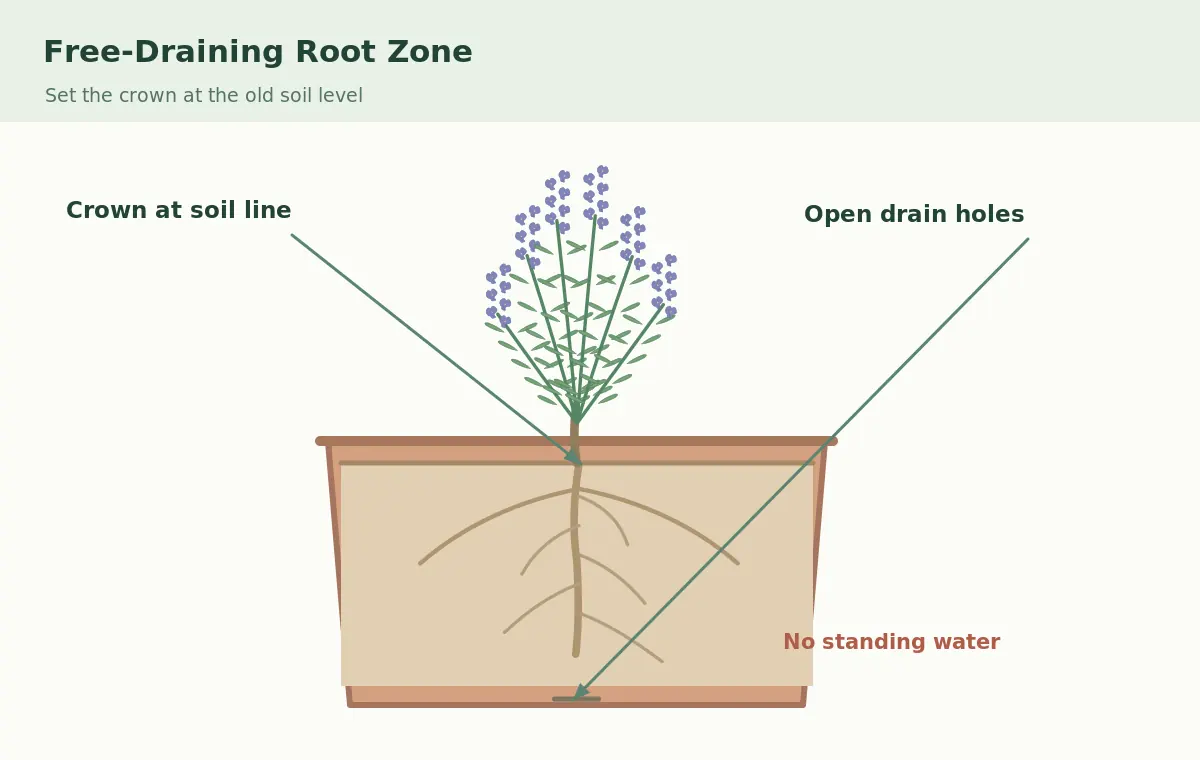
Use a stable pot with actual drainage holes and sufficient room for the mature crown rather than a decorative sealed cachepot. NC State and RHS agree that hyssop likes well-drained conditions. Fill with a suitable potting mix that admits air as well as water, and set the root ball at the same surface level it occupied in its nursery pot. A layer of gravel below potting mix does not substitute for drainage holes; water must leave the bottom of the container.
A sturdy pot matters because flowering shoots can become woody and top-heavy in wind. Leave some headspace for watering and place the pot where runoff will not stain a sensitive surface. A deep saucer permanently filled with water converts a draining pot into a wet basin. The action illustration shows a continuous airy mix, intact crown and open exit holes rather than falsely suggesting stones under a root ball are a cure for overwatering.
Give Bright Light but Adapt to Intense Summer Heat
Common hyssop favors sun and tolerates partial shade; its needs depend on local heat, wind and root-zone moisture. A bright balcony can work, but reflective pavement can heat a small container much more than an open garden bed. Move a newly purchased plant gradually into direct exposure instead of placing tender nursery foliage into full afternoon heat immediately. Adequate light keeps stems compact; prolonged deep shade tends to reduce flowering and can make growth less sturdy.
Check the actual plant and pot rather than relying on a USDA hardiness zone as a daily watering calendar. The zone describes a general winter-temperature range, not how rapidly potting mix dries on a particular patio. Give extra attention after transplanting when roots have not spread into the whole pot. Strong wind can desiccate foliage even when air temperatures are mild, so shelter a new planting until leaves remain turgid between waterings.
Water Based on the Mix, Not a Fixed Routine
Water thoroughly enough to moisten the root zone, allow surplus water to drain, then check the mix again before repeating. Established hyssop tolerates comparatively dry soil, whereas a freshly planted root ball needs more regular moisture to knit into its new mix. Probe below the immediate surface; a dry crust can sit above a damp root zone. Conversely, a heavy wet pot several days after watering suggests insufficient air around the roots or drainage trouble.
Yellowing foliage alone does not tell you which problem occurred. Check whether roots smell sour, the pot drains, and the plant has been subjected to heat or low light. If drainage is poor, correct it rather than adding fertilizer to a stressed plant. Avoid frequent splashes over the flower spikes late in the day; watering the medium is simpler and keeps foliage drier. The comparison diagram separates a firm leafy shoot from one affected by stagnant wet conditions.
Trim Living Tips While Preserving Leafy Nodes
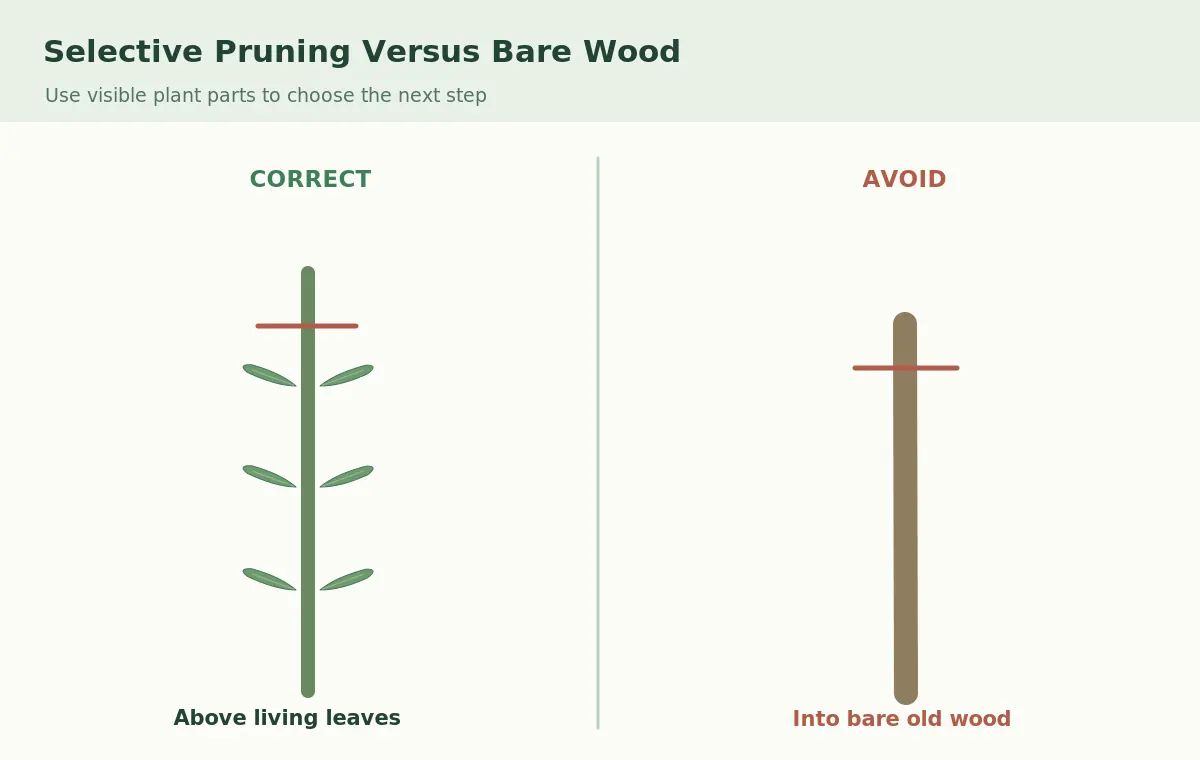
NC State recommends spring trimming to maintain a compact shape. Locate green leafy branches above the established woody base, then cut a small amount just above a healthy leaf pair or branching shoot. New growth can emerge at retained living nodes; pruning into an entirely bare old stump is a different and riskier action. Use clean sharp pruners and look carefully where the blades will meet the stem. Do not confuse the top of a flower spike with a renewal node.
After flowering, remove spent spikes if desired while still leaving substantial living foliage. If the plant has become severely woody, favor moderate gradual shaping rather than assuming it will recover from complete scalping. In cold regions, harsh late pruning can leave young shoots exposed to winter injury. Local Extension guidance is better than a universal date. The pruning diagram puts a dotted cut line slightly above two intact opposite leaves and clearly labels the old wood that stays untouched.
Prevent Crowding and Choose Sensible Propagation
Hyssop flowers provide nectar to pollinators, so observe visiting insects before clipping long stems. Plants can be raised from seed, cuttings or division according to NC State. A small rooted nursery plant often gives a beginner a clearer idea of the species than an unlabelled mixed-herb seed tray. For propagation, choose healthy material and use a clean draining medium. Keep stem-cutting foliage from wilting while roots develop, without leaving the base immersed in stagnant water.
Give several plants separate root space rather than squeezing a large clump into a tiny pot. If stems shade one another completely, move to a larger pot or separate rooted plants when conditions favor establishment. Check the leaves regularly for unusual spots or insects, but do not spray simply because bees visit blue flowers. The crop is ordinarily grown as an aromatic herb and ornamental, not as a source of concentrated medicinal extracts; essential oils require different safety considerations.
Decide Whether to Keep or Replace an Aging Plant
A well-kept common hyssop crown has a recognizable woody framework and a halo of living green shoots. Renewal is gradual and may weaken as the short-lived perennial ages. If all tips are brown, test the stems carefully for live flexible tissue and inspect the roots; a plant that has rotted throughout will not improve with repeated feeding. Replacing a failing specimen may be more productive than making ever deeper cuts into dead stems.
Write the plant name and acquisition year on a weatherproof tag. When buying another specimen, choose true Hyssopus officinalis rather than assuming every mint with blue spikes has the same growth habit. Keep a few flowers for bees and leave room for airflow. Successful pot culture is an interaction of identity, adequate drainage, sensible watering and selective pruning, not an exact number of daily ounces of water or a complicated additive.
Related Guides
How We Research and Verify Plant Identification
Sources checked on 2026-10-27: plants.ces.ncsu.edu: NC State describes Hyssopus officinalis as a woody mint-family subshrub with narrow opposite leaves, blue two-lipped flowers, good drainage and spring trimming. www.rhs.org.uk: RHS identifies true hyssop as a semi-evergreen shrub with linear leaves, blue flower spikes and well-drained neutral-to-alkaline soil. plants.ces.ncsu.edu: NC State shows that anise hyssop is a different species with broader, toothed leaves and a taller herbaceous habit. The botanical figures are explanatory drawings, not photographs; actual cultivars vary in appearance and scale. Specific sowing timing must follow local conditions.
This educational article has no sponsor or paid product placement. Read our affiliate disclosure. Follow local Cooperative Extension directions and legally approved product labels before using any pest-control product.
No. Common hyssop is Hyssopus officinalis; anise hyssop is Agastache foeniculum and has much broader leaves.
Yes. The potting medium should drain freely and never stand in water for long periods.
Trim above living leafy nodes and retain healthy shoots instead of cutting the whole plant into bare old wood.
Bright light is preferred, but adjust exposure and watering to your heat, wind and the plant’s establishment.
Check for prolonged soggy mix, poor root health, shade, and temperature stress before changing nutrition.