
Smokebush earns its name from cloudlike summer flower plumes, yet many gardeners choose the same shrub for rich purple or lime-colored leaves. Those goals lead to very different pruning. A full-size Cotinus can usually be left as a graceful specimen with only dead or crossing branches removed. A foliage-focused shrub can be cut back more strongly in late winter or early spring, but its flowers may be lost. The right first step is deciding which display matters in your garden and whether your plant is vigorous enough to recover from the proposed work.
Confirm You Have a Cotinus Shrub
Smokebush usually refers to Cotinus coggygria and related cultivated selections; American smoketree, Cotinus obovatus, may become a substantial small tree. Both carry simple rounded to oval leaves and airy branching inflorescences that turn feathery as flowers develop. These plants are not the same as smoke-colored spirea or dark-leaved ninebark, which follow other pruning rules. Look up the botanical name on the label and check the mature size. If your specimen has a distinct trunk and tree canopy, avoid treating it like a short annual foliage stool. A young establishing plant also needs different restraint from a well-rooted mature shrub that has grown beyond its space. For the basics, see our guide: When to Prune American Beautyberry Without Removing Its Berry Display.
Decide Whether Flowers or Leaves Matter Most
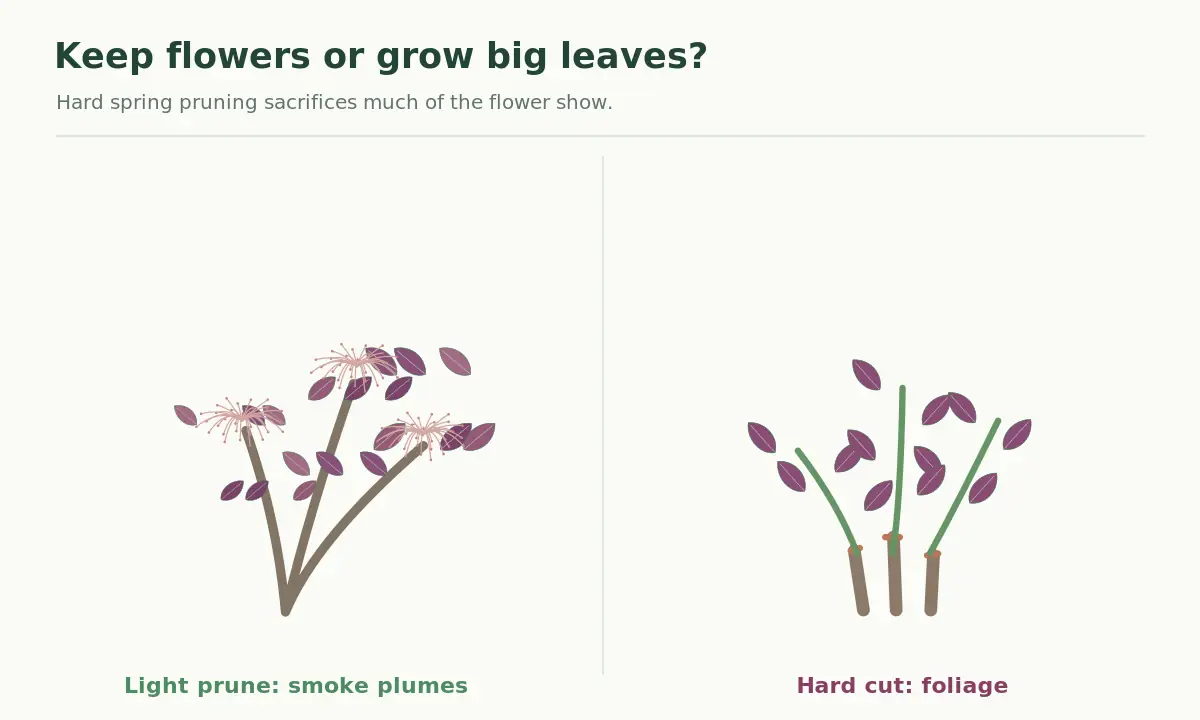
If your aim is the broad cloud of smoky summer inflorescences, retain much of the established twiggy branching framework. Hard spring pruning stimulates young vegetative shoots but can substantially reduce or eliminate that year’s floral display. RHS specifically describes cutting Cotinus back for larger leaves and compact growth, not as a way to increase the same season’s smoke-like flowers. Purple foliage cultivars can look dramatic without flowering, but that is an intentional tradeoff. Photograph the plant in summer, decide which feature justifies its position, and make your pruning plan accordingly. Do not use the flower-focused method on an overgrown shrub without first allowing enough physical space.

Time Foliage-Focused Cuts Before Spring Growth
For a specimen maintained primarily for foliage, University of Minnesota Extension lists smokebush among shrubs to prune in spring before new growth begins. RHS gives late winter to early spring for stronger low-framework cutting. Actual dates vary with frozen ground, winter damage and when buds swell locally. Do not assume USDA zones alone specify a day or use a warm day in midwinter as proof that dormancy is over. Work on a dry day when woody cuts are accessible and tools are sharp. Avoid late-season hard pruning that encourages tender new shoots just before severe cold, especially in climates where winter injury is already common.
Make Only Selective Cuts on Flowering Specimens
Start with dead, broken or rubbing wood, removing it back to a suitable branch union instead of leaving a long stub. Keep most healthy older stems when you want flowers. Where the shrub has become crowded, selectively thin one or two awkward shoots to open the form without removing its entire flowering framework. Do not shear the canopy into a geometric ball: repeated heading cuts can produce congested tufts and spoil the natural airy habit. Use bypass pruners for slender shoots and a saw on larger wood, with proper support for long branches. Large structural tree pruning may require a qualified arborist rather than a homeowner attempting deep ladder work.
Use Coppicing Only for a Defined Foliage Goal
Coppicing means cutting stems back to a very low, established framework to promote vigorous young shoots. RHS describes it as one option for Cotinus grown for colorful or large leaves. This is a substantial intervention, best considered on a healthy established plant that can resprout. It often produces fewer or no flowers that season. Do not assume all Cotinus selections, climates, or weakened shrubs will respond identically; severely stressed plants may not recover well. If you need only modest size control, selective thinning is less disruptive than reducing every shoot to the ground. Plan for the taller straight new stems that follow rather than expecting an instantly compact permanent ball.
| Garden goal | Suitable strategy | Flower tradeoff |
|---|---|---|
| Preserve smoky plumes | Selective thinning of unwanted branches | Most flowering framework retained |
| Maximize fresh ornamental foliage | Late-winter/early-spring low framework cut | Many or all flowers may be lost |
| Young or weak plant | Delay strong pruning; correct stress | Protect establishment |

Keep Cuts Above the Correct Woody Structure
Identify the living base, sound branch collars and any vigorous buds or new shoots before cutting. When removing an entire branch, cut just outside its branch collar; do not make a flush cut against the trunk. When reducing to an intentional established low framework, keep the chosen stubs structurally sound and avoid smashing the central crown. For stem reduction, cut near a suitable outward-directed bud where practical. Disinfect tools when moving between visibly diseased plants, and avoid torn bark. Never cut into a trunk simply to force a shrub to fit a narrow walkway; poor placement is not something pruning can fix safely year after year.
Protect Young and Winter-Damaged Plants
Newly planted smokebushes need roots and foliage to establish. Resist dramatic pruning in their first growing season unless a broken stem creates a hazard. Where winter kills back shoot tips, wait until living tissue becomes apparent before deciding how much to remove. An apparently dead bud may still develop in a cool climate, while brittle dry wood with no viable tissue should be removed. Correct drainage, irrigation and soil problems before demanding vigorous resprouting after hard cuts. Too much fertilizer will not repair a damaged crown or restore the lost flower framework. If repeated winter damage occurs, review the cultivar’s regional suitability rather than adopting progressively lower annual pruning.
Understand the Difference Between Thinning and Shearing
Thinning removes a shoot at its point of origin or back to a suitable lateral branch. It can lighten congestion while maintaining the shrub’s existing outline and mature leaf size. Shearing removes many shoot tips along an artificial surface; this often promotes denser outer growth and a poorer interior, reducing the airy appearance typical of Cotinus. Coppicing is more drastic still, intentionally replacing much of the top growth for fresh foliage. These are not interchangeable names for the same task. Pick a technique after assessing the age and shape of the stems. A hedge trimmer is not an efficient shortcut for preserving natural smoky inflorescences.
Leave Space for the Mature Plant
Before cutting, read the mature dimensions of the named cultivar. A smokebush kept beside a doorway or directly beneath wires may need frequent heavy pruning simply because its location is unsuitable. When flower plumes are your main goal, a spacious site helps you preserve natural branching without severe annual reduction. Leaf-focused coppicing can work within a deliberate ornamental system, but new shoots may still grow surprisingly tall. Avoid planting near vulnerable structures without checking likely spread. Check local invasive-plant or landscaping guidance for Cotinus cultivars in your region and do not dispose of potentially seeding branches into natural areas. Good siting often saves more work than increasingly elaborate cuts. For the basics, see our guide: When to Prune Butterfly Bush and Why Local Invasive Rules Matter.
Use a Two-Path Pruning Plan Each Year
At the end of winter, first ask whether you want smoky flowers or vigorous large leaves in the coming summer. For flowers, remove only dead or poorly placed wood and protect healthy mature framework; do not coppice. For foliage, consider a planned late-winter or early-spring low-framework cut only on a healthy established plant, accepting reduced bloom. If a plant is weak, newly transplanted or winter-injured, postpone aggressive shaping and assess recovery. Mark a few stems before starting and keep the plan visible as you work. A deliberate choice prevents the common disappointment of pruning correctly for leaves but expecting a full flower display afterward.
How We Research and Verify This Guidance
Sources reviewed on 2026-10-24: Royal Horticultural Society; University of Minnesota Extension; Royal Horticultural Society. We read the crop-specific or pest-specific material, checked timing and species distinctions, and made these simplified instructional drawings as teaching aids rather than photographs. This guide does not replace site-specific soil testing, local restrictions or recommendations from your Cooperative Extension office.
Sources, Disclosures, and Local Safety
Factual scope for each source is also recorded in the article metadata. No specific product, sponsorship or affiliate relationship is claimed. Read our affiliate disclosure. Confirm species and mature size; hard coppicing can sacrifice flowers and should not be attempted on a stressed or recently planted specimen.
For foliage-focused pruning, late winter or early spring before new growth is the usual preferred window; avoid late hard cuts.
Heavy pruning often reduces or prevents that season’s smoke-like flowering display by replacing the mature framework.
Not necessarily. A healthy specimen with adequate space may need only occasional removal of dead or crossing wood.
It is generally better to establish the root system first; severe coppicing suits vigorous established specimens and carries recovery risks.
Do not assume so. Cotinus obovatus can become a tree; preserve its structure and seek local tree-pruning guidance.